
Official statement
Other statements from this video 9 ▾
- □ Google lance un tableau de bord officiel pour les incidents de recherche : faut-il encore surveiller Twitter ?
- □ Quels incidents Google communique-t-il officiellement sur son dashboard de statut ?
- □ Comment Google détecte-t-il réellement les incidents sur son moteur de recherche ?
- □ Faut-il vraiment rester les bras croisés quand Google signale un incident ?
- □ Google garantit-il vraiment des mises à jour régulières sur ses incidents de recherche ?
- □ Pourquoi Google a-t-il séparé techniquement son Search Status Dashboard de google.com ?
- □ Pourquoi certaines fonctionnalités de recherche échappent-elles au monitoring de Google ?
- □ Faut-il s'abonner au flux RSS du Search Status Dashboard pour anticiper les incidents Google ?
- □ Pourquoi Google ne considère-t-il pas la chute de classement d'un seul site comme un incident ?
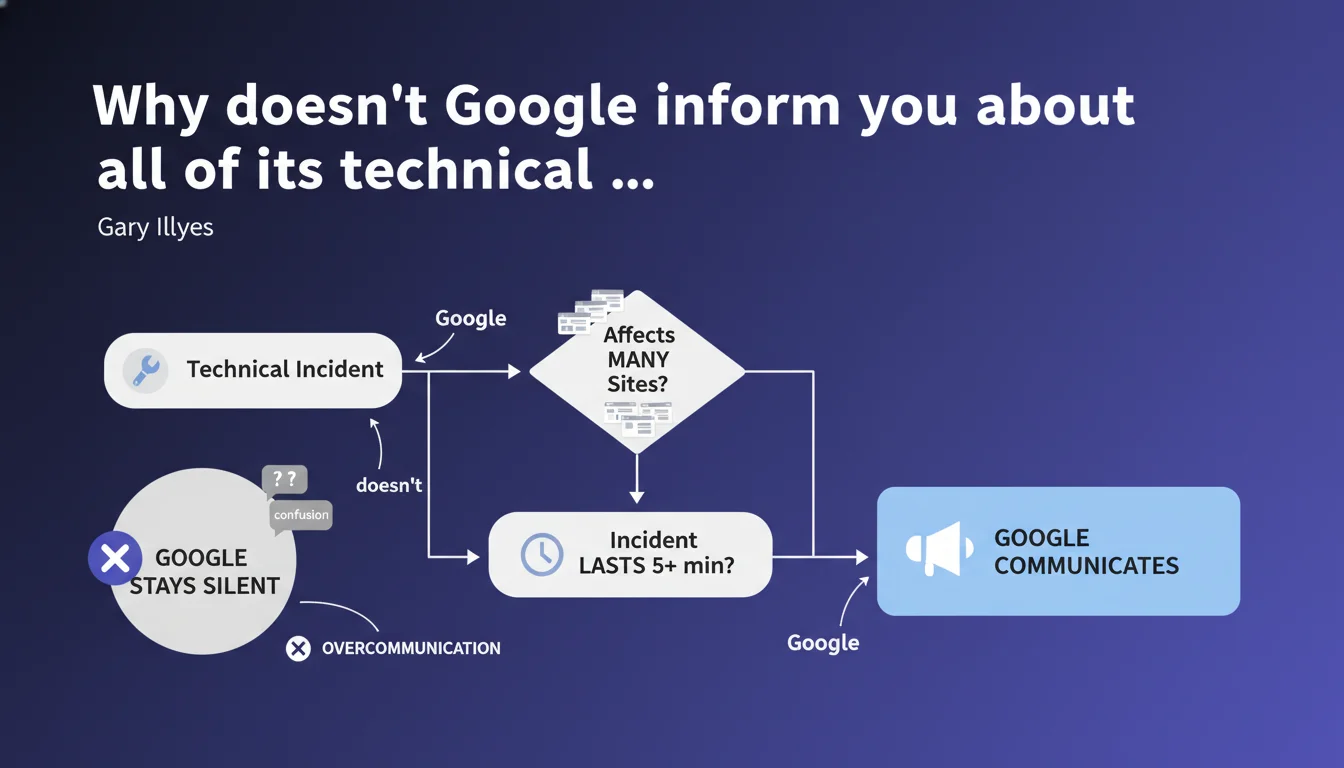
Google applies a communication threshold to its technical incidents: only those affecting a large number of sites and lasting long enough are made public. Micro-incidents lasting 5 minutes are not announced to avoid overcommunication. This policy means that many crawling or indexation problems go unnoticed in official channels.
What you need to understand
What does this communication threshold actually mean in practice?
Google doesn't publish systematic alerts for every infrastructure malfunction. The company filters according to two main criteria: the scope of impact (number of affected sites) and the duration of the problem. An incident limited to a few minutes, even if it touches multiple domains, can remain undocumented.
This approach aims to reduce information noise. Google considers that alerting on every micro-incident would create more confusion than anything else — especially since most resolve themselves before a webmaster even has time to react.
What types of incidents remain in the shadows?
Temporary Googlebot slowdowns, indexing bugs limited to certain page categories, intermittent JavaScript rendering issues — all of this can occur without official communication. If your site suddenly loses 30% of its indexed pages for 10 minutes then returns to normal, you probably won't see any mention on the Search Status Dashboard.
Geographically localized incidents or those affecting specific niches also often go unnoticed in official channels.
How does this policy impact daily SEO diagnostics?
It seriously complicates analysis work. When you notice a sudden drop in traffic or indexation, you can't systematically check whether it's a Google-side issue by consulting their official statuses. Google's silence doesn't mean "everything is fine" — it can just mean "not serious enough to announce".
This reality forces SEO professionals to develop their own monitoring systems and rely on informal channels: specialized forums, private groups, pattern observation across multiple client sites.
- Google filters its communication based on incident scope and duration
- Many temporary malfunctions are never officially documented
- The Search Status Dashboard reflects only a fraction of real problems
- SEO professionals must develop their own independent detection tools
SEO Expert opinion
Does this approach really serve webmasters?
Let's be honest: this policy serves Google first, not web professionals. The argument about "overcommunication" masks a more pragmatic reality — communicating on every incident would expose the real instability of infrastructure supposedly ultra-reliable. [To verify]: Google has never published the specific criteria defining this "threshold" (how many sites? what minimum duration?).
In practice, I observe that incidents affecting thousands of sites for 20-30 minutes sometimes receive no official mention whatsoever. The filter applied seems very restrictive — probably too restrictive.
What are the consequences for trust in official diagnoses?
This policy erodes the reliability of the Search Status Dashboard as a diagnostic tool. When you check the dashboard and it displays "no problems detected" while you observe major anomalies across multiple properties, you're left in the dark. Is it a site-side problem? An undocumented Google bug? An algorithmic penalty?
Time wasted ruling out the hypothesis of a Google incident — because there's nothing official — can delay identifying the real problem. And that's where it gets stuck: absence of information confirms nothing.
Is this statement consistent with observed practices?
Completely. Gary Illyes is verbalizing here an implicit policy that any experienced SEO has already observed. Minor incidents — but nonetheless disruptive for those experiencing them — regularly disappear without official trace. Only the "big ones" (major outages, massive indexation bugs lasting several hours) are documented.
What's new is that Google owns this openly rather than leaving ambiguity. But this transparency about opacity doesn't solve the fundamental problem: how do you distinguish a temporary Google incident from a structural problem on your site when Google says nothing?
Practical impact and recommendations
How can you compensate for the lack of official information?
Implement multi-source monitoring that doesn't depend solely on Google. Follow specialized forums (WebmasterWorld, Reddit r/bigseo, private groups), use third-party tools that aggregate anomaly reports (SEMrush Sensor, Mozcast, RankRanger), and most importantly: document your own observations.
Create a detailed history of your key metrics — organic traffic, indexed pages, crawl speed, rankings on strategic queries. This history will let you detect patterns: if several of your sites simultaneously experience the same type of anomaly for 10-15 minutes then return to normal, you've probably identified an undocumented Google incident.
Should you systematically suspect a Google incident when anomalies occur?
No, and that's precisely the trap. The majority of indexation or traffic problems have internal causes: temporary 5xx errors, poorly managed robots.txt or sitemap modifications, server problems, poorly tested technical deployments. Always start by eliminating site-side hypotheses before blaming Google.
The reflex should be: check your server logs, inspect Search Console for error messages, test your page rendering via the URL inspection tool. Only when these verifications explain nothing AND other sites report similar anomalies at the same time does the hypothesis of a Google incident become credible.
What mistakes should you avoid facing this communication policy?
Don't waste time waiting for official confirmation that may never come. If you detect a problem, launch your internal diagnosis immediately. Google's silence should neither reassure nor paralyze you.
Also avoid over-reacting to micro-fluctuations. A Google incident lasting 5 minutes that temporarily crashes your indexation doesn't justify rushed technical modifications. Document, monitor, but only intervene if the problem persists beyond a reasonable timeframe (generally 24-48 hours).
- Install independent monitoring (rankings, indexation, crawl) that alerts in real time
- Join active SEO communities to cross-reference ground observations
- Systematically document anomalies with timestamp and precise metrics
- Check for internal causes first before blaming Google
- Don't wait for official confirmation to launch a diagnosis
- Distinguish normal fluctuations from real incidents through historical analysis
❓ Frequently Asked Questions
Google communique-t-il sur tous les incidents affectant son moteur de recherche ?
Comment savoir si une chute de trafic est liée à un incident Google non communiqué ?
Le Search Status Dashboard de Google est-il fiable pour diagnostiquer des problèmes ?
Combien de temps dure typiquement un incident Google non communiqué ?
Faut-il modifier son site en urgence si on soupçonne un incident Google temporaire ?
🎥 From the same video 9
Other SEO insights extracted from this same Google Search Central video · published on 14/12/2022
🎥 Watch the full video on YouTube →
💬 Comments (0)
Be the first to comment.