
Official statement
Other statements from this video 9 ▾
- □ Google lance un tableau de bord officiel pour les incidents de recherche : faut-il encore surveiller Twitter ?
- □ Quels incidents Google communique-t-il officiellement sur son dashboard de statut ?
- □ Pourquoi Google ne vous prévient-il pas de tous ses incidents techniques ?
- □ Comment Google détecte-t-il réellement les incidents sur son moteur de recherche ?
- □ Faut-il vraiment rester les bras croisés quand Google signale un incident ?
- □ Google garantit-il vraiment des mises à jour régulières sur ses incidents de recherche ?
- □ Pourquoi certaines fonctionnalités de recherche échappent-elles au monitoring de Google ?
- □ Faut-il s'abonner au flux RSS du Search Status Dashboard pour anticiper les incidents Google ?
- □ Pourquoi Google ne considère-t-il pas la chute de classement d'un seul site comme un incident ?
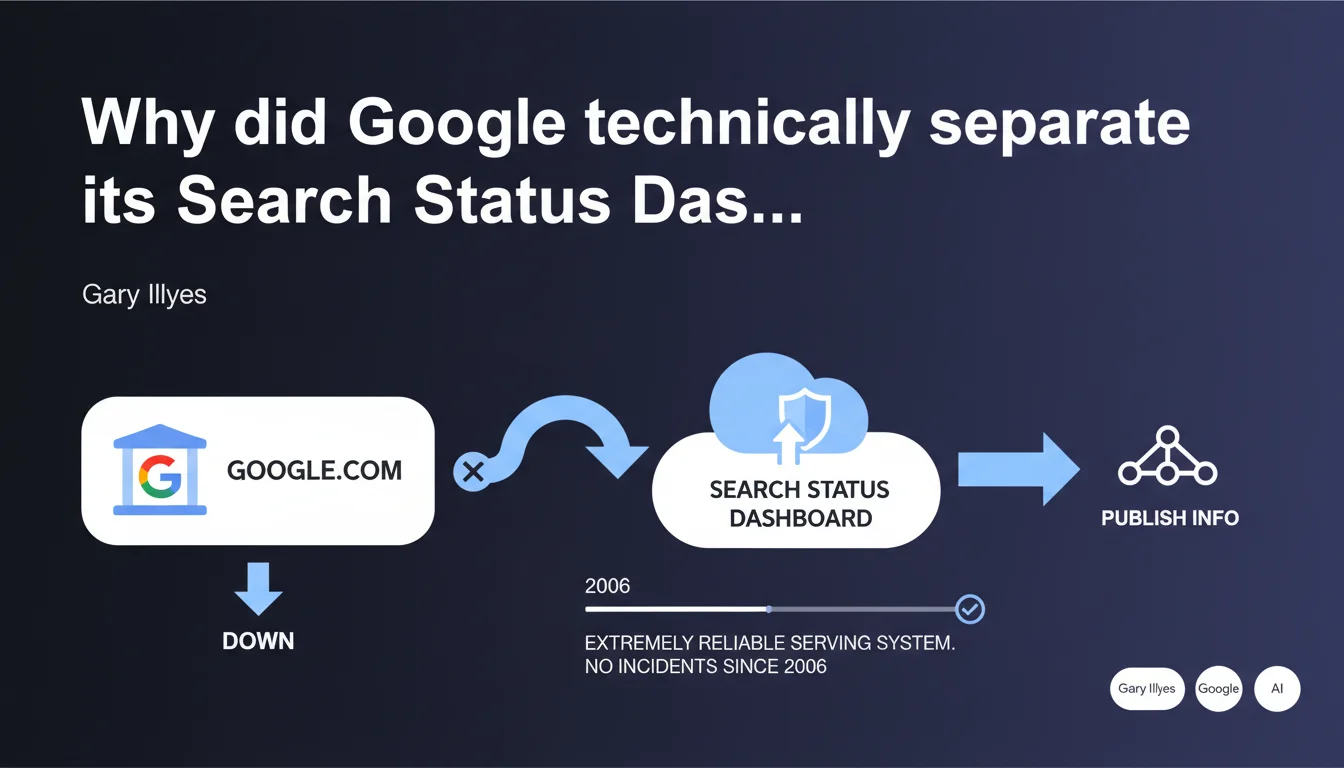
Google technically decoupled its Search Status Dashboard from google.com's infrastructure to ensure it remains accessible even if the search engine goes down. The serving system used has demonstrated exemplary reliability for nearly two decades without major incidents. This independent architecture aims to maintain communication with SEO professionals even during technical crises.
What you need to understand
What is the real objective of this separate infrastructure?
Google has designed its Search Status Dashboard on infrastructure that is completely independent from google.com. Concretely, if the search engine experiences a major outage, the dashboard remains operational to publish information about the ongoing incident.
This technical separation is not insignificant — it reflects a desire to maintain a reliable communication channel with SEO professionals, webmasters, and publishers, even in the worst-case scenarios. It is an implicit acknowledgment that these stakeholders need real-time information during incidents.
What is the claimed reliability of this system?
Gary Illyes states that the serving system used is extremely reliable, with no incidents since 2006. This statement establishes a solid temporal marker: nearly two decades without documented interruption.
The dashboard infrastructure clearly relies on proven technologies, probably simpler and less exposed to the continuous modifications that google.com's main architecture undergoes. Reliability also comes from this architectural simplicity: fewer components means fewer potential points of failure.
How does this change Google-SEO communication?
Before this dashboard, SEO professionals relied on informal channels — Twitter/X, forums, communities — to obtain incident confirmations. The technical decoupling provides an official reference point accessible under all circumstances.
This independence materializes an evolution in Google's posture: acknowledging that operational transparency has become a necessity, not an option. Let's be honest, it's also a way to centralize and control crisis communication.
- Distinct infrastructure: the dashboard does not share the same servers as google.com
- Guaranteed availability: remains accessible even if the search engine is down
- Historical reliability: serving system with no documented incidents for nearly 20 years
- Crisis communication: official channel to publish information during major outages
- Architectural simplification: technology stack likely more stable and less complex
SEO Expert opinion
Is this statement consistent with field observations?
Yes, and that's where it gets interesting. During major Google outages (rare, but spectacular), the Search Status Dashboard has indeed remained accessible while google.com was partially or completely unavailable. This consistency reinforces the credibility of Illyes' statement.
However — and this is important — the dashboard's availability does not guarantee the speed at which information is published. Being technically available does not mean updated instantly. Several major incidents have seen the dashboard remain silent for hours, even though it was technically accessible.
What nuances should be added to this reliability claim?
The technical reliability of a serving system says nothing about the quality and comprehensiveness of published information. The dashboard can be online and not reflect all ongoing problems — this is a crucial distinction.
The claim "no incidents since 2006" deserves questioning: does it refer to pure availability incidents, or does it include display bugs, publication delays, and partial information? [To be verified] — the definition of "incident" here remains unclear.
Furthermore, this separate infrastructure raises a strategic question: why doesn't Google systematically apply this principle of critical decoupling to other services essential for professionals (Search Console, for example)? The answer probably lies in costs and maintenance complexity.
What is the blind spot in this communication?
What Gary Illyes doesn't say is that the separate infrastructure solves only a technical problem — not the organizational one. The real question is not "will the dashboard be accessible?", but "who will decide what to publish, and when?".
The reliability of the serving system is one thing, human responsiveness is another. And that's where the rub is: even with perfect infrastructure, if no one publishes information during the first 2-3 hours of a major incident, the practical usefulness remains limited.
Practical impact and recommendations
What should you do concretely with this information?
First action: integrate the Search Status Dashboard into your bookmarks and monitoring processes. During a sudden drop in organic traffic or unexplained anomalies, this is the first reflex to have — before panicking or modifying your site.
Second reflex: don't make it your sole source of information. The technical decoupling guarantees access, not comprehensiveness. Systematically supplement it with other channels — official Google Twitter/X accounts, SEO communities, third-party monitoring tools.
How do you integrate this dashboard into your incident response workflow?
Build an incident response protocol that explicitly includes consulting the dashboard. Document this process for your teams or clients: define who checks, how frequently, and how information escalates.
Use automated monitoring tools to alert you to dashboard publications. Some third-party services offer push notifications or emails when Google publishes a new status — this avoids checking manually every hour during a crisis.
What mistakes should you avoid when interpreting this dashboard?
Do not overestimate the granularity of the information. Google generally communicates about global incidents, rarely about problems specific to a sector, region, or site type. If your traffic collapses and the dashboard shows green, the problem is likely on your side.
Avoid confusing absence of information with absence of problems. The dashboard may show nothing for organizational reasons (Google hasn't yet approved publication) while an incident is ongoing. Patience is required — but not inaction: continue your internal verifications in parallel.
- Add the Search Status Dashboard to your favorites and daily monitoring tools
- Document a crisis protocol including systematic dashboard verification
- Cross-reference dashboard information with other sources (Twitter/X, SEO communities)
- Configure automated alerts for new status publications
- Never interpret an empty dashboard as confirmation that everything is fine on your side
- Train your teams or clients to distinguish Google incidents from local problems
- Avoid modifying your site hastily without confirming the source of the problem
❓ Frequently Asked Questions
Le Search Status Dashboard affiche-t-il tous les problèmes d'indexation ou de crawl ?
Pourquoi Google n'applique-t-il pas cette architecture séparée à Search Console ?
Combien de temps après un incident Google publie-t-il généralement sur le dashboard ?
Peut-on se fier uniquement au dashboard pour diagnostiquer une chute de trafic ?
L'infrastructure séparée signifie-t-elle que le dashboard utilise une technologie différente de google.com ?
🎥 From the same video 9
Other SEO insights extracted from this same Google Search Central video · published on 14/12/2022
🎥 Watch the full video on YouTube →
💬 Comments (0)
Be the first to comment.