
Official statement
Other statements from this video 9 ▾
- □ Google lance un tableau de bord officiel pour les incidents de recherche : faut-il encore surveiller Twitter ?
- □ Quels incidents Google communique-t-il officiellement sur son dashboard de statut ?
- □ Pourquoi Google ne vous prévient-il pas de tous ses incidents techniques ?
- □ Comment Google détecte-t-il réellement les incidents sur son moteur de recherche ?
- □ Faut-il vraiment rester les bras croisés quand Google signale un incident ?
- □ Pourquoi Google a-t-il séparé techniquement son Search Status Dashboard de google.com ?
- □ Pourquoi certaines fonctionnalités de recherche échappent-elles au monitoring de Google ?
- □ Faut-il s'abonner au flux RSS du Search Status Dashboard pour anticiper les incidents Google ?
- □ Pourquoi Google ne considère-t-il pas la chute de classement d'un seul site comme un incident ?
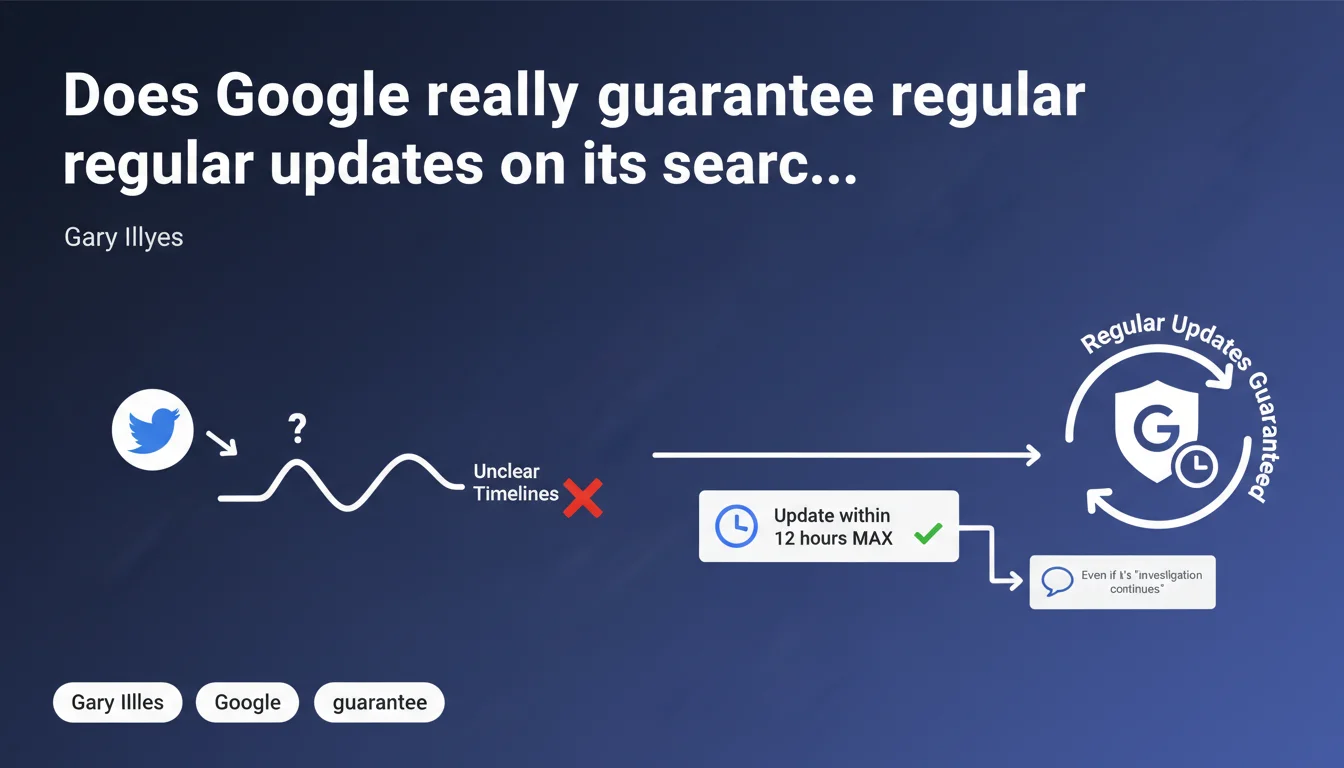
Google now commits to updating its incident dashboard within a maximum of 12 hours, even if it's just to indicate that the investigation is still ongoing. A major shift from the Twitter era when update timelines remained unclear and communications were erratic.
What you need to understand
Why this shift in incident communication?
For years, SEO professionals had to play guessing games during sudden fluctuations. Gary Illyes implicitly acknowledges that the old practice of communicating via Twitter lacked structure and predictability.
The incident dashboard now promises a guaranteed maximum 12-hour window between each update. Even if Google has no new information, it must signal that the investigation is ongoing. This is a step toward greater transparency — at least in theory.
What does this actually change for practitioners?
Before, an SEO who noticed a sudden traffic drop had to compile tweets from Gary, John Mueller, Danny Sullivan, cross-reference with Reddit discussions, and hope a Googler would deign to respond. No clear commitment on timelines.
Now, the dashboard centralizes information and enforces an informal SLA: if nothing is published after 12 hours, it means Google doesn't consider there to be a widespread incident. This absence of information becomes exploitable data in itself.
Does the dashboard cover all types of incidents?
No, and that's where it gets sticky. Google only publishes incidents it deems "significant" and "widespread". Regional bugs, sector-specific issues, or fluctuations that only affect "a few" thousand sites may never appear.
An SEO professional must therefore continue monitoring multiple sources: the dashboard, forums, third-party monitoring tools. The dashboard is just one piece of the puzzle, not the single source of truth.
- Commitment to update within 12 hours on the official dashboard
- Centralization of communications rather than scattered Twitter updates
- Major limitation: only "significant" incidents are covered
- No information after 12 hours = Google doesn't consider there to be a widespread incident
- Third-party monitoring tools remain essential for detecting anomalies that go unrecognized
SEO Expert opinion
Is this statement consistent with observed practices?
Partially. Since the dashboard launched, Google generally respects this 12-hour window — but only for incidents it publicly acknowledges. The real issue remains the definition of "significant incident."
Concretely? Traffic drops of 30-40% across entire sectors have sometimes been ignored for days before a Googler bothered to tweet "we're looking into it". The dashboard provides a framework, but Google keeps control over what deserves to be listed.
What nuances should we add to this commitment?
First, 12 hours is long. For an e-commerce site in the middle of Black Friday that loses 80% of its organic traffic at 10am, potentially waiting until 10pm for an update saying "investigation continues" delivers zero actionable value. [Needs verification] whether this deadline is actually met outside US business hours.
Second, the phrasing "even if it's just to say the investigation continues" is revealing: Google can publish non-information and consider it has met its commitment. No promise on substance, only on timing.
In what cases does this transparency remain insufficient?
Silent bugs: progressive deindexation, crawl issues specific to certain site types, unannounced algorithmic penalties. If Google doesn't categorize them as "incidents," they'll never appear on the dashboard.
Chaotic Core Updates: when an update deployment generates abnormal fluctuations, Google may choose not to flag it as an incident but as "expected behavior." The line between bug and feature remains at Mountain View's discretion.
Practical impact and recommendations
What should you do concretely when you detect an anomaly?
First step: check Google's official dashboard. If an incident is recognized and your site matches the described symptoms, you have your answer. Document the impact on your KPIs but don't act hastily.
Second step: if nothing appears on the dashboard after 12 hours and the anomaly persists, launch an internal technical audit. Check robots.txt, sitemap, crawl errors, recent changes. The absence of a recognized incident suggests the problem likely originates on your end.
How to interpret an "investigation continues" update?
Let's be honest: it tells you nothing actionable. Google acknowledges something is happening, but you won't know the cause, estimated duration, or affected sites. Your only option is to wait for the next update.
In the meantime, take no radical decisions based solely on this information. No emergency redesigns, no rushed migrations, no massive content strategy changes. Recognized incidents generally resolve within 24-72 hours.
What mistakes should you avoid during a confirmed incident?
Don't multiply technical modifications while an incident is ongoing. You risk masking a real structural problem or creating side effects that are hard to diagnose once the incident is resolved.
Don't rely solely on the dashboard to detect problems. Some critical bugs never appear there. Maintain independent monitoring with alerts on your key metrics: organic traffic, indexation rate, positions on strategic queries.
- Check the Google dashboard within 12 hours of detecting an anomaly
- Document symptoms precisely: traffic drop (%), affected pages, queries involved
- Wait for official resolution before any major technical modifications if incident is confirmed
- Launch a full technical audit if no incident is recognized after 12 hours
- Maintain independent monitoring combining Search Console, Analytics, and third-party tools
- Keep a history of past incidents and their impact on your site to identify patterns
❓ Frequently Asked Questions
Le délai de 12 heures s'applique-t-il 24/7 ou seulement en heures ouvrées ?
Que faire si mon site est impacté mais qu'aucun incident n'est publié sur le dashboard ?
Les incidents régionaux ou sectoriels sont-ils couverts par le dashboard ?
Peut-on s'appuyer sur le dashboard pour justifier une baisse de trafic auprès d'un client ?
Le dashboard remplace-t-il le monitoring via des outils tiers ?
🎥 From the same video 9
Other SEO insights extracted from this same Google Search Central video · published on 14/12/2022
🎥 Watch the full video on YouTube →
💬 Comments (0)
Be the first to comment.