
Official statement
Other statements from this video 9 ▾
- □ Google lance un tableau de bord officiel pour les incidents de recherche : faut-il encore surveiller Twitter ?
- □ Quels incidents Google communique-t-il officiellement sur son dashboard de statut ?
- □ Pourquoi Google ne vous prévient-il pas de tous ses incidents techniques ?
- □ Faut-il vraiment rester les bras croisés quand Google signale un incident ?
- □ Google garantit-il vraiment des mises à jour régulières sur ses incidents de recherche ?
- □ Pourquoi Google a-t-il séparé techniquement son Search Status Dashboard de google.com ?
- □ Pourquoi certaines fonctionnalités de recherche échappent-elles au monitoring de Google ?
- □ Faut-il s'abonner au flux RSS du Search Status Dashboard pour anticiper les incidents Google ?
- □ Pourquoi Google ne considère-t-il pas la chute de classement d'un seul site comme un incident ?
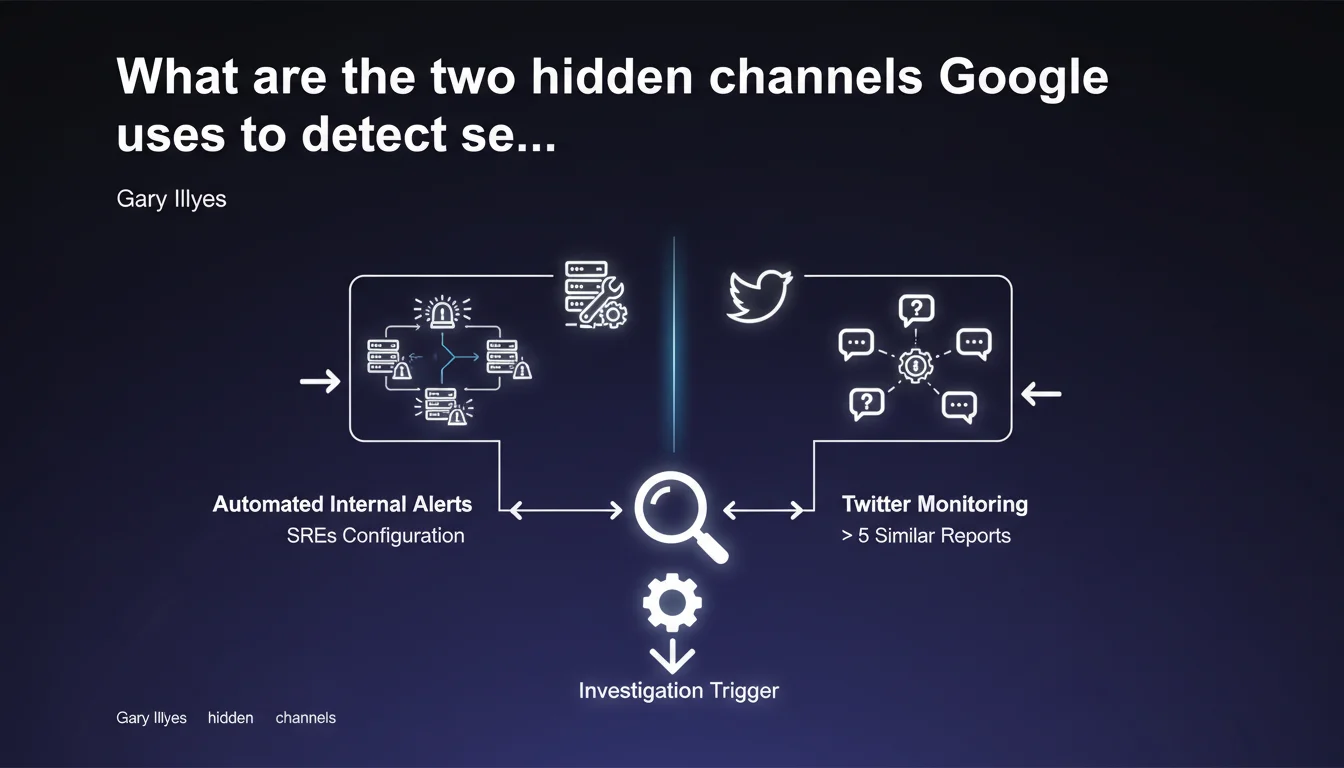
Google identifies technical issues through two channels: automated internal alerts configured by its SRE teams, and active monitoring of Twitter where 5+ similar reports trigger an investigation. In other words, tweeting about a bug can literally speed up its resolution.
What you need to understand
This statement from Gary Illyes reveals the mechanisms behind incident detection at Google. For SEO practitioners, understanding these processes enables you to anticipate Google's reactions to technical problems and optimize your reporting strategy.
What exactly counts as an incident in Google's ecosystem?
An incident refers to any anomaly affecting the normal functioning of the search engine: massive indexing problems, crawl bugs, sudden ranking errors, or Search Console tool outages.
These incidents can affect an isolated site or the entire ecosystem. The distinction is critical: Google only deploys its SRE resources to systemic problems, not to your individual indexing issues.
Why does Twitter play a role in detection?
Google actively monitors reports on Twitter because the platform concentrates the global SEO community. When multiple professionals (5+) report the same problem simultaneously, it signals a potential large-scale incident.
This social monitoring complements internal technical alerts. In other words, your tweets can literally trigger an investigation at Google — provided enough people report the same issue.
How do SREs configure their automated alerts?
The Site Reliability Engineers set critical thresholds on key metrics: server response time, crawl error rate, volume of indexed pages, query latency.
When a threshold is breached, the alert triggers automatically. This internal system typically detects incidents before the community reports them — but not always, which explains the importance of Twitter monitoring.
- Two detection channels: automated SRE alerts and Twitter monitoring (5+ similar reports)
- Twitter serves as a community alert system for bugs not detected automatically
- Individual incidents typically don't trigger SRE team intervention
- Reporting a problem collectively on Twitter can accelerate its resolution
SEO Expert opinion
Is this approach consistent with real-world observations?
Absolutely. We regularly observe that bugs massively reported on Twitter (for example: sudden disappearance of indexed pages) receive an official response within hours, while individual Search Console tickets go unanswered for weeks.
The threshold of "5+ reports" remains somewhat unclear. Does it mean 5 influential accounts or 5 random reports? In practice, some bugs reported by recognized voices (John Mueller, Barry Schwartz, etc.) seem to trigger investigations even without reaching this numerical threshold. [To verify]
What limitations should be noted in this statement?
Gary Illyes doesn't specify the time window: 5 reports in one hour or one week? This imprecision makes it difficult to assess the urgency Google perceives.
Furthermore, the statement doesn't mention other potential channels: Search Central forums, direct reports via Googlers, escalations through premium partners. It's unlikely that Twitter is the only monitored social channel — Reddit and LinkedIn also host technical SEO discussions.
Can you tactically exploit this information?
Let's be honest: some practitioners might be tempted to orchestrate coordinated reports to force an investigation. Bad idea. Google easily detects coordinated campaigns, and crying wolf without legitimate reason damages your credibility.
However, documenting a bug precisely (screenshots, affected URLs, timeline) before reporting it publicly increases your chances of being taken seriously. A well-documented report beats ten vague tweets.
Practical impact and recommendations
What should you do when you detect a potential incident?
First, verify it's not a local problem: test on multiple devices, networks, browsers. Check monitoring tools (Search Console, server logs, third-party tools) to confirm the anomaly.
Next, scan Twitter and SEO forums to verify if other professionals are reporting the same issue. If you're alone, it's probably a problem specific to your site, not a Google incident.
How to effectively report a bug to Google?
If multiple sources confirm the problem, document it rigorously: timestamped screenshots, affected URLs, before/after comparison, quantified data (traffic, impressions, indexed pages).
Then post on Twitter mentioning @searchliaison or @googlesearchc, with a concise message and visual proof. Avoid alarmist tone — stay factual. If the bug is confirmed by 5+ professionals, Google will investigate.
- Verify the anomaly isn't related to your infrastructure or configuration
- Check Twitter, Reddit and Search Central to corroborate the problem
- Document with factual data (screenshots, logs, metrics)
- Report publicly only if multiple independent sources confirm
- Avoid false alarms that damage your credibility
- Use proper tags (#GoogleSearchBug) and mentions (@searchliaison)
Should you integrate this process into your monitoring workflow?
Yes, but without becoming paranoid. Implement automated Twitter monitoring on keywords like "Google indexing bug", "Search Console issue", "Google crawl problem". This alerts you quickly to systemic incidents.
In parallel, configure your own alerts on critical KPIs: sudden traffic drops (-20%+ in 24 hours), abnormal variations in indexed page volume, spikes in 5xx errors in your logs.
This statement confirms that collective voice carries weight with Google. Methodically reporting systemic bugs accelerates their resolution, but requires rigor and coordination. Don't cry wolf alone — verify, document, corroborate.
Implementing a robust monitoring system and effective community monitoring requires pointed technical expertise. These processes can quickly become time-consuming for already stretched teams. In this context, working with a specialized SEO agency allows you to benefit from advanced surveillance tools and immediate responsiveness to incidents, without permanently mobilizing your internal resources.
❓ Frequently Asked Questions
Google surveille-t-il d'autres plateformes que Twitter pour détecter les incidents ?
Le seuil de 5 signalements est-il strict ou indicatif ?
Tweeter un problème individuel peut-il déclencher une investigation ?
Quelle est la fenêtre temporelle des 5+ signalements nécessaires ?
Les alertes SRE détectent-elles tous les bugs avant Twitter ?
🎥 From the same video 9
Other SEO insights extracted from this same Google Search Central video · published on 14/12/2022
🎥 Watch the full video on YouTube →
💬 Comments (0)
Be the first to comment.