
Official statement
Other statements from this video 16 ▾
- □ Le crawl budget est-il vraiment négligeable pour votre site ?
- □ Faut-il publier plus souvent pour être crawlé plus régulièrement par Google ?
- □ Faut-il vraiment s'inquiéter de la duplication de contenu interne ?
- □ Le contenu récent bénéficie-t-il vraiment d'un boost de ranking automatique ?
- □ Le hreflang fonctionne-t-il vraiment page par page et non pour tout un site ?
- □ Comment Google mesure-t-il réellement la Page Experience dans son algorithme ?
- □ Chrome et Analytics influencent-ils vraiment le classement Google ?
- □ Le hreflang modifie-t-il vraiment le ranking ou se contente-t-il de permuter les URLs ?
- □ Faut-il vraiment choisir entre redirection 301 et canonical pour une migration ?
- □ Top Stories sans AMP : faut-il encore optimiser la vitesse de vos pages ?
- □ Les URLs découvertes en JavaScript gaspillent-elles vraiment votre crawl budget ?
- □ Le nofollow empêche-t-il vraiment l'indexation d'une page ?
- □ Pourquoi Google refuse-t-il d'indexer certaines pages de votre site ?
- □ Faut-il supprimer les pages à faible trafic pour améliorer son SEO ?
- □ Les erreurs de balisage breadcrumb entraînent-elles une pénalité Google ?
- □ Le contenu unique booste-t-il vraiment le ranking global d'un site ?
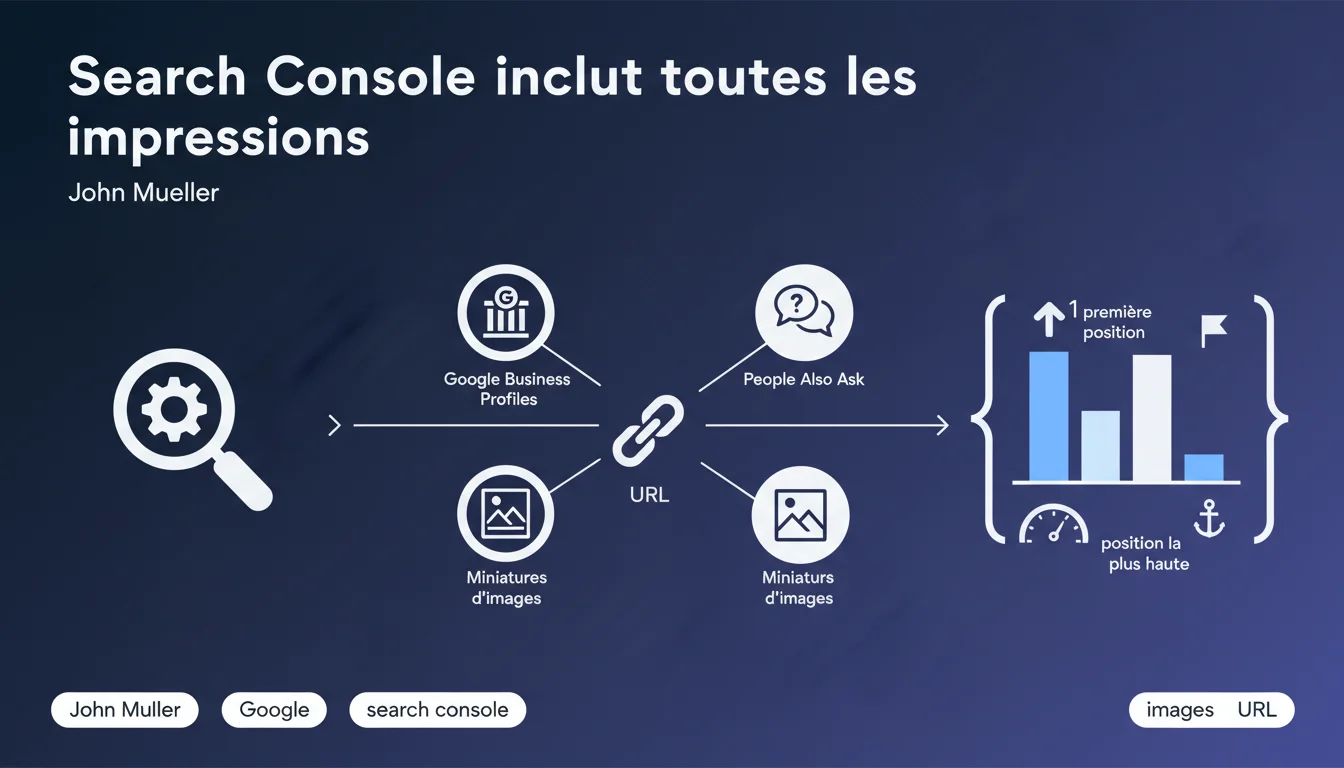
Search Console records all impressions where a URL from the site appears, including in Google Business Profile, People Also Ask, and image thumbnails. The average position displayed corresponds to the highest position reached, not a real average across the page. This clarification changes the interpretation of performance data.
What you need to understand
What impressions are actually counted in Search Console? <\/h3>
Mueller's statement specifies that all appearances of a URL<\/strong> generate an impression — not just standard organic results. This includes Google Business Profile blocks<\/strong>, People Also Ask (PAA) questions<\/strong>, and even image thumbnails<\/strong> when they point to a page on the site.<\/p> Specifically, if your URL appears simultaneously in organic position 5 AND in a visible PAA block, Search Console records two distinct impressions. The confusion arises from the fact that these different sources of impressions are not distinguished in the standard report.<\/p> The most important nuance: the average position is not an average<\/strong>. It is the highest position<\/strong> recorded for that URL during the display. If your page appears in organic position 3 and position 15 in a PAA block, Search Console retains position 3.<\/p> This logic skews the classic interpretation of the data. An average position of 8.2 does not mean your page hovers around that position — it could very well alternate between position 3 (organic) and position 20 (image), with Google consistently retaining the best one.<\/p>How is the average position calculated? <\/h3>
Why does this clarification change the game? <\/h3>
SEO Expert opinion
Is this statement consistent with field observations? <\/h3>
Yes and no. The inclusion of PAA and Business Profile impressions is consistent with what is observed — some queries generate abnormally high impression volumes<\/strong> without proportional traffic. However, the methodology for calculating the 'highest' position is problematic.<\/p> In practice, this logic means that a page that appears sporadically in position 3<\/strong> through a featured snippet but consistently in position 18<\/strong> in organic will show an average displayed position around 3-5. Except that 95% of the impressions come from position 18. The data becomes misleading.<\/p> Mueller remains vague on several critical points. [To verify]<\/strong>: Are impressions in video carousels, shopping results for product URLs, or 'Insights' blocks also counted? No clarification.<\/p> Another gray area: how does Google manage simultaneous multiple impressions<\/strong> of the same URL on a SERP? If your page appears in organic AND in two different PAA blocks, does it count 3 impressions or just 1 with the highest position of the three? The wording suggests it's 3, but that remains an interpretation.<\/p> Sites with a strong presence in rich snippets<\/strong> (recipes, FAQs, videos) are the most affected. Their Search Console metrics become difficult to exploit without manual segmentation.<\/p> Concrete example: an e-commerce site with product listings optimized for images. Thumbnails generate thousands of impressions with a dismal CTR, drowning out the actual organic data. It becomes impossible to know if the content strategy is working without cross-referencing with Analytics and third-party tools.<\/p>What are the gray areas in this explanation? <\/h3>
In what cases does this rule completely skew analysis? <\/h3>
Practical impact and recommendations
How to properly interpret your Search Console data? <\/h3>
First step: segment by type of search<\/strong>. Use the 'Search type' filters (Web, Images, Videos) to isolate pure organic impressions. This is the minimum to gain a less polluted view.<\/p> Next, cross-reference with Google Analytics<\/strong>. Compare the volume of clicks from Search Console with actual organic sessions. A significant gap often indicates pollution from non-organic impressions (PAA, images) that generate little actual traffic.<\/p> Never use the average CTR from Search Console as a performance indicator without context. A CTR of 2% can be excellent if your impressions mostly come from images, but catastrophic if they are purely organic in positions 1-5.<\/p> Also avoid celebrating an 'improvement in average position' without checking the actual distribution of positions<\/strong>. Download the complete data and analyze the distribution — you often discover a bimodality (sporadic high positions + frequent low positions).<\/p> The counting methodology of Search Console makes raw metrics unreliable for strategic decisions<\/strong>. Build a multi-source dashboard that cross-references Search Console, Analytics, and a position tracker to get a realistic view.<\/p> These cross-analyses and advanced segmentations require technical expertise and a fine understanding of tools. If your team lacks resources or time to implement this monitoring setup, engaging a specialized SEO agency<\/strong> can ensure a correct interpretation of your data and strategic recommendations based on truly actionable metrics.<\/p><\/div>What analysis errors should you absolutely avoid? <\/h3>
What concrete actions should be implemented? <\/h3>
❓ Frequently Asked Questions
Les impressions dans les blocs People Also Ask comptent-elles même si l'utilisateur ne déploie pas la question ?
Si mon URL apparaît en position 5 organique et dans une miniature d'image en position 12, quelle position Search Console affiche-t-elle ?
Comment savoir quelle proportion de mes impressions vient des blocs enrichis plutôt que de l'organique classique ?
Le CTR moyen Search Console est-il encore un KPI pertinent avec cette logique de comptage ?
Dois-je arrêter d'utiliser Search Console pour suivre mes positions ?
🎥 From the same video 16
Other SEO insights extracted from this same Google Search Central video · published on 09/01/2022
🎥 Watch the full video on YouTube →Related statements
Get real-time analysis of the latest Google SEO declarations
Be the first to know every time a new official Google statement drops — with full expert analysis.
💬 Comments (0)
Be the first to comment.