
Official statement
Other statements from this video 16 ▾
- □ Le crawl budget est-il vraiment négligeable pour votre site ?
- □ Faut-il publier plus souvent pour être crawlé plus régulièrement par Google ?
- □ Faut-il vraiment s'inquiéter de la duplication de contenu interne ?
- □ Le contenu récent bénéficie-t-il vraiment d'un boost de ranking automatique ?
- □ Le hreflang fonctionne-t-il vraiment page par page et non pour tout un site ?
- □ Comment Google mesure-t-il réellement la Page Experience dans son algorithme ?
- □ Chrome et Analytics influencent-ils vraiment le classement Google ?
- □ Le hreflang modifie-t-il vraiment le ranking ou se contente-t-il de permuter les URLs ?
- □ Faut-il vraiment choisir entre redirection 301 et canonical pour une migration ?
- □ Top Stories sans AMP : faut-il encore optimiser la vitesse de vos pages ?
- □ Search Console compte-t-elle vraiment toutes vos impressions SEO ?
- □ Les URLs découvertes en JavaScript gaspillent-elles vraiment votre crawl budget ?
- □ Le nofollow empêche-t-il vraiment l'indexation d'une page ?
- □ Pourquoi Google refuse-t-il d'indexer certaines pages de votre site ?
- □ Faut-il supprimer les pages à faible trafic pour améliorer son SEO ?
- □ Le contenu unique booste-t-il vraiment le ranking global d'un site ?
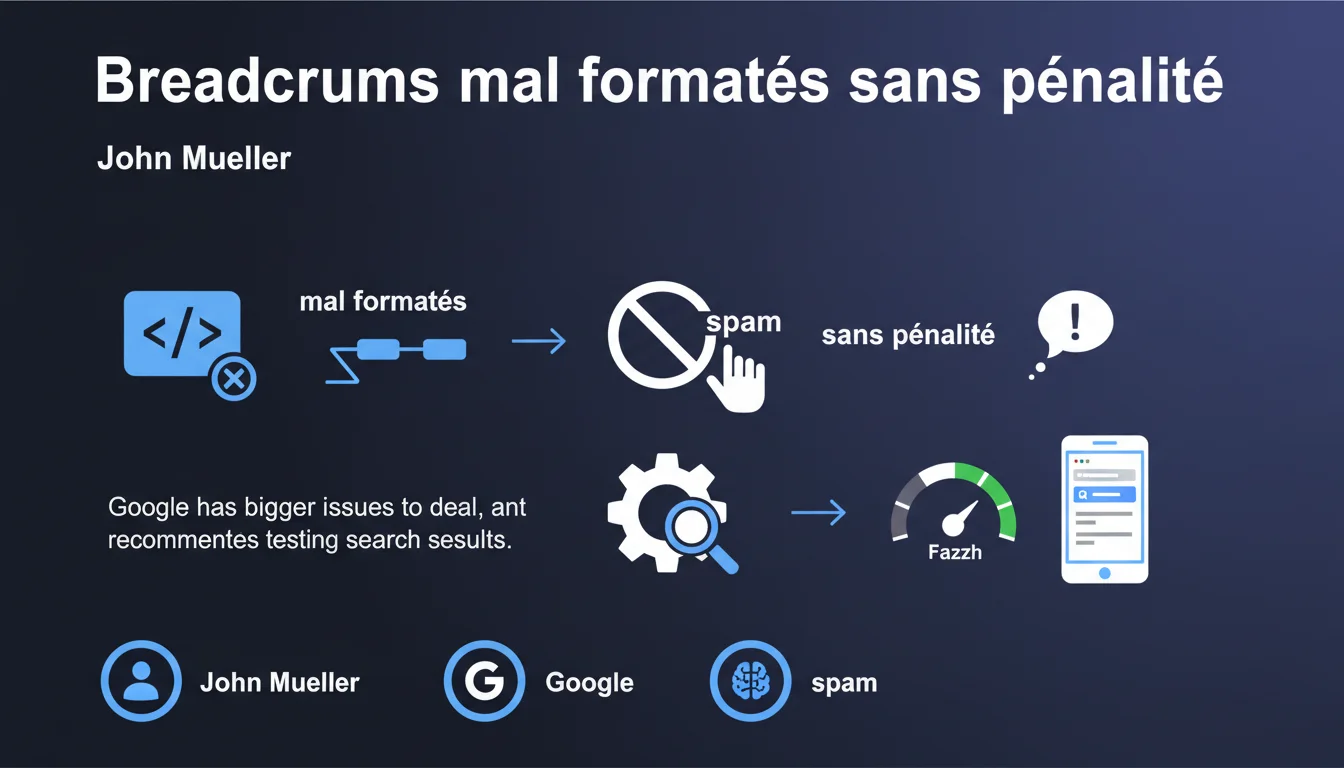
Google does not penalize breadcrumb markup errors. The spam team has other priorities than punishing misformatted breadcrumbs. The main issue remains display in the SERP — a poorly marked breadcrumb does not drop you in the results, but it can deprive you of an optimized display.
What you need to understand
This statement from John Mueller addresses a recurring concern: many SEO practitioners fear that a structured markup error will trigger a manual action. This is particularly true for breadcrumbs, for which the schema.org BreadcrumbList markup has become almost standard.
Mueller sets a clear boundary: Google does not waste time penalizing this type of technical error. The spam team focuses on more serious manipulations — spam, cloaking, link schemes, automated content generated for manipulative purposes.
Why doesn’t Google penalize these errors?
Breadcrumbs are a visual enhancement element in search results, not a direct ranking signal. If the markup is incorrect or missing, Google simply loses the opportunity to display a breadcrumb in the SERP. Nothing more.
The engine distinguishes between two levels of issues: those that harm the understanding of the page (misleading content, manipulation) and those that simply break a optional display. Breadcrumbs fall into the latter category.
What does this mean for display in SERP?
A poorly formatted breadcrumb simply will not display. Google may replace it with the raw URL or completely ignore this feature in the snippet. You lose visual clarity and potential CTR, but not ranking.
Mueller recommends testing actual display in results — Search Console and the rich results testing tool allow you to quickly verify if the markup is interpreted correctly.
- Breadcrumb errors trigger no manual action from the spam team
- Google prioritizes real spam fighting over trivial technical errors
- A poorly marked breadcrumb affects SERP display, not ranking
- Testing via Search Console or the dedicated tool remains the best approach to validate the markup
- The absence of marked breadcrumbs does not prevent Google from understanding site structure through other signals
SEO Expert opinion
Is this statement consistent with field observations?
Yes, absolutely. No documented case shows a penalty specifically related to a poorly formatted breadcrumb. Manual actions target deliberate manipulations, not schema.org syntax errors.
However, the important nuance lies in what constitutes an "error." If your breadcrumb deliberately misleads the user — for instance, displaying a fictitious hierarchy to artificially inflate a page's perceived authority — we enter another category of problem. But this is rare.
Should we neglect breadcrumb markup?
No. Even though the absence of a penalty is reassuring, properly marked breadcrumbs improve SERP readability and can influence CTR. A clear snippet with a visible navigation path inspires more trust than a raw URL.
Moreover, Google sometimes uses the breadcrumb to better understand a site's thematic structure. While it is not a direct ranking signal, it contributes to overall understanding. Saying "it doesn’t penalize" doesn’t mean "it doesn’t contribute".
In what cases might this principle falter?
If you multiply structured markup errors on a large scale — breadcrumbs, FAQs, products, reviews — Google might interpret this as an attempt at manipulation or a technically neglected site. [To verify] no official data quantifies the threshold beyond which Google would lose trust, but a site filled with schema.org errors sends a signal of low technical quality.
Practical impact and recommendations
What should be done specifically with breadcrumbs?
Make sure your BreadcrumbList markup is clean and consistent with the actual structure of your site. Use Google's rich results testing tool to detect syntax errors. If you see alerts, correct them — not out of fear of a penalty, but to maximize your chances of optimized display.
Also, test the actual display in the Search Console. The "Enhancements" tab highlights pages with detected breadcrumbs and any potential problems. If the breadcrumb isn’t displaying when it should, dig deeper: incorrect syntax, location in the DOM, or inconsistency with the actual hierarchy.
What errors must absolutely be avoided?
Do not create artificial breadcrumbs to inflate the perception of depth. Google detects inconsistencies between the marked breadcrumb and the actual site structure. If the URL indicates /category/product but the breadcrumb shows Home > Thematic A > Sub-thematic B > Product, you are sending conflicting signals.
Avoid marking a breadcrumb invisible to the user. The schema.org must reflect what the visitor actually sees — not a hidden version intended solely for engines.
How can you check if everything works correctly?
Manually inspect a few strategic pages in Google. Search for the exact page title and observe the snippet. Does the breadcrumb display? Is it consistent? If not, return to the code and check the JSON-LD or microdata syntax.
- Validate the BreadcrumbList markup through Google’s testing tool
- Check actual SERP display on a few key pages
- Ensure that the marked breadcrumb matches what the user sees
- Correct any detected errors in Search Console (Enhancements tab)
- Do not create fictitious or manipulative breadcrumbs
- Regularly monitor structured data reports to anticipate issues
❓ Frequently Asked Questions
Un breadcrumb mal balisé peut-il affecter mon classement Google ?
Dois-je absolument corriger toutes les erreurs de breadcrumb remontées dans Search Console ?
Google peut-il afficher un breadcrumb même si je ne l'ai pas balisé ?
Puis-je baliser plusieurs breadcrumbs différents sur une même page ?
Faut-il inclure la page d'accueil dans le breadcrumb balisé ?
🎥 From the same video 16
Other SEO insights extracted from this same Google Search Central video · published on 09/01/2022
🎥 Watch the full video on YouTube →
💬 Comments (0)
Be the first to comment.