
Official statement
Other statements from this video 16 ▾
- □ Le crawl budget est-il vraiment négligeable pour votre site ?
- □ Faut-il publier plus souvent pour être crawlé plus régulièrement par Google ?
- □ Faut-il vraiment s'inquiéter de la duplication de contenu interne ?
- □ Le contenu récent bénéficie-t-il vraiment d'un boost de ranking automatique ?
- □ Le hreflang fonctionne-t-il vraiment page par page et non pour tout un site ?
- □ Chrome et Analytics influencent-ils vraiment le classement Google ?
- □ Le hreflang modifie-t-il vraiment le ranking ou se contente-t-il de permuter les URLs ?
- □ Faut-il vraiment choisir entre redirection 301 et canonical pour une migration ?
- □ Top Stories sans AMP : faut-il encore optimiser la vitesse de vos pages ?
- □ Search Console compte-t-elle vraiment toutes vos impressions SEO ?
- □ Les URLs découvertes en JavaScript gaspillent-elles vraiment votre crawl budget ?
- □ Le nofollow empêche-t-il vraiment l'indexation d'une page ?
- □ Pourquoi Google refuse-t-il d'indexer certaines pages de votre site ?
- □ Faut-il supprimer les pages à faible trafic pour améliorer son SEO ?
- □ Les erreurs de balisage breadcrumb entraînent-elles une pénalité Google ?
- □ Le contenu unique booste-t-il vraiment le ranking global d'un site ?
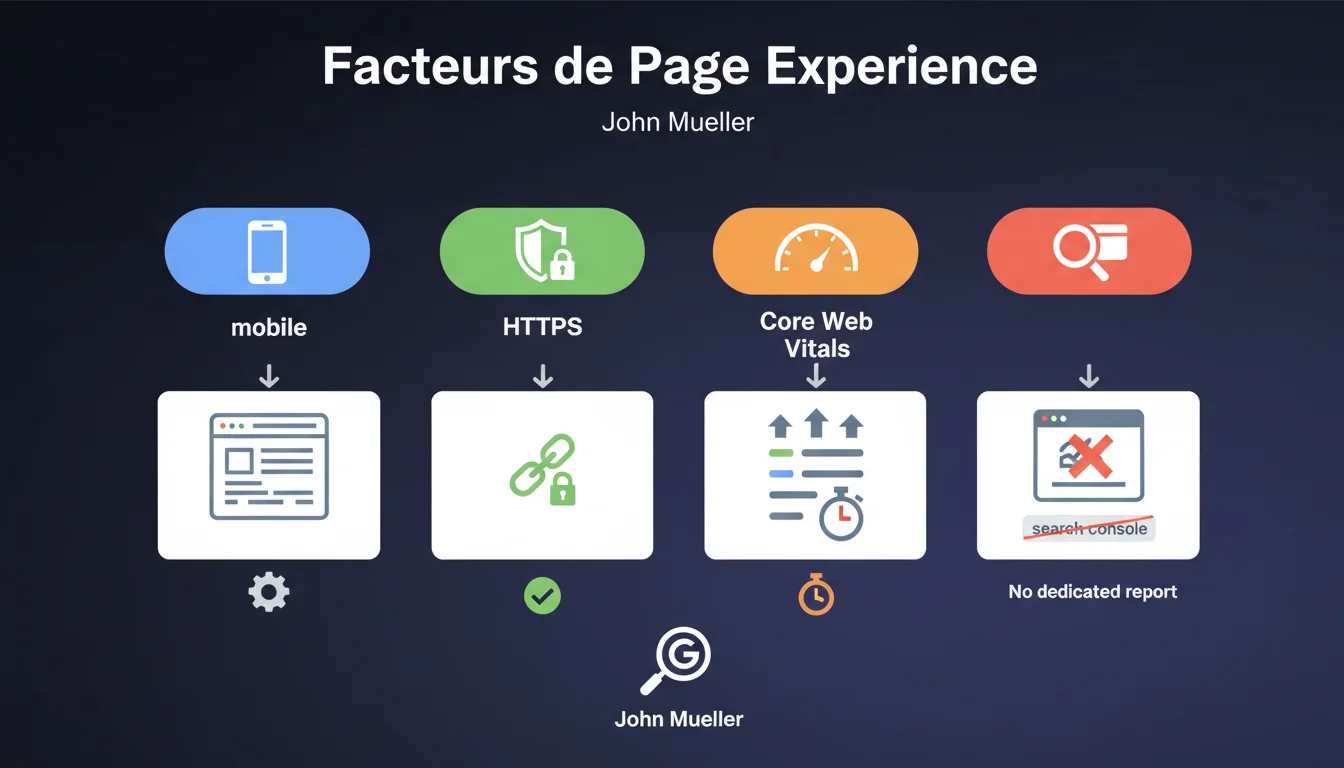
Google confirms that Page Experience encompasses four criteria: mobile-friendliness, HTTPS, Core Web Vitals, and intrusive interstitials. Notably, there is no dedicated report in Search Console to specifically track intrusive interstitials, unlike the three other pillars.
What you need to understand
What are the four pillars of Page Experience exactly?<\/h3>
Google explicitly lists the components: mobile-friendliness<\/strong>, HTTPS<\/strong>, Core Web Vitals<\/strong>, and intrusive interstitials<\/strong>. These four criteria form what the algorithm considers as "user experience" from a technical perspective.<\/p>
Unlike other, more vague SEO signals, these factors are defined and measurable — well, almost all of them. The first three benefit from dedicated reports in Search Console, allowing for precise tracking.<\/p>
John Mueller points out a glaring asymmetry<\/strong>: while mobile, HTTPS, and Core Web Vitals have their respective reports, interstitials do not appear anywhere. No official tool indicates whether your pop-ups violate the rules.<\/p>
This absence raises questions. Either Google considers this criterion less of a priority — which would contradict its inclusion in the list — or the company hasn’t found a reliable method to automate large-scale detection.<\/p>
Mueller presents these four factors as the current components<\/strong> of Page Experience. The term "currently" regarding the reports suggests that this setup is not fixed.<\/p>
The very structure of this signal — a grouping of technical criteria — allows for future additions. Other dimensions of user experience could be integrated without major algorithmic overhauls.<\/p>
Why does Search Console ignore intrusive interstitials?<\/h3>
Is this list exhaustive or evolving?<\/h3>
SEO Expert opinion
Does this statement really address the gray areas?<\/h3>
Mueller confirms what professionals already knew: Page Experience is not an abstract concept but a collection of measurable signals<\/strong>. Let's be honest — this enumeration doesn’t bring anything new since the initial rollout of this update.<\/p>
The only notable element? The implicit admission that Google provides no tool to audit interstitials<\/strong>. This gap creates a dissonance between what Google says it monitors and what it allows for checking. [To verify]<\/strong> to what extent this factor is actually implemented without a transparent control mechanism.<\/p>
If Google penalizes intrusive pop-ups without providing feedback in Search Console, webmasters are navigating blindly. Unlike Core Web Vitals, where each issue is reported accurately, here — radio silence.<\/p>
Two hypotheses: either automated detection is too complex (which would explain the absence of a tool), or this criterion is weighted so little that Google deemed it unnecessary to invest in a dedicated report. In either case, this puts its actual importance in ranking into perspective.<\/p>
Simplifying user experience to four technical criteria is an extreme oversimplification. A site can check all these boxes and still provide a disastrous experience — confusing navigation, unreadable content, aggressive ads.<\/p>
Google measures what is technically measurable at scale<\/strong>, not what is qualitatively satisfactory. This statement confirms that the algorithm favors quantifiable proxies over a holistic evaluation of UX. And that’s where it gets tricky: these signals remain approximations.<\/p>Why does the lack of a report on interstitials pose a problem?<\/h3>
Does this checklist approach have limitations?<\/h3>
Practical impact and recommendations
What should you prioritize auditing on your site?<\/h3>
Focus first on the three trackable factors<\/strong> via Search Console. There's no need to speculate about interstitials as long as you have concrete alerts regarding mobile, HTTPS, or Core Web Vitals.<\/p>
The logical prioritization: fix what Google explicitly signals before optimizing what it measures in the shadows. The available reports provide a clear roadmap — leverage them.<\/p>
Apply the strict definition<\/strong> Google has published: intrusive are pop-ups that cover the main content immediately after landing from search results. Newsletters, legal age checks, or cookies are not concerned.<\/p>
In practice? If you use marketing interstitials, trigger them after 5-10 seconds of visit or upon scrolling, never on direct load. This practice respects both the guidelines and the actual experience.<\/p>
Create a consolidated dashboard<\/strong> that aggregates the four dimensions: Mobile-Friendly report, HTTPS status, Core Web Vitals, and a manual monthly audit of interstitials. Don’t rely solely on Search Console — supplement with third-party tools for CWV.<\/p>
And that’s where the complexity arises: between evolving thresholds, multiplying metrics (INP replaces FID), and interpreting field data, maintaining optimal compliance requires constant technical monitoring.<\/p>
How to address the issue of interstitials without feedback?<\/h3>
What follow-up methodology should be established?<\/h3>
❓ Frequently Asked Questions
Les Core Web Vitals sont-ils plus importants que les autres facteurs de Page Experience ?
Pourquoi Google ne propose-t-il aucun rapport sur les interstitiels intrusifs ?
Un site peut-il bien ranker avec de mauvais Core Web Vitals ?
Faut-il supprimer toutes les pop-ups pour éviter une pénalité ?
Cette liste de quatre facteurs peut-elle évoluer à l'avenir ?
🎥 From the same video 16
Other SEO insights extracted from this same Google Search Central video · published on 09/01/2022
🎥 Watch the full video on YouTube →Related statements
Get real-time analysis of the latest Google SEO declarations
Be the first to know every time a new official Google statement drops — with full expert analysis.
💬 Comments (0)
Be the first to comment.