
Official statement
Other statements from this video 16 ▾
- □ Le crawl budget est-il vraiment négligeable pour votre site ?
- □ Faut-il publier plus souvent pour être crawlé plus régulièrement par Google ?
- □ Faut-il vraiment s'inquiéter de la duplication de contenu interne ?
- □ Le contenu récent bénéficie-t-il vraiment d'un boost de ranking automatique ?
- □ Le hreflang fonctionne-t-il vraiment page par page et non pour tout un site ?
- □ Comment Google mesure-t-il réellement la Page Experience dans son algorithme ?
- □ Chrome et Analytics influencent-ils vraiment le classement Google ?
- □ Le hreflang modifie-t-il vraiment le ranking ou se contente-t-il de permuter les URLs ?
- □ Faut-il vraiment choisir entre redirection 301 et canonical pour une migration ?
- □ Top Stories sans AMP : faut-il encore optimiser la vitesse de vos pages ?
- □ Search Console compte-t-elle vraiment toutes vos impressions SEO ?
- □ Les URLs découvertes en JavaScript gaspillent-elles vraiment votre crawl budget ?
- □ Le nofollow empêche-t-il vraiment l'indexation d'une page ?
- □ Faut-il supprimer les pages à faible trafic pour améliorer son SEO ?
- □ Les erreurs de balisage breadcrumb entraînent-elles une pénalité Google ?
- □ Le contenu unique booste-t-il vraiment le ranking global d'un site ?
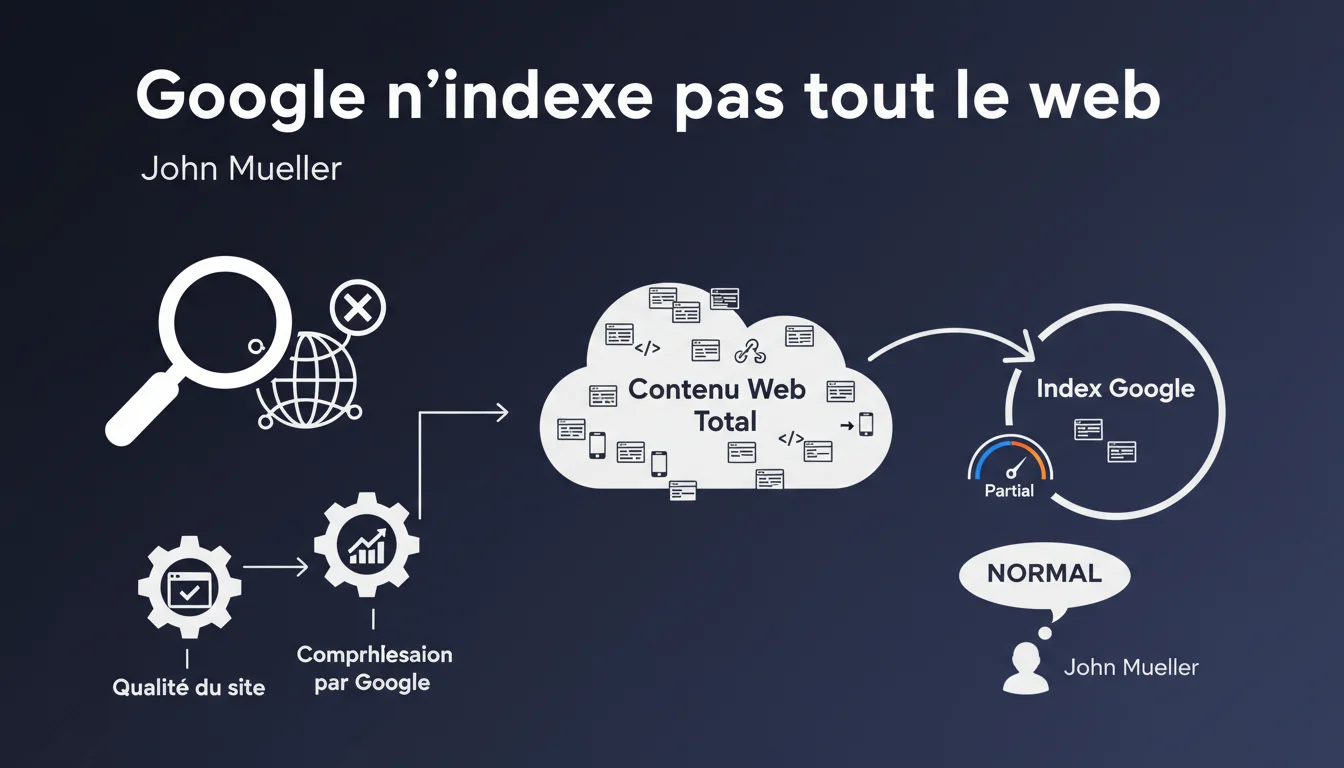
Google does not index every page of a website, and that's normal. The amount of content indexed directly depends on the overall quality perception that Google has of your domain. In practical terms: if Google considers your site mediocre, even decent pages may remain unindexed.
What you need to understand
Does this statement imply that Google engages in arbitrary filtering?
Not exactly arbitrary, but subjective. Google evaluates the overall quality of a site to determine how many resources it will allocate to its indexing. If your domain is perceived as unreliable or low quality, Google may decide not to index a significant portion of your pages, even if they are technically crawlable.
This mechanism is not a direct penalty but an optimization of crawl resources. Google cannot index everything: it prioritizes. Your domain-wide reputation plays a key role in this prioritization.
What criteria determine this 'understanding of quality'?
Google remains vague about the specific details — intentionally. It is known that signals like content quality, domain authority, user signals (bounce rate, time spent), and update frequency come into play.
But the essence is that Google evaluates your site as a whole. An excellent article on a lousy site may never be indexed. Conversely, an average page on a trusted domain will be indexed quickly.
Does this challenge the logic of 'quality content first'?
No, but it does seriously nuance it. Publishing good content is necessary, but not sufficient. If your site has accumulated a quality debt — weak pages, duplicate content, spam — even your new articles may be penalized by association.
This also means that a spring cleaning can have a direct impact on indexing. Removing or improving mediocre pages can unlock the indexing of better pages.
- Indexing is not a right: Google actively chooses what to index based on its perception of your domain
- The overall quality of the site impacts the indexing of each individual page
- A site with a lot of low or duplicated content will see its indexing rate drop
- Improving overall quality can unlock indexing for pages that were previously ignored
SEO Expert opinion
Does this statement align with field observations?
Absolutely. For years, it has been observed that sites with a history of poor quality struggle to index new pages, even excellent ones. Mueller is merely confirming what we suspected: Google applies a form of preventive filtering based on domain reputation.
Specifically, an affiliate site filled with thin content will have a disastrous indexing rate, even if you publish an ultra-detailed 5000-word guide. Google may not even bother reading it.
What nuances should be added to this statement from Google?
The problem is that Google provides no quantifiable indicators to know where you stand. How many unindexed pages is 'normal'? 10%? 50%? It depends on what exactly? [To be verified] — we are sorely lacking concrete data.
Furthermore, Mueller speaks of 'understanding of quality,' but this understanding is largely opaque. The precise signals used for this global evaluation are never detailed. Is it based on Core Web Vitals? Backlinks? Click-through rates in the SERPs? Probably a mix, but no one really knows.
In what cases does this rule not apply?
Sites with an established authority enjoy obvious preferential treatment. A major media outlet can publish average content and have it indexed within minutes. A small blog will have to prove its worth over months before receiving the same treatment.
Very specialized niche sites can also circumvent this logic if they completely dominate their sector — even with modest volume, strong thematic authority can compensate for an average overall perception.
Practical impact and recommendations
What concrete actions should be taken to improve your indexing rate?
First step: brutal quality audit. Identify all weak, duplicated, or low-value pages. Remove or radically improve them. Google evaluates your site as a whole — every mediocre page pulls the rest down.
Then, focus your efforts on thematic consistency. A site dealing with 15 different topics without real expertise in any will be perceived as a generic content aggregator. It's better to be excellent in 3 themes than mediocre in 15.
Also monitor your user signals. If your pages generate high bounce rates and low visit times, Google deduces that your content does not meet expectations. Improve engagement — it's a quality proxy that Google understands very well.
What mistakes should be absolutely avoided?
Don’t fall into the trap of volume for the sake of volume. Publishing 50 mediocre articles per month to 'feed the site' is counterproductive. You degrade your overall reputation and reduce your chances of future indexing.
Also avoid neglecting already indexed pages. A site with 1000 indexed pages, 800 of which are outdated or of poor quality, is a burden. Google sees a site with 80% waste. Clean up regularly.
Lastly, don’t rely on technical quick fixes to force indexing. Manually submitting URLs or spamming the sitemap does nothing if Google has decided that your domain does not deserve more attention.
How can I check if my site is well positioned on this issue?
Calculate your real indexing rate: number of indexed pages (via Search Console) divided by the number of crawlable pages (via Screaming Frog or OnCrawl crawl). A rate below 70% on an editorial site is a warning sign.
Analyze the coverage reports in Search Console. If you see many pages in 'Discovered - currently not indexed' or 'Crawled - currently not indexed,' it means Google has seen your pages but has chosen not to index them. Why? Insufficient overall quality.
- Audit and remove/improve all low-quality pages
- Strengthen the site's thematic consistency
- Improve user signals (time spent, bounce rate)
- Calculate the real indexing rate and monitor its evolution
- Monitor coverage reports in Search Console
- Don’t publish just to publish — prioritize quality over volume
❓ Frequently Asked Questions
Quel est un taux d'indexation normal pour un site éditorial ?
Peut-on forcer Google à indexer une page spécifique ?
Si je supprime des pages faibles, l'indexation de mon site va-t-elle s'améliorer ?
Google indexe-t-il différemment les gros sites et les petits sites ?
Comment savoir pourquoi Google n'indexe pas mes pages ?
🎥 From the same video 16
Other SEO insights extracted from this same Google Search Central video · published on 09/01/2022
🎥 Watch the full video on YouTube →
💬 Comments (0)
Be the first to comment.