
Official statement
Other statements from this video 16 ▾
- □ Le crawl budget est-il vraiment négligeable pour votre site ?
- □ Faut-il publier plus souvent pour être crawlé plus régulièrement par Google ?
- □ Faut-il vraiment s'inquiéter de la duplication de contenu interne ?
- □ Le hreflang fonctionne-t-il vraiment page par page et non pour tout un site ?
- □ Comment Google mesure-t-il réellement la Page Experience dans son algorithme ?
- □ Chrome et Analytics influencent-ils vraiment le classement Google ?
- □ Le hreflang modifie-t-il vraiment le ranking ou se contente-t-il de permuter les URLs ?
- □ Faut-il vraiment choisir entre redirection 301 et canonical pour une migration ?
- □ Top Stories sans AMP : faut-il encore optimiser la vitesse de vos pages ?
- □ Search Console compte-t-elle vraiment toutes vos impressions SEO ?
- □ Les URLs découvertes en JavaScript gaspillent-elles vraiment votre crawl budget ?
- □ Le nofollow empêche-t-il vraiment l'indexation d'une page ?
- □ Pourquoi Google refuse-t-il d'indexer certaines pages de votre site ?
- □ Faut-il supprimer les pages à faible trafic pour améliorer son SEO ?
- □ Les erreurs de balisage breadcrumb entraînent-elles une pénalité Google ?
- □ Le contenu unique booste-t-il vraiment le ranking global d'un site ?
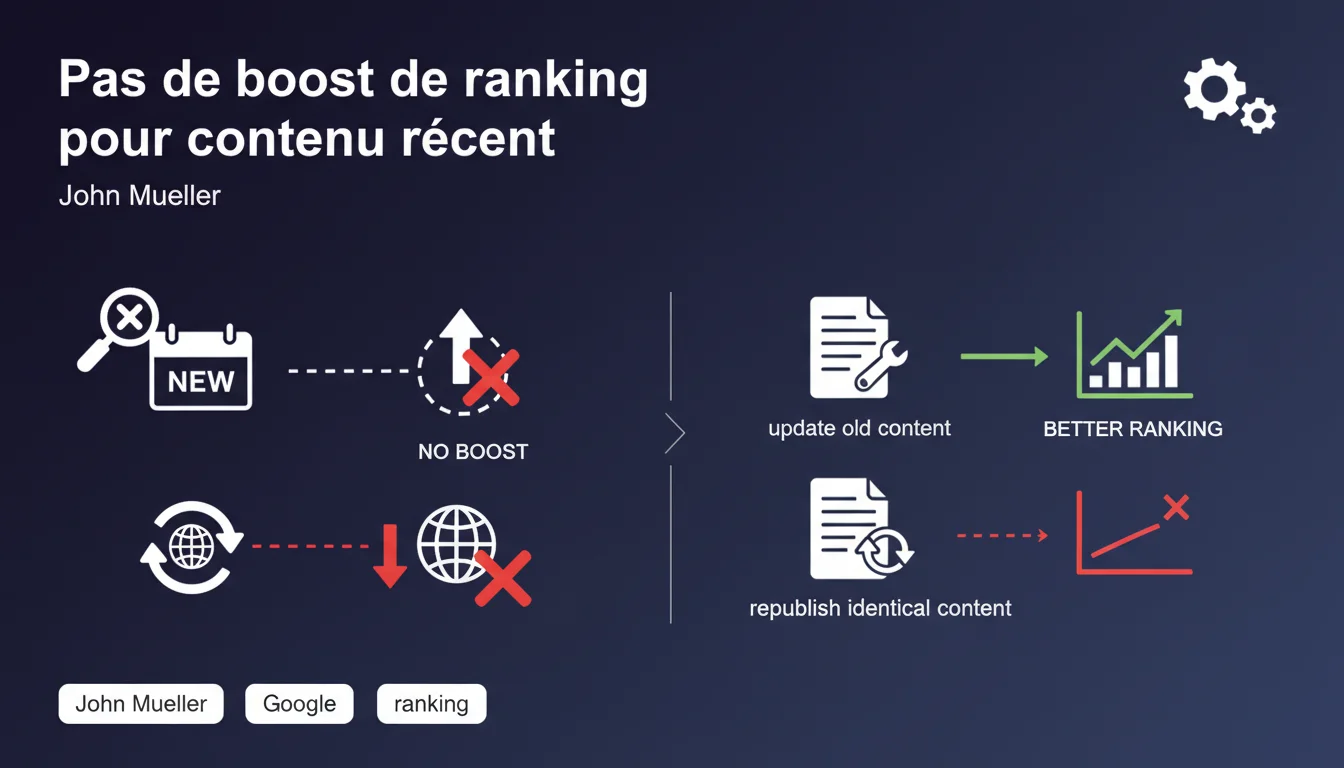
Google does not provide an automatic ranking advantage for freshly published or republished content. Simply updating a date does nothing — what matters is the actual improvement of the content. Republishing an identical article by just changing the date is a waste of time.
What you need to understand
Does Google automatically favor recent content in its results?<\/h3>
The answer is no<\/strong>. Contrary to a widespread belief in the industry, Google does not provide a systematic boost to freshly published pages. There is no premium for novelty<\/strong> in the core algorithm.<\/p> This clarification debunks a persistent myth: that of systematically republishing old content with a new date to 'trick' Google. If the content remains identical, changing the date produces no positive effect on ranking.<\/p> Freshness counts for time-sensitive queries<\/strong>: news, recent events, trends, evolving legal or technical information. For these specific queries, Google actively seeks up-to-date content.<\/p> But this logic does not apply to the majority of informational or commercial searches. A guide on 'how to choose a mattress' published two years ago can easily surpass content published yesterday — if its quality and relevance are superior.<\/p> Updating<\/strong> enriches existing content: adding sections, refreshing data, improving structure, new images. This is what Google recommends.<\/p> Republishing<\/strong> means duplicating an existing article by just changing the date, sometimes the URL. If the content remains the same, this is pointless or even counterproductive — it dilutes your crawl budget and may create potential keyword cannibalization.<\/p>When does freshness actually matter?<\/h3>
What is the difference between updating and republishing?<\/h3>
SEO Expert opinion
Is this statement consistent with field observations?<\/h3>
Yes, and it is verifiable. Content that is several years old continues to rank on the first page for competitive queries — as long as it remains relevant and comprehensive. The initial publication date is clearly not a blocking criterion.<\/p>
Conversely, publishing new but mediocre content does not generate any magic boost. I've seen clients exhaust themselves republishing their articles each quarter 'for freshness' — result: no measurable impact on traffic, just a messy version history.<\/p>
What nuances should be added to this rule?<\/h3>
Let's be honest: Google does not tell the whole truth here<\/strong>. For certain types of queries — health, finance, tech, news — the algorithms implicitly favor recent content. Not through an 'automatic boost', but via indirect signals: recent links, user engagement, media coverage.<\/p> The crucial nuance? It is not the publication date<\/strong> that counts, it is the perceived freshness of the content<\/strong>: up-to-date data, recent references, current examples. An article from 2021 significantly updated in 2023 outperforms a mediocre article published in 2024. [To be verified]<\/strong>: Google never precisely details which temporal signals weigh the heaviest.<\/p> For query deserves freshness (QDF)<\/strong>, Google explicitly activates a freshness filter. Elections, natural disasters, product launches, scandals — in those cases, a recent date becomes a major criterion. But this represents a minority of queries.<\/p> Another exception: news sites. For them, freshness is structurally integrated into the ranking criteria of Google News and Top Stories. But this is a separate ecosystem, with its own rules.<\/p>In what situations does this rule not apply?<\/h3>
Practical impact and recommendations
What should you concretely do with your old content?<\/h3>
Stop republishing blindly. Start with a content audit<\/strong>: identify those that rank well but could gain positions with enrichment. Prioritize those that are on Google pages 1-2 — that's where the effort is most profitable.<\/p> Actually improve the content: add missing sections, update figures, integrate visuals, clarify structure, answer PAA (People Also Ask). Keep the same URL, the same original publication date — just modify the 'last modified' field in your schema tags.<\/p> Do not change the URL of a performing article just to make it 'new'. You lose your link history, ranking signals, and page age. It's SEO suicide.<\/p> Do not massively manipulate your publication dates to simulate freshness. Google detects suspicious patterns — and even if it does not penalize you directly, you dilute your crawl budget for nothing.<\/p> Do not neglect evergreen content. A comprehensive and timeless guide on a stable topic can rank for years without an update. Not all pages need to be refreshed constantly.<\/strong><\/p> Track the evolution of ranking and traffic page by page after each significant update. Use Search Console to compare impressions and clicks before/after. If an update generates no impact after 4-6 weeks, question the actual quality of the improvement.<\/p> Monitor your crawl budget: if Google crawls your freshly updated pages more frequently, that's a good sign. If crawl traffic stagnates despite your efforts, the content may not be as 'improved' as you think.<\/p>What mistakes should be absolutely avoided?<\/h3>
How can you verify if your update strategy is working?<\/h3>
❓ Frequently Asked Questions
Faut-il systématiquement mettre à jour la date de publication d'un article amélioré ?
Google pénalise-t-il les sites qui republient du contenu identique avec une nouvelle date ?
Comment savoir si une requête est sensible au temps (QDF) ?
Vaut-il mieux créer un nouveau contenu ou mettre à jour un ancien qui performe mal ?
Le champ 'dateModified' dans les balises schema influence-t-il le ranking ?
🎥 From the same video 16
Other SEO insights extracted from this same Google Search Central video · published on 09/01/2022
🎥 Watch the full video on YouTube →Related statements
Get real-time analysis of the latest Google SEO declarations
Be the first to know every time a new official Google statement drops — with full expert analysis.
💬 Comments (0)
Be the first to comment.