
Official statement
Other statements from this video 16 ▾
- □ Is crawl budget really insignificant for your site?
- □ Should you publish more frequently to be crawled more regularly by Google?
- □ Should you really worry about internal content duplication?
- □ Does hreflang really function on a page-by-page basis and not for the entire site?
- □ How does Google truly measure Page Experience in its algorithm?
- □ Does Google really not use Chrome and Analytics data for rankings?
- □ Does hreflang really change the ranking or just swap the URLs?
- □ Do you really need to choose between a 301 redirect and a canonical link for a migration?
- □ Is it true that Top Stories can thrive without AMP? Here's what you need to know!
- □ Does Google Search Console really account for all your SEO impressions?
- □ Does JavaScript-generated URLs really waste your crawl budget?
- □ Does nofollow really prevent a page from being indexed?
- □ Why does Google choose not to index certain pages on your site?
- □ Should you really delete low-traffic pages to boost your SEO?
- □ Does improperly formatted breadcrumb markup lead to a Google penalty?
- □ Does unique content really enhance a site's overall ranking?
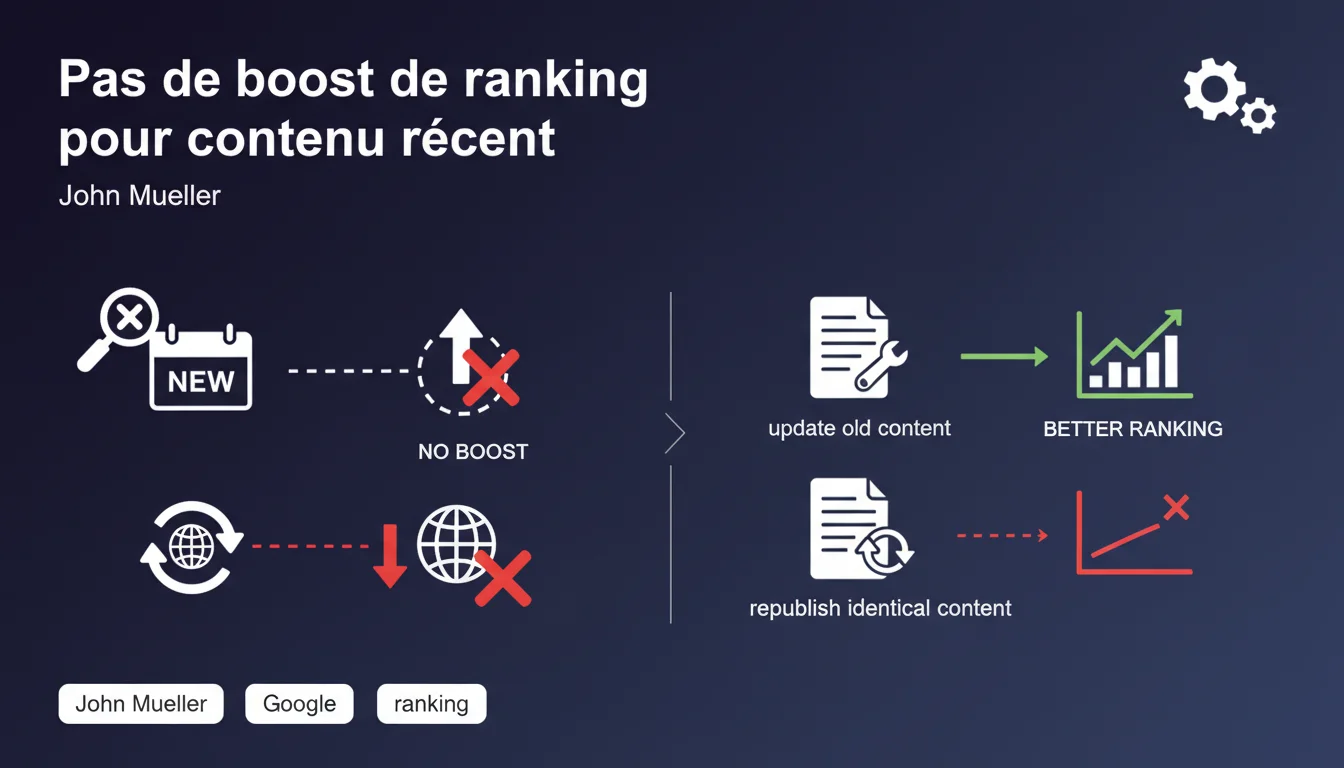
Google does not provide an automatic ranking advantage for freshly published or republished content. Simply updating a date does nothing — what matters is the actual improvement of the content. Republishing an identical article by just changing the date is a waste of time.
What you need to understand
Does Google automatically favor recent content in its results?
The answer is no. Contrary to a widespread belief in the industry, Google does not provide a systematic boost to freshly published pages. There is no premium for novelty in the core algorithm. This clarification debunks a persistent myth: that of systematically republishing old content with a new date to 'trick' Google. If the content remains identical, changing the date produces no positive effect on ranking. Freshness counts for time-sensitive queries: news, recent events, trends, evolving legal or technical information. For these specific queries, Google actively seeks up-to-date content. But this logic does not apply to the majority of informational or commercial searches. A guide on 'how to choose a mattress' published two years ago can easily surpass content published yesterday — if its quality and relevance are superior. Updating enriches existing content: adding sections, refreshing data, improving structure, new images. This is what Google recommends. Republishing means duplicating an existing article by just changing the date, sometimes the URL. If the content remains the same, this is pointless or even counterproductive — it dilutes your crawl budget and may create potential keyword cannibalization.When does freshness actually matter?
What is the difference between updating and republishing?
SEO Expert opinion
Is this statement consistent with field observations?
Yes, and it is verifiable. Content that is several years old continues to rank on the first page for competitive queries — as long as it remains relevant and comprehensive. The initial publication date is clearly not a blocking criterion.
Conversely, publishing new but mediocre content does not generate any magic boost. I've seen clients exhaust themselves republishing their articles each quarter 'for freshness' — result: no measurable impact on traffic, just a messy version history.
What nuances should be added to this rule?
Let's be honest: Google does not tell the whole truth here. For certain types of queries — health, finance, tech, news — the algorithms implicitly favor recent content. Not through an 'automatic boost', but via indirect signals: recent links, user engagement, media coverage. The crucial nuance? It is not the publication date that counts, it is the perceived freshness of the content: up-to-date data, recent references, current examples. An article from 2021 significantly updated in 2023 outperforms a mediocre article published in 2024. [To be verified]: Google never precisely details which temporal signals weigh the heaviest. For query deserves freshness (QDF), Google explicitly activates a freshness filter. Elections, natural disasters, product launches, scandals — in those cases, a recent date becomes a major criterion. But this represents a minority of queries. Another exception: news sites. For them, freshness is structurally integrated into the ranking criteria of Google News and Top Stories. But this is a separate ecosystem, with its own rules.In what situations does this rule not apply?
Practical impact and recommendations
What should you concretely do with your old content?
Stop republishing blindly. Start with a content audit: identify those that rank well but could gain positions with enrichment. Prioritize those that are on Google pages 1-2 — that's where the effort is most profitable. Actually improve the content: add missing sections, update figures, integrate visuals, clarify structure, answer PAA (People Also Ask). Keep the same URL, the same original publication date — just modify the 'last modified' field in your schema tags. Do not change the URL of a performing article just to make it 'new'. You lose your link history, ranking signals, and page age. It's SEO suicide. Do not massively manipulate your publication dates to simulate freshness. Google detects suspicious patterns — and even if it does not penalize you directly, you dilute your crawl budget for nothing. Do not neglect evergreen content. A comprehensive and timeless guide on a stable topic can rank for years without an update. Not all pages need to be refreshed constantly. Track the evolution of ranking and traffic page by page after each significant update. Use Search Console to compare impressions and clicks before/after. If an update generates no impact after 4-6 weeks, question the actual quality of the improvement. Monitor your crawl budget: if Google crawls your freshly updated pages more frequently, that's a good sign. If crawl traffic stagnates despite your efforts, the content may not be as 'improved' as you think.What mistakes should be absolutely avoided?
How can you verify if your update strategy is working?
❓ Frequently Asked Questions
Faut-il systématiquement mettre à jour la date de publication d'un article amélioré ?
Google pénalise-t-il les sites qui republient du contenu identique avec une nouvelle date ?
Comment savoir si une requête est sensible au temps (QDF) ?
Vaut-il mieux créer un nouveau contenu ou mettre à jour un ancien qui performe mal ?
Le champ 'dateModified' dans les balises schema influence-t-il le ranking ?
🎥 From the same video 16
Other SEO insights extracted from this same Google Search Central video · published on 09/01/2022
🎥 Watch the full video on YouTube →
💬 Comments (0)
Be the first to comment.