
Official statement
Other statements from this video 16 ▾
- □ Is crawl budget really insignificant for your site?
- □ Should you publish more frequently to be crawled more regularly by Google?
- □ Should you really worry about internal content duplication?
- □ Does new content really get an automatic ranking boost?
- □ Does hreflang really function on a page-by-page basis and not for the entire site?
- □ How does Google truly measure Page Experience in its algorithm?
- □ Does Google really not use Chrome and Analytics data for rankings?
- □ Does hreflang really change the ranking or just swap the URLs?
- □ Do you really need to choose between a 301 redirect and a canonical link for a migration?
- □ Is it true that Top Stories can thrive without AMP? Here's what you need to know!
- □ Does JavaScript-generated URLs really waste your crawl budget?
- □ Does nofollow really prevent a page from being indexed?
- □ Why does Google choose not to index certain pages on your site?
- □ Should you really delete low-traffic pages to boost your SEO?
- □ Does improperly formatted breadcrumb markup lead to a Google penalty?
- □ Does unique content really enhance a site's overall ranking?
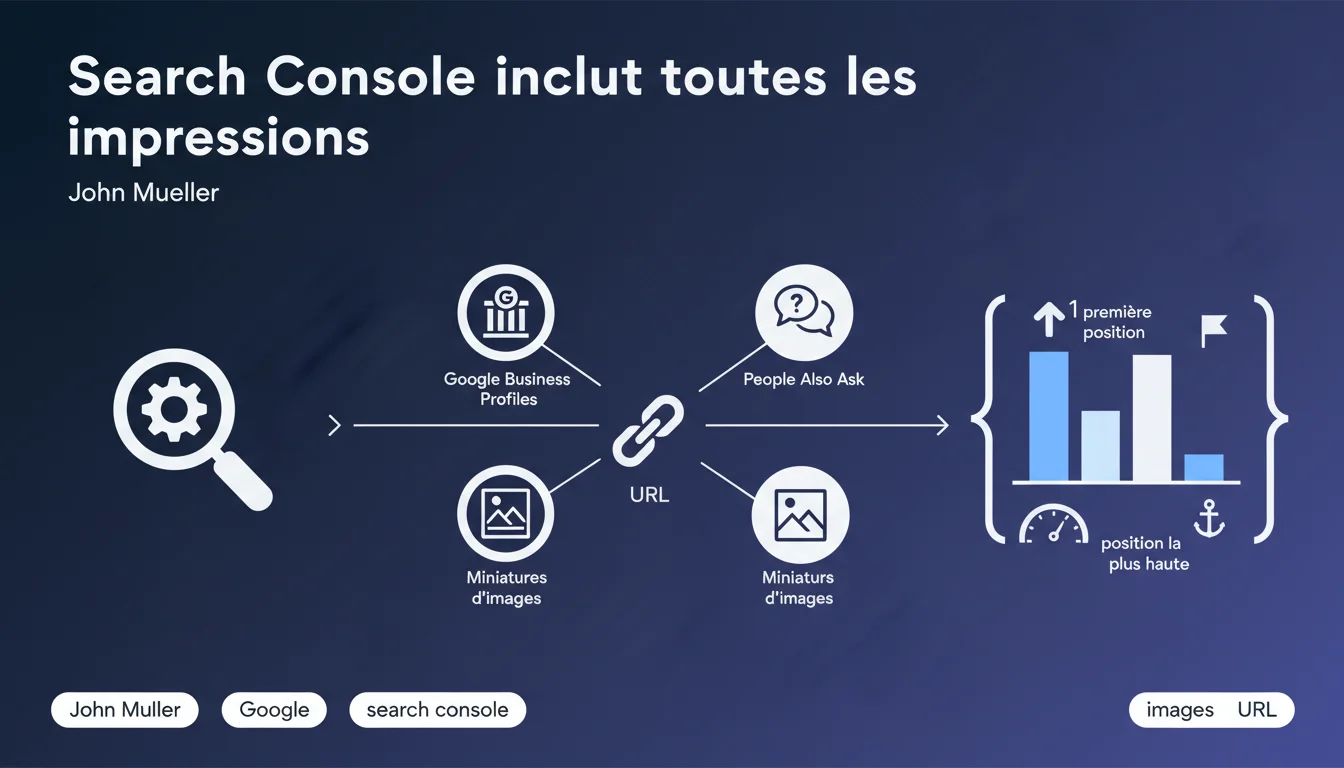
Search Console records all impressions where a URL from the site appears, including in Google Business Profile, People Also Ask, and image thumbnails. The average position displayed corresponds to the highest position reached, not a real average across the page. This clarification changes the interpretation of performance data.
What you need to understand
What impressions are actually counted in Search Console?
Mueller's statement specifies that all appearances of a URL generate an impression — not just standard organic results. This includes Google Business Profile blocks, People Also Ask (PAA) questions, and even image thumbnails when they point to a page on the site. Specifically, if your URL appears simultaneously in organic position 5 AND in a visible PAA block, Search Console records two distinct impressions. The confusion arises from the fact that these different sources of impressions are not distinguished in the standard report. The most important nuance: the average position is not an average. It is the highest position recorded for that URL during the display. If your page appears in organic position 3 and position 15 in a PAA block, Search Console retains position 3. This logic skews the classic interpretation of the data. An average position of 8.2 does not mean your page hovers around that position — it could very well alternate between position 3 (organic) and position 20 (image), with Google consistently retaining the best one.How is the average position calculated?
Why does this clarification change the game?
SEO Expert opinion
Is this statement consistent with field observations?
Yes and no. The inclusion of PAA and Business Profile impressions is consistent with what is observed — some queries generate abnormally high impression volumes without proportional traffic. However, the methodology for calculating the 'highest' position is problematic. In practice, this logic means that a page that appears sporadically in position 3 through a featured snippet but consistently in position 18 in organic will show an average displayed position around 3-5. Except that 95% of the impressions come from position 18. The data becomes misleading. Mueller remains vague on several critical points. [To verify]: Are impressions in video carousels, shopping results for product URLs, or 'Insights' blocks also counted? No clarification. Another gray area: how does Google manage simultaneous multiple impressions of the same URL on a SERP? If your page appears in organic AND in two different PAA blocks, does it count 3 impressions or just 1 with the highest position of the three? The wording suggests it's 3, but that remains an interpretation. Sites with a strong presence in rich snippets (recipes, FAQs, videos) are the most affected. Their Search Console metrics become difficult to exploit without manual segmentation. Concrete example: an e-commerce site with product listings optimized for images. Thumbnails generate thousands of impressions with a dismal CTR, drowning out the actual organic data. It becomes impossible to know if the content strategy is working without cross-referencing with Analytics and third-party tools.What are the gray areas in this explanation?
In what cases does this rule completely skew analysis?
Practical impact and recommendations
How to properly interpret your Search Console data?
First step: segment by type of search. Use the 'Search type' filters (Web, Images, Videos) to isolate pure organic impressions. This is the minimum to gain a less polluted view. Next, cross-reference with Google Analytics. Compare the volume of clicks from Search Console with actual organic sessions. A significant gap often indicates pollution from non-organic impressions (PAA, images) that generate little actual traffic. Never use the average CTR from Search Console as a performance indicator without context. A CTR of 2% can be excellent if your impressions mostly come from images, but catastrophic if they are purely organic in positions 1-5. Also avoid celebrating an 'improvement in average position' without checking the actual distribution of positions. Download the complete data and analyze the distribution — you often discover a bimodality (sporadic high positions + frequent low positions). The counting methodology of Search Console makes raw metrics unreliable for strategic decisions. Build a multi-source dashboard that cross-references Search Console, Analytics, and a position tracker to get a realistic view. These cross-analyses and advanced segmentations require technical expertise and a fine understanding of tools. If your team lacks resources or time to implement this monitoring setup, engaging a specialized SEO agency can ensure a correct interpretation of your data and strategic recommendations based on truly actionable metrics.What analysis errors should you absolutely avoid?
What concrete actions should be implemented?
❓ Frequently Asked Questions
Les impressions dans les blocs People Also Ask comptent-elles même si l'utilisateur ne déploie pas la question ?
Si mon URL apparaît en position 5 organique et dans une miniature d'image en position 12, quelle position Search Console affiche-t-elle ?
Comment savoir quelle proportion de mes impressions vient des blocs enrichis plutôt que de l'organique classique ?
Le CTR moyen Search Console est-il encore un KPI pertinent avec cette logique de comptage ?
Dois-je arrêter d'utiliser Search Console pour suivre mes positions ?
🎥 From the same video 16
Other SEO insights extracted from this same Google Search Central video · published on 09/01/2022
🎥 Watch the full video on YouTube →
💬 Comments (0)
Be the first to comment.