
Official statement
Other statements from this video 16 ▾
- □ Is crawl budget really insignificant for your site?
- □ Should you publish more frequently to be crawled more regularly by Google?
- □ Should you really worry about internal content duplication?
- □ Does new content really get an automatic ranking boost?
- □ Does hreflang really function on a page-by-page basis and not for the entire site?
- □ How does Google truly measure Page Experience in its algorithm?
- □ Does Google really not use Chrome and Analytics data for rankings?
- □ Does hreflang really change the ranking or just swap the URLs?
- □ Do you really need to choose between a 301 redirect and a canonical link for a migration?
- □ Is it true that Top Stories can thrive without AMP? Here's what you need to know!
- □ Does Google Search Console really account for all your SEO impressions?
- □ Does JavaScript-generated URLs really waste your crawl budget?
- □ Does nofollow really prevent a page from being indexed?
- □ Why does Google choose not to index certain pages on your site?
- □ Should you really delete low-traffic pages to boost your SEO?
- □ Does improperly formatted breadcrumb markup lead to a Google penalty?
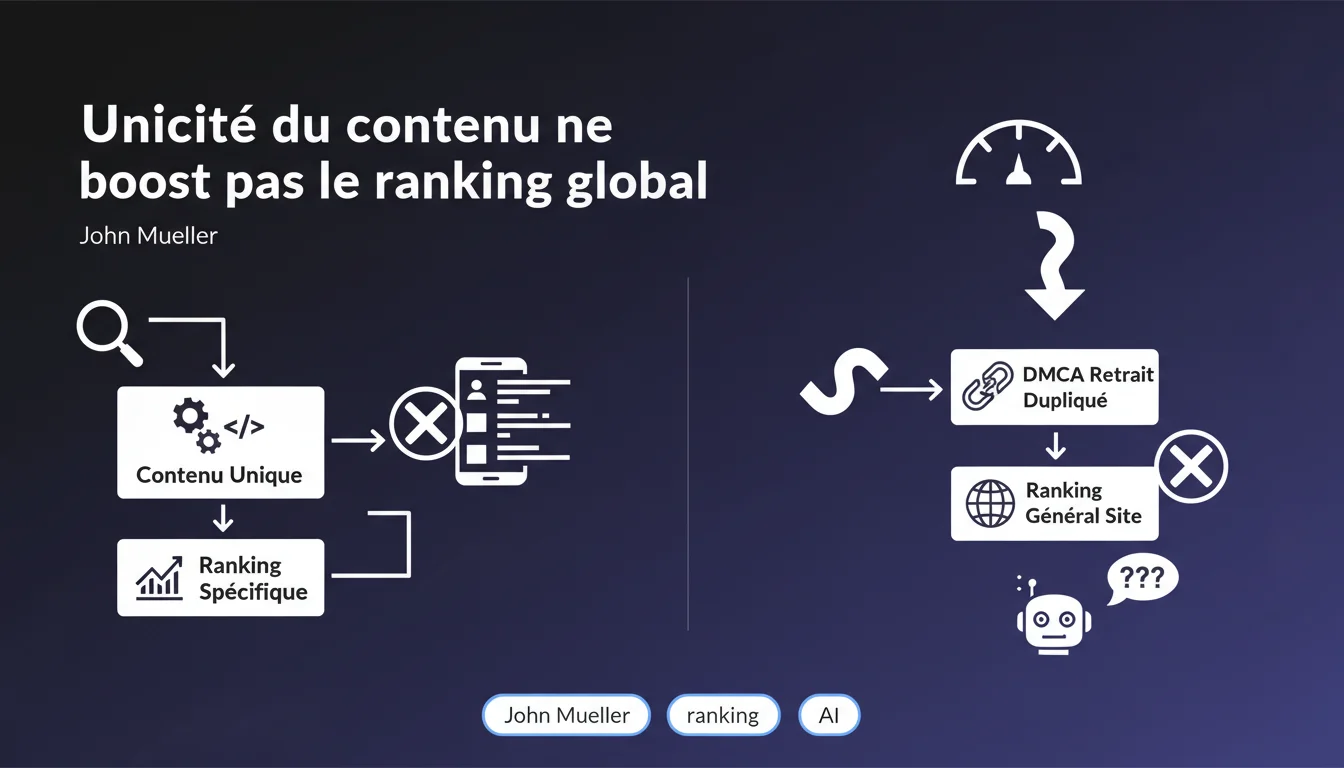
Google states that unique content does not automatically lead to better rankings for generic queries. Uniqueness only helps for specific searches related to that unique content. Removing duplicate content via DMCA does not improve the site's overall ranking.
What you need to understand
What exactly does Google say about content uniqueness?
Mueller's statement debunks a persistent myth: having unique content does not guarantee better overall ranking . Uniqueness serves as a relevance filter, not as a visibility multiplier. In practical terms, if you publish a fresh angle on a topic, you won't rank better for generic queries — only for those targeting that specific angle. Generic queries — the ones that drive traffic — won't receive an automatic boost simply because you have 10% original content on your site. Google treats search intents differently. A broad query ("car insurance") triggers complex ranking signals: domain authority, thematic depth, UX signals . Content uniqueness is just one factor among dozens of others. Conversely, an ultra-specific query ("car insurance comparison for Tesla Model 3 in rural areas") drastically reduces competition. Here, uniqueness becomes critical — simply because few sites cover that precise angle. Mueller is categorical: removing duplicate content via DMCA does not enhance overall ranking . This clarification targets negative strategies aimed at "cleaning" the web of duplicates in hopes of climbing rankings. The DMCA addresses plagiarism issues, not ranking issues. If your site is stagnant, it's probably not because 15 sites are reblogging your articles — you need to look elsewhere.Why is there a distinction between generic and specific searches?
What happens with DMCA removals of duplicate content?
SEO Expert opinion
Is this statement consistent with real-world observations?
Yes, and it's one of the few statements from Google that aligns perfectly with observed patterns. Sites that excel on generic queries never owe that to their mere originality — they accumulate authority, solid linking, qualified backlinks, engagement signals . However, uniqueness remains a significant asset for seizing neglected niches. Sites thriving on ultra-specific long-tail queries owe their traffic to unique angles that no one else covers. Mueller doesn’t say uniqueness is useless — he states it’s insufficient. A major distinction. Unique but mediocre content (poorly structured, superficial, lacking demonstrated expertise) won’t rank, even for specific queries. Another point to emphasize: uniqueness can indirectly boost overall ranking if it generates natural backlinks, social shares, or high reading time. These signals, indeed, impact overall ranking. [To verify] : Google never specifies how it measures "uniqueness" of content — is it purely lexical, semantic, or based on editorial angles? For YMYL topics (health, finance), unique expertise — in the sense of "content written by a recognized expert" — can become an indirect ranking signal. Google will never state this explicitly, but medical sites with credible authors and original angles perform better than generic content farms. Another borderline case: news sites. Being the first to publish with a unique angle can generate a temporary visibility spike (via Google Discover, Top Stories). But this boost is fleeting and does not translate into a lasting better overall ranking.What nuances should be added to this statement?
In what scenarios does this rule not fully apply?
Practical impact and recommendations
What should you concretely do with this information?
Stop thinking "I need to be unique" and instead think "I need to be relevant for a specific intent ". If you're targeting generic queries, uniqueness won't save you — focus on authority, thematic depth, and user experience. If you're leveraging long-tail queries, uniqueness becomes your main weapon. Target ultra-specific angles, precise use cases, neglected keyword combinations. Here, originality will provide a real competitive advantage. Don’t waste energy tracking and removing duplicate content on other sites. Unless there's massive plagiarism harming your brand image, duplicates do not impact your ranking . Focus your resources on content creation, not on policing the web. Another common mistake: mechanically rewriting existing content to make it "unique" without adding value. Google detects these maneuvers — a reformulated but hollow content won’t rank better than generic content. Audit your top-performing pages: are they ranking for generic or specific queries? If it’s generic, analyze the real ranking signals (backlinks, authority, UX signals). If it’s specific, validate that the uniqueness of the angle is indeed the differentiating factor. Segment your editorial strategy: "pillar" pages for generic queries (where uniqueness will never be enough), "niche" pages for specific queries (where uniqueness becomes pivotal). Don’t mix the logics.What mistakes should absolutely be avoided?
How can you verify that your strategy aligns with this logic?
❓ Frequently Asked Questions
Le contenu unique améliore-t-il le ranking sur toutes les requêtes ?
Faut-il supprimer le contenu dupliqué externe via DMCA pour booster son ranking ?
Comment exploiter l'unicité du contenu en SEO ?
Un contenu reformulé compte-t-il comme unique aux yeux de Google ?
L'unicité peut-elle indirectement améliorer le ranking global ?
🎥 From the same video 16
Other SEO insights extracted from this same Google Search Central video · published on 09/01/2022
🎥 Watch the full video on YouTube →
💬 Comments (0)
Be the first to comment.