
Official statement
Other statements from this video 16 ▾
- □ Is crawl budget really insignificant for your site?
- □ Should you publish more frequently to be crawled more regularly by Google?
- □ Does new content really get an automatic ranking boost?
- □ Does hreflang really function on a page-by-page basis and not for the entire site?
- □ How does Google truly measure Page Experience in its algorithm?
- □ Does Google really not use Chrome and Analytics data for rankings?
- □ Does hreflang really change the ranking or just swap the URLs?
- □ Do you really need to choose between a 301 redirect and a canonical link for a migration?
- □ Is it true that Top Stories can thrive without AMP? Here's what you need to know!
- □ Does Google Search Console really account for all your SEO impressions?
- □ Does JavaScript-generated URLs really waste your crawl budget?
- □ Does nofollow really prevent a page from being indexed?
- □ Why does Google choose not to index certain pages on your site?
- □ Should you really delete low-traffic pages to boost your SEO?
- □ Does improperly formatted breadcrumb markup lead to a Google penalty?
- □ Does unique content really enhance a site's overall ranking?
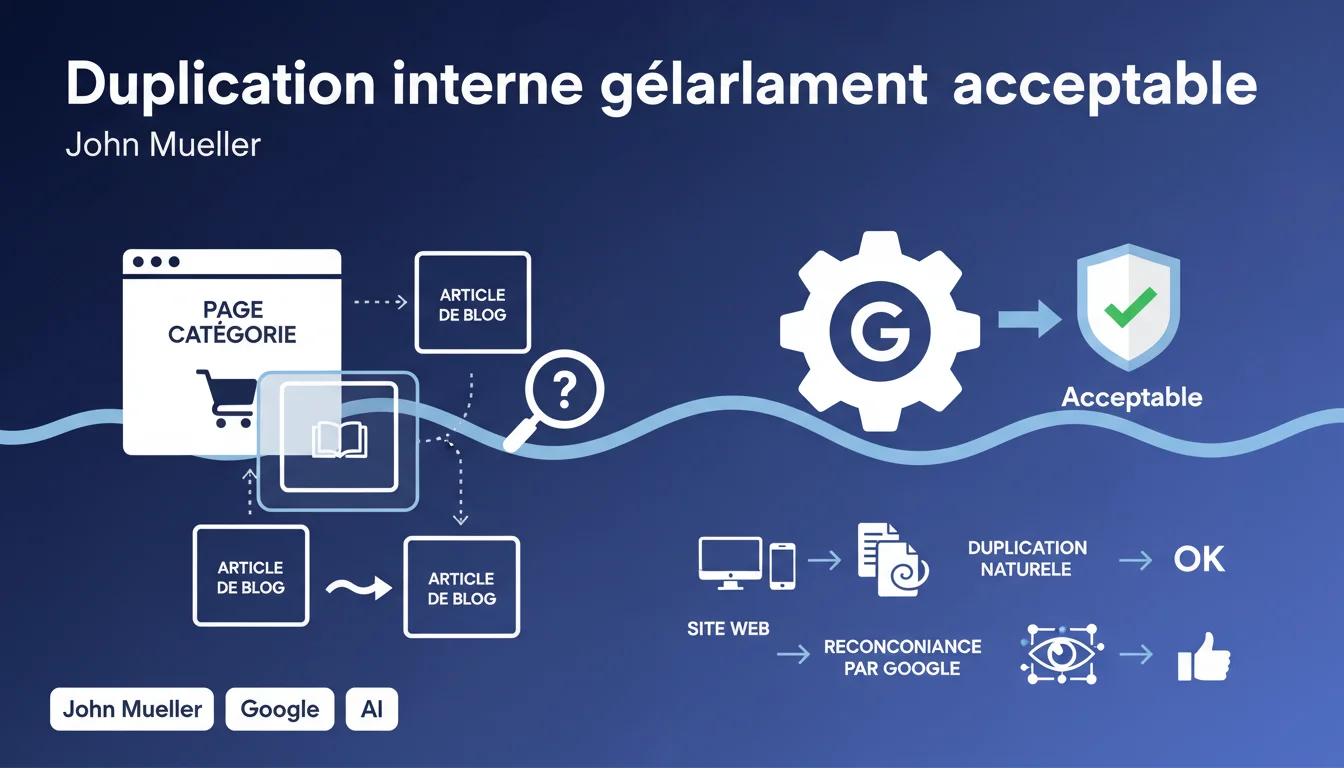
Google considers internal content duplication to be normal and acceptable. There is no automatic penalty if your category page includes excerpts from articles or if multiple pages cover the same topic. Google's algorithms detect and tolerate these natural redundancies within the same domain.
What you need to understand
What exactly does Google mean by "internal duplication"?
It refers to identical or very similar contents present on multiple pages of the same site. Typically: a category page displaying the introductions of your articles, a sidebar repeating the same block on all pages, or product sheets sharing common technical descriptions. Unlike external duplication (such as scraping or outright plagiarism), internal duplication results from legitimate architectural choices. Google recognizes this and does not systematically sanction these situations. Search engines understand that all structured websites naturally generate repetitions. An e-commerce site with filters mechanically creates URLs displaying similar products. A blog categorizes its articles, which implies summary lists. Automatically penalizing this duplication would mean penalizing the architecture itself. Therefore, Google favors an approach of intelligent detection and management rather than blind repression. Mueller's statement remains unclear about the critical threshold. Google does not penalize, of course, but there is no guarantee that all your duplicated pages will be indexed or well-positioned.Why is there tolerance from Google?
What are the limits of this tolerance?
SEO Expert opinion
Does this statement reflect what we see on the ground?
Yes, in the majority of cases. E-commerce sites with thousands of filtered pages do not disappear from the SERPs. Blogs displaying excerpts in their categories continue to rank for their individual articles.
But — and this is where it gets tricky — tolerance does not mean the absence of impact. It is regularly observed that Google indexes selectively: some category pages are crawled but never indexed, while other product variants disappear from results in favor of an arbitrarily chosen "canonical" version. Mueller does not clarify what shifts from "acceptable duplication" to "real problem". [To be verified] — no official metric exists to quantify this threshold. Observations show that duplication becomes problematic when it constitutes the majority of crawlable content. Specifically: if 80% of your indexed pages display the same template with 3 lines of variable text, you dilute your crawl budget and your relevance signals. Google will not penalize you, but it likely will not index everything either. When duplication results from overt manipulation: automatically generated satellite pages targeting keyword variants, doorway pages, mass duplicate content to artificially inflate the number of indexed pages. The boundary remains subjective. Google theoretically differentiates intent — but in practice, their algorithms judge based on technical criteria. A site with 10,000 pages of which 9,500 are nearly identical will be treated differently depending on whether Google perceives editorial logic or an attempt at spam.What nuances should we add to this statement?
In which cases does this rule not apply?
Practical impact and recommendations
What should you do concretely with internal duplication?
First rule: do not panic. If your duplication arises from legitimate architecture (categories, filters, lists), there is no need to completely overhaul everything. Google manages. Second rule: optimize what can be optimized. Even though Google tolerates it, reducing duplication enhances your performance. Unique introductions for category pages, differentiated product descriptions, conditional sidebar blocks — all of this strengthens your signals without revolutionizing your site. Do not massively block your duplicated pages via robots.txt or noindex without a clear strategy. You risk deindexing pages that convert or capture long-tail traffic without realizing it. Avoid the obsession with systematic canonicalization. Yes, canonical tags help Google to choose, but over-canonicalizing creates confusion. A category page should not canonically link to an individual article — these are two different search intents. Internal duplication is not an SEO crime, but it is not a neutral practice either. Google tolerates, but does not reward. Intelligently reducing duplication enhances your effectiveness without requiring a complete overhaul. These architectural and editorial optimizations can be complex to manage alone, especially on large sites with interwoven template systems. Enlisting a specialized SEO agency can provide a precise diagnosis and a strategy tailored to your specific context, rather than applying generic recipes that could degrade your existing performance.What mistakes should you absolutely avoid?
❓ Frequently Asked Questions
Google pénalise-t-il la duplication de contenu interne ?
Faut-il utiliser la balise canonical sur toutes les pages dupliquées ?
La duplication interne affecte-t-elle le crawl budget ?
Dois-je bloquer mes pages catégories en noindex pour éviter la duplication ?
Comment savoir si ma duplication interne pose problème ?
🎥 From the same video 16
Other SEO insights extracted from this same Google Search Central video · published on 09/01/2022
🎥 Watch the full video on YouTube →
💬 Comments (0)
Be the first to comment.