
Official statement
Other statements from this video 16 ▾
- □ Is crawl budget really insignificant for your site?
- □ Should you publish more frequently to be crawled more regularly by Google?
- □ Should you really worry about internal content duplication?
- □ Does new content really get an automatic ranking boost?
- □ Does hreflang really function on a page-by-page basis and not for the entire site?
- □ How does Google truly measure Page Experience in its algorithm?
- □ Does Google really not use Chrome and Analytics data for rankings?
- □ Do you really need to choose between a 301 redirect and a canonical link for a migration?
- □ Is it true that Top Stories can thrive without AMP? Here's what you need to know!
- □ Does Google Search Console really account for all your SEO impressions?
- □ Does JavaScript-generated URLs really waste your crawl budget?
- □ Does nofollow really prevent a page from being indexed?
- □ Why does Google choose not to index certain pages on your site?
- □ Should you really delete low-traffic pages to boost your SEO?
- □ Does improperly formatted breadcrumb markup lead to a Google penalty?
- □ Does unique content really enhance a site's overall ranking?
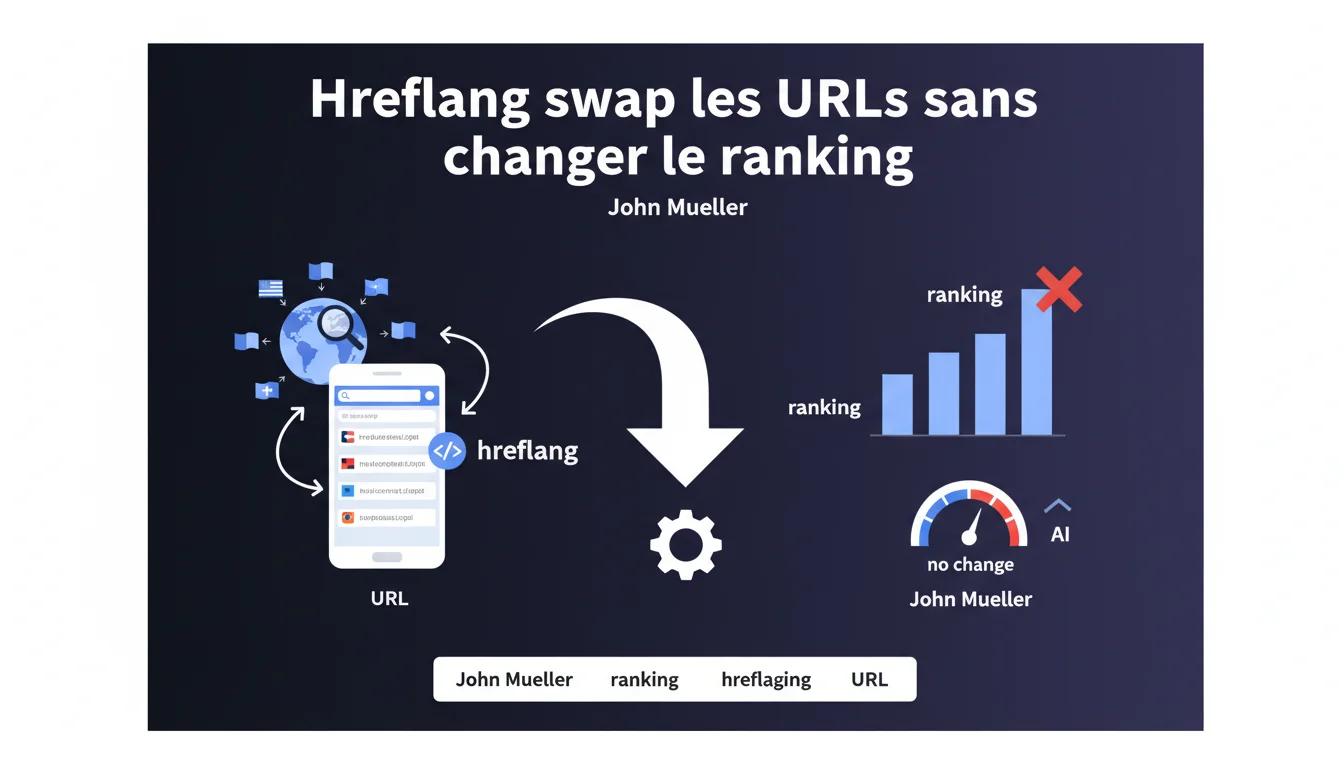
Hreflang does not affect page ranking — it simply replaces the URL displayed in search results with the most relevant language or regional version for the user. In practical terms: your ranking signals remain attached to the source page, but Google displays the most suitable URL based on the search context.
What you need to understand
What is the actual function of hreflang in search results?
The hreflang acts as a URL switching system. When a user makes a query, Google identifies the most relevant language or regional version and displays that URL in the SERPs , even if the ranking signals come from the originating page. Imagine a site with a fr-FR version and a fr-CA version. If a French-speaking Canadian searches for a product, Google may display the Canadian URL in the results, but the ranking itself relies on the signals accumulated by the entire cluster of alternative pages. No. Google treats pages linked by hreflang as a logical group . Signals — backlinks, authority, engagement — are consolidated, then redistributed according to the search context. This is not duplication: it's a smart pooling of signals to serve the right version to the right user. The page that appears is just a contextual facade . The foundation of the ranking remains global to the hreflang cluster. Because it debunks a common misconception: some SEO practitioners fear that multiplying language versions dilutes signals and weakens ranking. This is false — provided that hreflang is implemented correctly.Are ranking signals diluted among different versions?
Why is Mueller's clarification important?
SEO Expert opinion
Is this statement consistent with field observations?
Overall, yes. On well-structured international sites, it is observed that backlinks to the English version also benefit the French or Spanish versions, as long as hreflang is properly implemented. The ranking does not drop when adding language versions — on the contrary, local visibility increases. But — and this is where it gets tricky — this pooling is never perfect . On some sites, less ‘nourished’ versions in content or backlinks may struggle to rank as well, even with impeccable hreflang. [To be verified]: Google claims that the ranking remains the same, but reality suggests that the local context (competition, specific search intentions) can modulate this principle. Mueller talks about a URL swap , not a total merging of signals. Specifically: Google does not guarantee that all versions will rank identically. It simply states that hreflang does not penalize ranking by itself. Let's be honest: if your fr-CA version has poorer content, fewer local backlinks, or a degraded user experience, it won't rank as well as the fr-FR version — hreflang or not. Hreflang does not compensate for the weaknesses of a version, it merely makes it visible to the right audience. When the language versions are too different in terms of quality, internal linking, or structure. If your German version is a copy-paste translated automatically, with few backlinks and a high bounce rate, Google won’t magically boost it just because it's linked via hreflang. Similarly, if you target markets with divergent search intentions (e.g., a popular product in France but marginal in Canada), hreflang won't perform miracles. It will display the correct URL, but the ranking will depend on the actual local relevance.What nuances should be added to this statement?
When does this rule not fully apply?
Practical impact and recommendations
What should you do practically to take advantage of hreflang?
First, correctly implement hreflang tags. Each page must point to all its language alternatives, including itself. Annotations must be bidirectional : if fr-FR points to fr-CA, then fr-CA must point to fr-FR. Next, ensure your language versions have equivalent quality content . Hreflang won’t rescue a hastily translated page. Invest in native translations, adapt content to cultural and local specifics. Don't incoherently mix hreflang and canonical. If a fr-FR page has a canonical to en-US, hreflang becomes useless — Google will favor the canonical. These two annotations must logically coexist . Another classic pitfall: using hreflang on similar pages within the same language (e.g., targeting fr-FR and fr-BE with the same content). If the content is identical, rather use a canonical and target geographically via Search Console. Hreflang is meant for distinct language or regional variants , not for duplicated content. Google Search Console remains your best ally. Go to the International Targeting section to spot reciprocity errors, missing tags, or invalid language codes. Also, test using tools like Screaming Frog or Sitebulb to crawl your pages and validate the consistency of annotations. Also, remember to monitor impressions by country in Search Console: if a language version never appears in its target market, it indicates a problem — either technical (poorly configured hreflang) or content-related (page irrelevant to that market).What mistakes should be absolutely avoided?
How can I check if my implementation is correct?
❓ Frequently Asked Questions
Le hreflang a-t-il un impact sur le classement de mes pages ?
Peut-on utiliser hreflang et canonical sur la même page ?
Que se passe-t-il si le hreflang est mal implémenté ?
Dois-je utiliser hreflang pour des pages identiques dans deux pays de même langue ?
Comment vérifier que mon hreflang fonctionne correctement ?
🎥 From the same video 16
Other SEO insights extracted from this same Google Search Central video · published on 09/01/2022
🎥 Watch the full video on YouTube →
💬 Comments (0)
Be the first to comment.