
Official statement
Other statements from this video 7 ▾
- □ Do Core Web Vitals Really Impact Your Rankings in Google's Helpful Content System?
- □ Should you worry about Google removing the mobile usability report from Search Console?
- □ Why is Google shutting down its mobile-friendly testing tool?
- □ Is Google Really Replacing FID with INP in Core Web Vitals—And What Does It Mean for Your Rankings?
- □ Can you finally edit code directly in Google's rich results test tool?
- □ Can you really get better content insights from Search Console without connecting Google Analytics?
- □ Does Google's Search Labs let you test new AI features before everyone else gets them?
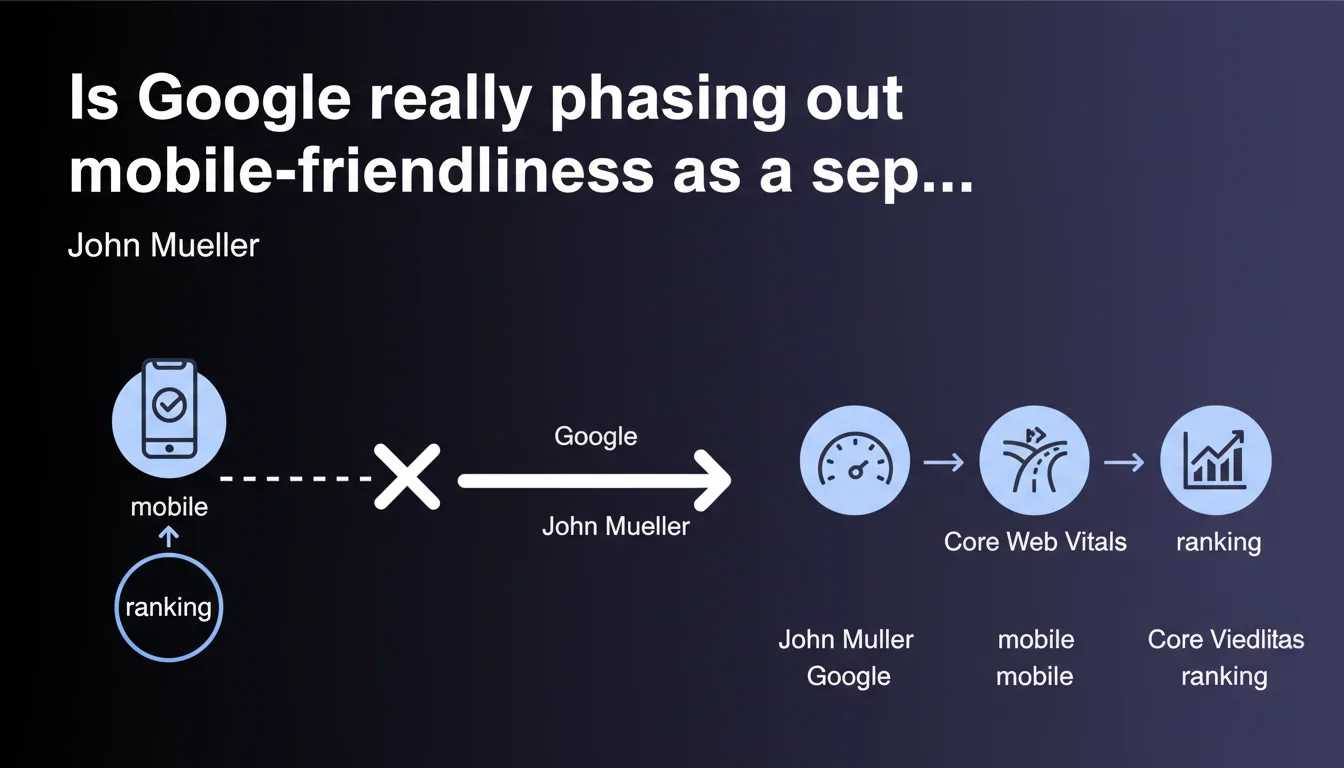
Google is officially removing mobile-friendliness as a distinct ranking factor, now considering it integrated within Core Web Vitals. This consolidation streamlines the mobile approach, but raises questions about how real mobile user experience is evaluated beyond speed metrics alone.
What you need to understand
Why is Google merging mobile compatibility with Core Web Vitals?
For years, Google has evaluated mobile compatibility (responsive design, button size, touch spacing) and Core Web Vitals (LCP, CLS, INP) as separate signals. This distinction created redundancy: a site could be technically responsive yet deliver a catastrophic mobile experience due to poor performance.
This consolidation suggests Google now believes Core Web Vitals capture the essence of mobile experience. In other words: if your mobile LCP is solid, your CLS is stable, and your INP is responsive, the site is by definition usable on mobile. The separate mobile compatibility test becomes obsolete.
What changes concretely for rankings?
Technically, nothing revolutionary. Mobile-friendliness has already been a relatively weak signal since universal mobile-first indexing rolled out. Non-responsive sites were already penalized through other mechanisms: high bounce rates, low engagement, negative user signals.
What changes is the official messaging. Google simplifies its narrative: focus on mobile Core Web Vitals, everything else follows. No need to pass two separate tests.
Does mobile usability criteria disappear altogether?
No—and that's the trap in this announcement. Mobile ergonomic principles (clickable buttons, readable text without zoom, content fitting the screen) remain essential to user experience. They're simply no longer evaluated as an isolated ranking factor.
This means Google is betting that Core Web Vitals will indirectly detect these problems. A site with tiny buttons will likely generate degraded INP (multiple interactions required). Overflowing content will create CLS issues. But this indirect detection isn't foolproof.
- Mobile compatibility is no longer a distinct ranking factor separate from Core Web Vitals
- Mobile Core Web Vitals become the sole official indicator of mobile experience for rankings
- Ergonomic principles remain indirectly valued through performance metrics
- This simplification concerns ranking only, not overall site quality assessment
SEO Expert opinion
Does this consolidation truly reflect the complexity of mobile experience?
Let's be honest: no. Core Web Vitals measure speed and visual stability, but miss many critical aspects of mobile UX. A site can have excellent LCP and perfect CLS while having unusable forms on small screens, confusing navigation, or unreadable content.
Google is betting that these ergonomic problems will automatically translate into negative user signals (bounce rate, time spent). This is true in 70-80% of cases. But not always. [To verify] on high-intent transactional sites where users persist despite poor UX.
Are Core Web Vitals really sufficient to capture mobile-friendliness?
Partially. CLS detects mobile layout issues (shifting elements, overflowing content). INP reveals difficult interactions (tiny buttons requiring multiple taps). But LCP says nothing about text readability or touch accessibility.
The real risk? Sites optimizing solely for CWV metrics without caring about actual experience. Buttons at 30x30px pass Core Web Vitals but remain painful to click. 12px text loads fast but forces zooming. Google is betting users will penalize these sites—but the feedback loop can be slow.
Should you still monitor the Mobile-Friendly Test in Search Console?
Yes, but for different reasons. This test detects technical errors that Core Web Vitals miss: misconfigured viewport, Flash usage, incompatible plugins. These issues may no longer directly impact rankings, but they degrade user experience.
Also watch for sector nuances. In e-commerce, poor mobile ergonomics directly impact conversions—which eventually affects rankings through indirect signals. In pure content publishing, the impact is less immediate but equally real over time.
Practical impact and recommendations
What should you adjust in your current mobile strategy?
First step: audit mobile Core Web Vitals as absolute priority. If you hadn't already prioritized mobile for these metrics, now's the time. Google Mobile-Friendly Test becomes secondary compared to mobile PageSpeed Insights and Search Console's CWV report.
Next, don't throw the mobile compatibility test in the trash. Use it as a technical QA tool, not a ranking indicator. It remains relevant for detecting configuration errors that CWV doesn't capture.
What mistakes should you avoid during this transition?
The classic error: optimizing metrics only without caring about real experience. An LCP of 1.8s achieved by loading an unreadable hero image on mobile has zero value. Perfect INP with 28x28px buttons is still catastrophic UX.
Second trap: believing mobile ergonomic problems no longer impact SEO. They do, but indirectly and with a delay. Frustrated users bounce, don't share, don't convert—and these signals eventually affect rankings, even if no longer through a dedicated factor.
How do you verify your mobile approach remains solid?
Combine multiple data sources. Core Web Vitals give you technical performance. Heatmaps and mobile session recordings reveal actual friction (repeated zooms, missed clicks, erratic scrolling). Engagement metrics (time spent, pages per session, mobile vs desktop conversion rates) validate everything.
If your mobile CWV are green but mobile conversion rate is 50% below desktop, you have an ergonomic problem Core Web Vitals don't detect. That's the gap you need to monitor actively.
- Prioritize mobile Core Web Vitals optimization as the primary indicator
- Maintain the mobile compatibility test as a technical QA tool
- Cross-reference CWV data with actual engagement metrics (heatmaps, sessions, conversions)
- Avoid optimizing for metrics alone without validating concrete user experience
- Monitor performance and conversion gaps between mobile and desktop
- Regularly test mobile ergonomics on real devices with varied connections
❓ Frequently Asked Questions
Les sites non-responsive sont-ils encore pénalisés par Google ?
Faut-il encore utiliser le test de compatibilité mobile de Google ?
Les Core Web Vitals mobile suffisent-ils à garantir une bonne expérience mobile ?
Cette annonce change-t-elle quelque chose pour l'indexation mobile-first ?
Un site avec d'excellents CWV mobile mais une mauvaise ergonomie peut-il bien se classer ?
🎥 From the same video 7
Other SEO insights extracted from this same Google Search Central video · published on 18/07/2023
🎥 Watch the full video on YouTube →
💬 Comments (0)
Be the first to comment.