
Official statement
Other statements from this video 7 ▾
- □ Google abandonne-t-il la compatibilité mobile comme facteur de classement indépendant ?
- □ Faut-il s'inquiéter de la suppression du rapport d'utilisabilité mobile dans Search Console ?
- □ Pourquoi Google abandonne-t-il l'outil de test d'optimisation mobile ?
- □ Pourquoi Google remplace-t-il FID par INP dans les Core Web Vitals ?
- □ Peut-on enfin éditer le code directement dans le test des résultats enrichis de Google ?
- □ Search Console Insights fonctionne-t-il vraiment mieux sans Google Analytics ?
- □ Search Labs : comment tester les nouvelles fonctionnalités IA de Google avant leur déploiement ?
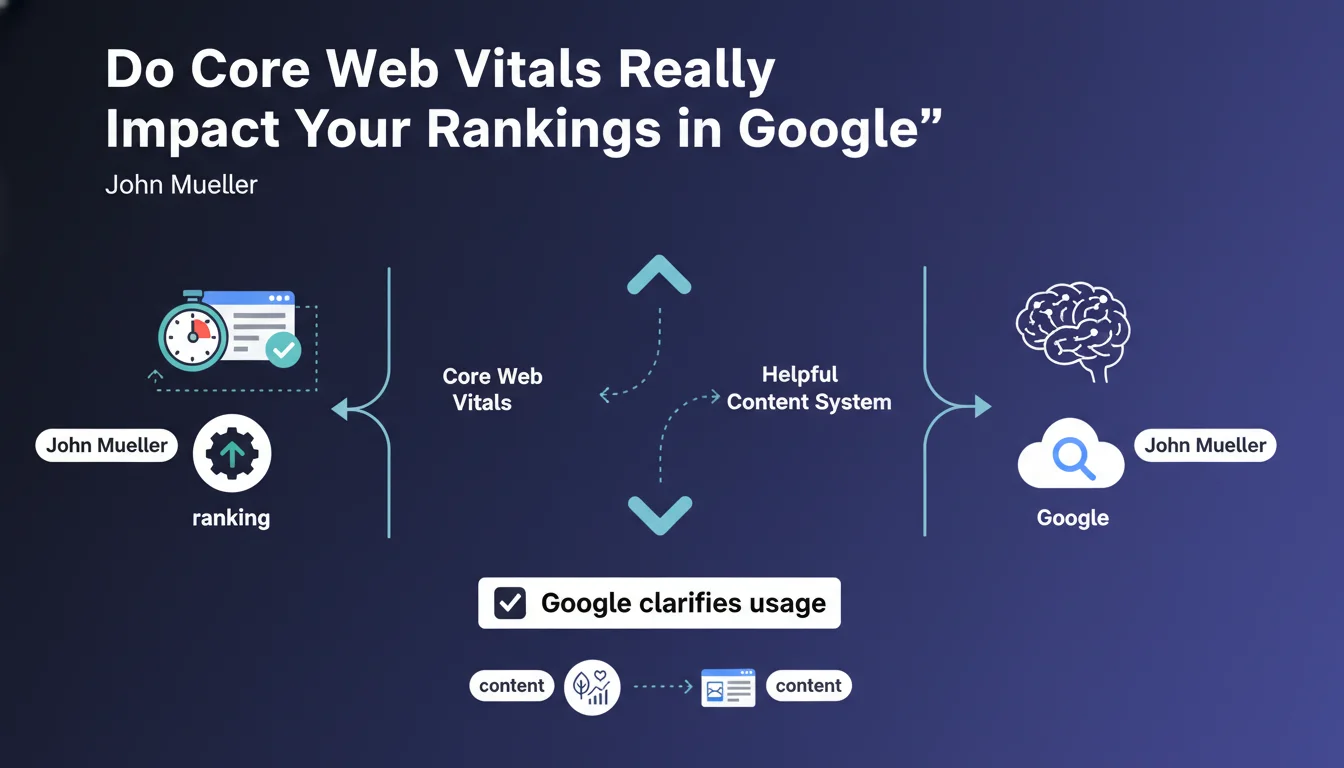
Google confirms that Core Web Vitals are integrated into its helpful content ranking system. In practical terms, technical performance doesn't compensate for poor content, but it can make the difference between two equally high-quality pieces. User experience becomes a tiebreaker criterion, not an absolute prerequisite.
What you need to understand
What exactly is the helpful content system?
The helpful content system is a Google algorithm designed to reward content created for humans rather than search engines. It penalizes sites that mass-produce content without genuine added value.
Historically, this system focused on editorial signals — depth of analysis, expertise, real utility. The integration of Core Web Vitals marks an evolution toward a more holistic approach to quality.
How do Core Web Vitals fit into this system?
CWV don't replace content criteria. They function as an additional tiebreaker when multiple pages offer similar content quality levels.
If your article perfectly answers the search intent but loads in 8 seconds with constant visual shifts, it risks being outranked by a competitor with slightly less comprehensive content but a smooth, fluid experience.
Why this clarification now?
Google has long maintained deliberate ambiguity about how its various ranking systems interact. This official statement formalizes what many SEO professionals were already observing in the field.
Technical performance is no longer a side issue to address "when you have time." It's now part of an overall quality logic that Google explicitly values.
- Core Web Vitals become an integrated criterion within the helpful content system, not an isolated signal
- Technical performance acts as a differentiator between equivalent quality content
- User experience and editorial quality are now inseparable in algorithmic evaluation
- Poor content will never be saved by excellent CWV — the reverse remains true to a lesser extent
SEO Expert opinion
Is this integration really something new?
Let's be honest: not really. SEO professionals were already observing this correlation following the Page Experience Update. What's changing is official acknowledgment of this mechanism by Google.
The important nuance — and this is where interpretation often goes wrong — lies in the concept of "tiebreaker factor." CWV don't mechanically boost a mediocre page. They optimize the ranking of content that's already eligible for top results.
In what cases doesn't this rule fully apply?
Highly specific informational queries represent a blind spot in this logic. When only one site holds the information being searched for, its catastrophic CWV won't prevent it from ranking — for lack of alternatives.
Similarly, sites with very strong topical authority benefit from greater tolerance margins. A reference media outlet with average CWV will continue dominating against an impeccable but unknown tech blog. [To be verified]: Google has never quantified this tolerance threshold.
What contradictions are observed in practice?
Many sites with disastrous CWV maintain dominant positions — particularly in e-commerce and media sectors. Content freshness, backlink diversity, and user engagement sometimes appear to take precedence.
What to remember: Google speaks of ranking systems in the plural. The final algorithm results from complex weighting where no single signal is decisive. CWV carry more weight in certain verticals (blogs, informational sites) than in others (marketplaces, news outlets).
Practical impact and recommendations
What should you prioritize in practice?
Start with a cross-audit: identify your strategic pages (high organic traffic, positions 4-10) and check their CWV. This is where optimization will have the most measurable impact.
Avoid the classic mistake of trying to fix everything at once. Focus on quick wins: image compression, lazy loading, removal of unnecessary blocking scripts. Measure impact over 4-6 weeks before going further.
What mistakes should you absolutely avoid?
Never sacrifice content depth for performance. A well-structured 3,000-word article that loads in 3 seconds will always beat superficial 500-word text that loads instantly.
Be wary of purely cosmetic optimizations in Search Console. An "all green" score obtained by removing useful features (filters, videos, comparison tools) can degrade actual engagement — and thus your overall performance.
How do you verify that your site meets the criteria?
Use real-world data (CrUX) rather than lab tests. PageSpeed Insights under controlled conditions doesn't reflect the experience of your actual users on mobile 4G.
Pay particular attention to CLS (Cumulative Layout Shift) — it's often the most penalizing and most overlooked metric. Ad banners, late-appearing pop-ups, and social embeds are the usual culprits.
- Audit your pages ranking in positions 4-10 on high-volume queries — this is where CWV optimization can shift rankings
- Prioritize LCP (Largest Contentful Paint) and CLS — INP comes in third in observed impact
- Test on actual mobile devices with 3G/4G connections, not just Chrome simulation
- Compare your CWV with those of your direct competitors ranking just above you — the gap reveals your gain potential
- Set up continuous monitoring: CWV regressions often go unnoticed until position drops occur
- Document each technical modification and its impact on CWV and organic traffic — correlation isn't causation
❓ Frequently Asked Questions
Un site avec d'excellents CWV mais un contenu médiocre peut-il bien se classer ?
Faut-il atteindre le score 'vert' sur tous les CWV pour bénéficier de cet effet ?
Les CWV pèsent-ils autant sur desktop que sur mobile ?
Cette intégration change-t-elle la stratégie de priorisation SEO ?
Peut-on perdre des positions uniquement à cause de CWV dégradés ?
🎥 From the same video 7
Other SEO insights extracted from this same Google Search Central video · published on 18/07/2023
🎥 Watch the full video on YouTube →
💬 Comments (0)
Be the first to comment.