
Official statement
What you need to understand
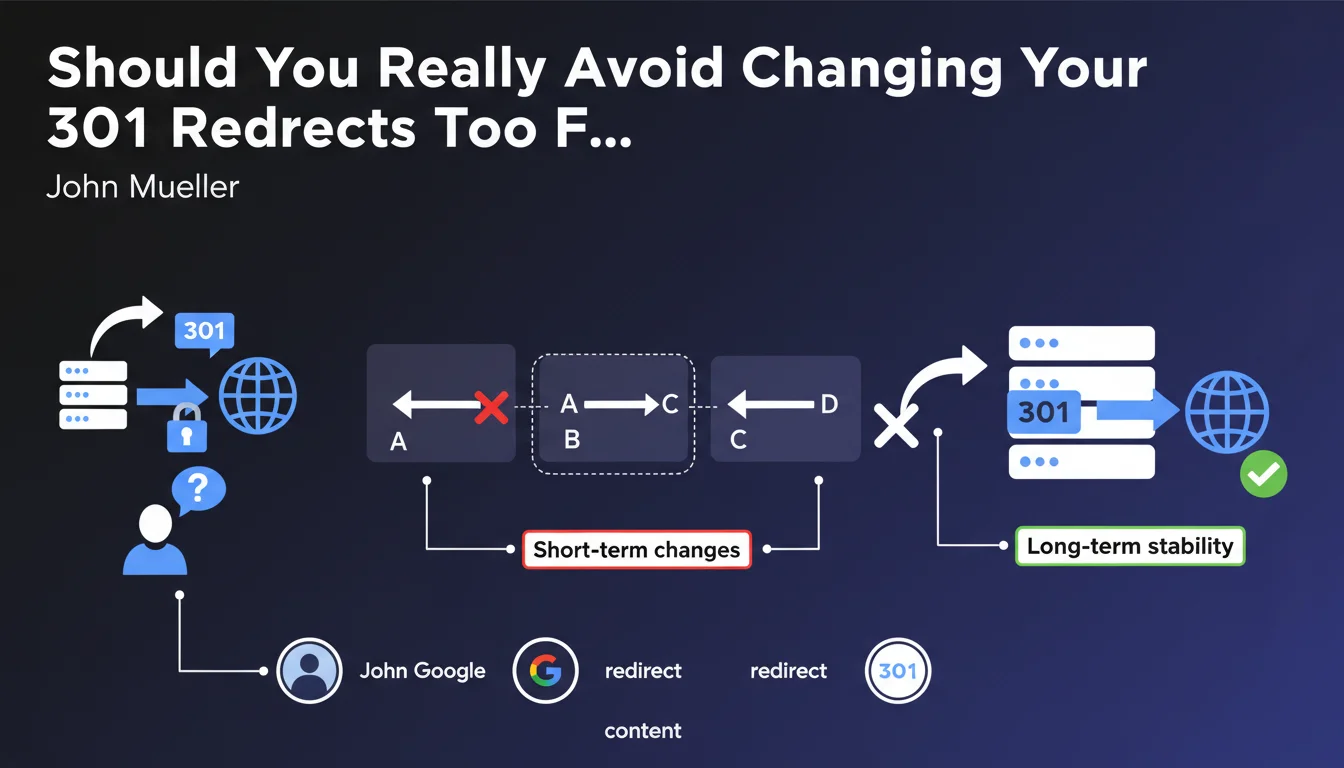
Google reminds us of a fundamental principle that is often overlooked: redirect stability is crucial for the proper functioning of crawling and indexing. A 301 redirect signals to the search engine a permanent move of content.
When you regularly modify or reverse your redirects, you create algorithmic confusion. Google must recalculate PageRank, reassess relevance signals, and reindex the affected pages with each change.
The concrete consequences include extended processing delays, possible dilution of transmitted SEO juice, and instability in your pages' positions in search results.
- A 301 redirect can be cancelled, it's not irreversible
- Frequent changes complicate Googlebot's work
- Planning your redirect strategy avoids constant adjustments
- URL stability promotes better transmission of SEO signals
SEO Expert opinion
This recommendation is perfectly consistent with field observations. Sites that frequently modify their redirect architecture often experience unexplained fluctuations in their rankings, particularly during the 2-3 weeks following each modification.
However, there are legitimate situations requiring adjustments. During a complex site migration, an architecture redesign, or the correction of redirect chain errors, modifications are inevitable. The key is to plan them in a single intervention rather than in multiple iterations.
The notion of "short term" remains vague in this statement. From experience, any redirect change within a period of less than 6 months after its implementation should be considered problematic and symptomatic of insufficient planning.
Practical impact and recommendations
- Audit your content strategy before setting up permanent redirects
- Document each redirect with its business and SEO justification in a tracking spreadsheet
- Favor direct redirects rather than multiple redirect chains
- Avoid temporary 302 redirects if you're not certain about returning to the original URL
- Group your modifications: if adjustments are necessary, make them in a single planned intervention
- Wait at least 6 months before modifying a 301 redirect already in place
- Monitor post-redirect metrics: positions, organic traffic, crawl budget for at least 3 months
- Maintain a complete history of all your redirects with dates and reasons for changes
Optimal redirect management requires a comprehensive strategic vision of your site architecture and your medium-term business objectives. This approach requires in-depth technical expertise combined with a thorough understanding of crawling mechanisms.
For complex projects involving hundreds of redirects or architecture redesigns, support from a specialized SEO agency can prove valuable in avoiding costly mistakes and ensuring a smooth transition without loss of visibility.
💬 Comments (0)
Be the first to comment.