
Official statement
Other statements from this video 13 ▾
- □ Les données structurées pros/cons dans les avis vont-elles changer la donne en SERP ?
- □ Les données structurées produits peuvent-elles vraiment transformer votre visibilité Google ?
- □ Le nouveau rapport Merchant Listings de Search Console change-t-il la donne pour l'e-commerce ?
- □ Le Helpful Content Update pénalise-t-il vraiment tout le site ou juste certaines pages ?
- □ Pourquoi le Helpful Content Update ne ciblait-il initialement que l'anglais ?
- □ Pourquoi Google maintient-il une page dédiée au suivi des mises à jour de ranking ?
- □ Comment utiliser le nouveau rapport Video Indexing de Search Console pour débloquer vos vidéos ?
- □ Comment exploiter les nouvelles données vidéo de l'outil d'inspection d'URL ?
- □ Le rapport HTTPS de Search Console peut-il vraiment booster votre ranking ?
- □ Search Console simplifie sa classification : faut-il revoir votre méthode de priorisation ?
- □ Search Console va-t-elle vraiment abandonner le ciblage géographique ?
- □ Googlebot impose-t-il vraiment une limite de 15 Mo au crawl HTML ?
- □ Comment optimiser vos feeds pour la fonctionnalité Follow de Google Discover ?
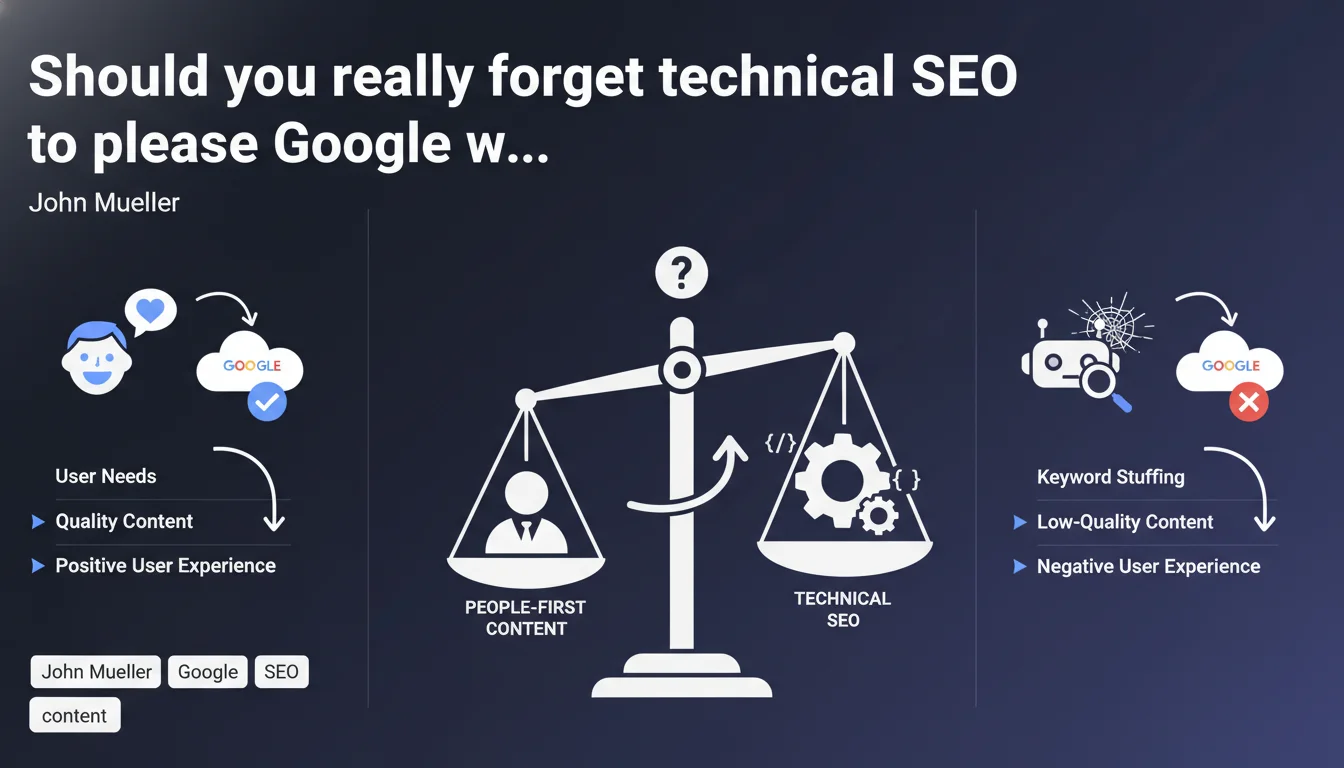
Google recommends creating 'people-first' content (user-centered) rather than 'search engine-first' content (optimized for engines first). John Mueller emphasizes this distinction, but the boundary between the two remains blurry in practice — content can be both useful AND optimized simultaneously.
What you need to understand
What exactly does 'people-first' mean in Google's vocabulary?
Google contrasts two content creation philosophies. People-first content addresses a real user need first: it informs, solves a problem, delivers value without worrying about rankings. Conversely, search engine-first content is designed to manipulate algorithms — keyword stuffing, artificial length, topics chosen purely for traffic potential.
The nuance? Good SEO content does both simultaneously. It responds to search intent (people-first) while respecting technical best practices (structure, markup, internal linking). Google isn't saying to ignore SEO — it's saying don't let SEO dictate your content's substance.
Why is Google pushing this distinction so hard right now?
Because the explosion of AI-generated content has amplified the problem of low-quality spam. Sites mass-produce articles optimized for lucrative queries with no real added value. The Helpful Content updates and successive Core Updates specifically target these practices.
Google wants creators to think about the 'why' before the 'how to rank.' It's a strategic directive as much as an algorithmic one — a way to reframe the SEO industry that has sometimes drifted toward pure optimization at the expense of usefulness.
Does this recommendation contradict established SEO practices?
No, it reframes them. Well-structured SEO content (H1-H6 headings, semantic markup, internal linking) remains essential. What Google criticizes is content creation solely motivated by SEO: 2,000-word articles without substance, mechanical repetition of keyword variations, topics with no real relevance to your audience.
The distinction often comes down to initial intent. If you ask yourself 'what would truly help my users?' before 'which keyword has the best volume/difficulty?', you're people-first. The reverse is search engine-first.
- People-first: start with a real user need, then optimize discoverability
- Search engine-first: target lucrative queries, then mechanically fill in content
- Good SEO practices (structure, tags, UX) remain compatible with people-first
- Google primarily targets mass-generated content with no added value
SEO Expert opinion
Is this statement consistent with what we actually see in the SERPs?
Only partially. Google says it prioritizes people-first, but in many competitive niches, top-ranking sites are clearly aggressively optimized — not always to the user's benefit. Endless articles with 10 paragraphs of preamble before the answer, subtle keyword stuffing, content calibrated to capture featured snippets.
Reality? The algorithm still often rewards volume, freshness, and authority more than true usefulness. A niche site with exceptional content but few backlinks will struggle against an authoritative domain pumping out mediocre content at scale. [To verify]: Google claims to detect search engine-first content, but the exact metrics remain opaque.
What nuances should we add to this recommendation?
Let's be honest: there are contexts where SEO optimization legitimately takes priority. An e-commerce category page must structure its filters and descriptions to rank — user experience also depends on discoverability. A technical content hub (documentation, tutorials) can benefit from a very SEO-friendly structure without harming quality.
The problem emerges when SEO becomes the only justification for content. Classic example: publishing 50 articles on variations of the same topic just to cover long-tail keywords, when one comprehensive article would better serve the user. Or creating auto-generated 'city + service' pages without genuine local value.
When does this rule not really apply?
On purely informational queries where intent is fuzzy, the most comprehensive and well-structured content often wins — even if verbose. Google prefers a well-organized 3,000-word guide to a concise but incomplete answer, especially when the user seeks a complete overview.
For transactional queries (e-commerce, SaaS), UX and commercial signals (reviews, pricing, availability) matter as much as 'content quality' in the editorial sense. A well-specified product with clear specs often beats a long unnecessary descriptive article.
Practical impact and recommendations
What should you concretely do to align your content with this recommendation?
First, audit your existing content with a critical filter: 'Would this content exist if Google didn't exist?' If the answer is no — if the article only serves to capture organic traffic without real value — it's a candidate for rewriting or deletion.
Next, reverse your creation process. Start with real user intent, not keywords. Interview your customers, analyze recurring support questions, identify gaps in your niche. Then optimize the discoverability of this useful content — don't create content just to optimize.
What mistakes should you avoid to not fall into 'search engine-first' territory?
Avoid producing content solely because an SEO tool tells you the query has good volume/difficulty. If you have nothing original or useful to add, skip it — or find a differentiating angle.
Beware of overly rigid content templates: 'Intro 150 words + 5 H2 sections + FAQ + conclusion.' This mechanical approach often produces predictable filler. Let structure emerge from the subject, not from an SEO template.
Eliminate flagrant practices: keyword stuffing, artificial keyword variation repetition, artificially inflated length without substance, mass-generated content without editorial oversight. Google increasingly detects these patterns — and Core Updates regularly penalize them.
How can you verify your site follows a people-first approach?
Test your content with real users (not just SEOs). Do they find the information they need quickly? Do they find the content helpful, or verbose and frustrating? Time on page and scroll depth aren't enough — a long article can retain without satisfying.
Analyze your engagement metrics: bounce rate, pages per session, conversions if applicable. Truly people-first content generates quality engagement — shares, natural backlinks, positive feedback, superior conversion rates.
- Audit existing content: delete or rebuild what only has SEO value
- Start with real user intent before target keyword
- Avoid rigid templates — adapt structure to the subject
- Ban keyword stuffing, artificial length, mass production
- Test with real users, not just SEO metrics analysis
- Prioritize quality engagement (shares, natural backlinks, conversions)
❓ Frequently Asked Questions
Un contenu optimisé SEO est-il forcément « search engine-first » ?
Google pénalise-t-il activement le contenu « search engine-first » ?
Comment savoir si mon article est vraiment utile ou juste optimisé ?
Peut-on encore cibler des mots-clés précis dans une logique people-first ?
Les pages catégories e-commerce sont-elles concernées par cette recommandation ?
🎥 From the same video 13
Other SEO insights extracted from this same Google Search Central video · published on 28/09/2022
🎥 Watch the full video on YouTube →
💬 Comments (0)
Be the first to comment.