
Official statement
Other statements from this video 13 ▾
- □ Les données structurées pros/cons dans les avis vont-elles changer la donne en SERP ?
- □ Le nouveau rapport Merchant Listings de Search Console change-t-il la donne pour l'e-commerce ?
- □ Le Helpful Content Update pénalise-t-il vraiment tout le site ou juste certaines pages ?
- □ Faut-il vraiment oublier le SEO technique pour plaire à Google avec du contenu « people-first » ?
- □ Pourquoi le Helpful Content Update ne ciblait-il initialement que l'anglais ?
- □ Pourquoi Google maintient-il une page dédiée au suivi des mises à jour de ranking ?
- □ Comment utiliser le nouveau rapport Video Indexing de Search Console pour débloquer vos vidéos ?
- □ Comment exploiter les nouvelles données vidéo de l'outil d'inspection d'URL ?
- □ Le rapport HTTPS de Search Console peut-il vraiment booster votre ranking ?
- □ Search Console simplifie sa classification : faut-il revoir votre méthode de priorisation ?
- □ Search Console va-t-elle vraiment abandonner le ciblage géographique ?
- □ Googlebot impose-t-il vraiment une limite de 15 Mo au crawl HTML ?
- □ Comment optimiser vos feeds pour la fonctionnalité Follow de Google Discover ?
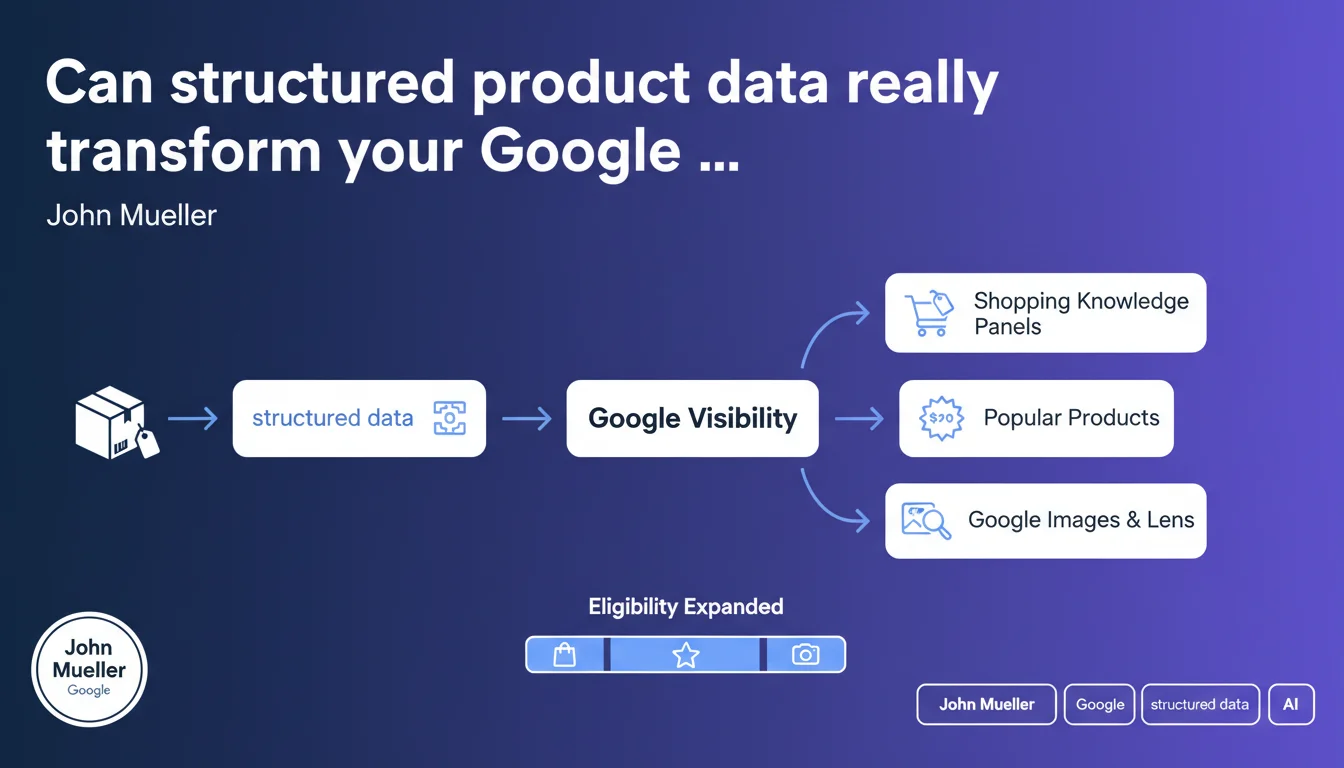
Google is expanding eligibility for certain product experiences based on structured data. In practical terms, more websites can now access shopping knowledge panels, "popular products" blocks, and enhanced features in Google Images and Lens. The stakes: capture these premium placements before they become exclusive to e-commerce giants.
What you need to understand
What's actually changing for product display?
Google is opening up access to enriched experiences that were previously reserved for a limited number of sites. Shopping knowledge panels, those detailed cards that appear on certain product queries, are becoming accessible to more merchants.
The "popular products" blocks and features in Google Images and Lens follow the same logic. If your structured data is properly implemented, you're in the game — even without being Amazon.
Why is Google expanding eligibility now?
The multiplication of product data sources forces Google to diversify its display surfaces. The search engine needs reliable structured data to feed its recommendation systems and visual interfaces.
By opening access, Google encourages e-commerce sites to standardize their markup. It's a win-win: better user experience, more exploitable data for the algorithm.
What are the immediate implications for an e-commerce site?
If your product structured data is already in place and valid, you might see these new features appear without additional action. But watch out: "eligible" doesn't mean "guaranteed".
Google remains in control of the trigger. Data quality, information consistency, site trustworthiness — everything counts. Poorly implemented structured data or contradictory information, and you stay on the sidelines.
- Expanded eligibility: more sites can now access enriched product experiences
- Affected features: shopping knowledge panels, popular products, Google Images, Lens
- Requirements: valid Product structured data consistent with page content
- No guarantee: eligibility doesn't automatically trigger display; Google decides case-by-case
SEO Expert opinion
Is this announcement consistent with what we're seeing in the field?
Yes and no. We're definitely seeing a multiplication of enriched product blocks in SERPs, even for mid-sized sites. But the eligibility criteria remain opaque.
Some merchants with impeccable structured data see no changes, while others — sometimes with sloppy markup — appear in knowledge panels. [To verify]: what are the real triggering thresholds? Google provides no metrics, no KPIs.
What nuances should be added to this claim?
The announcement speaks of "expanded eligibility," not general rollout. The distinction is crucial. Being eligible means entering the general pool, not securing a guaranteed spot.
We also observe that these features are highly sensitive to product categories. Some sectors (tech, fashion) benefit from systematic display, others (B2B, niche) remain invisible despite perfect markup. Google favors verticals with high search volume — commercial logic dictates this.
In what cases does this rule not apply?
If your site isn't a merchant in the strict sense — price comparators without transactions, pure affiliates, aggregators — you probably stay out of the game. Google favors direct sellers for these features.
Another case: sites with a history of spam or abusive structured data. Google has an elephant's memory. If you've stuffed your pages with fabricated schema.org in the past, eligibility will remain theoretical.
Practical impact and recommendations
What do you concretely need to do to benefit from this?
First, audit your existing Product structured data. Use Google's Rich Results Test, verify consistency between markup and visible content. No fake prices, no dishonest availability.
Then, enrich to the maximum: high-definition images, customer reviews with markup (Review, AggregateRating), real-time stock data. The more complete and reliable your structured data, the better your chances of triggering.
What mistakes should you absolutely avoid?
Don't markup products that don't actually exist on the page. Google cross-references signals: if your schema.org announces product X but the content discusses something else, you blow your credibility for a long time.
Also avoid duplicating structured data across similar pages without adapting the properties. Each product should have its own unique and consistent markup. Poorly configured templates that clone the same data everywhere will kill your eligibility.
How do you verify that your site is actually benefiting from these new features?
Monitor Google Search Console, go to "Enhancements" then "Products". If your rich results impressions spike dramatically, that's a good sign. Cross-reference with SERP monitoring tools (SERPWatcher, SEMrush, etc.) to see if your product cards appear in enriched blocks.
Watch out for the trap: an increase in impressions doesn't guarantee more clicks. If the knowledge panel directly answers the intent, traffic can stall or drop. Analyze your product CTR one by one.
- Validate your Product structured data with the Rich Results Test
- Enrich to the maximum: images, reviews, stock, current pricing
- Ensure perfect consistency between markup and visible content
- Avoid duplicating schema.org across similar products
- Monitor "Product Enhancements" in Search Console
- Track CTR evolution after enriched blocks appear
- Test target queries in private browsing to observe triggers
❓ Frequently Asked Questions
Tous les sites e-commerce peuvent-ils désormais apparaître dans les shopping knowledge panels ?
Faut-il ajouter de nouveaux types de structured data pour bénéficier de ces fonctionnalités ?
Les blocs enrichis produits peuvent-ils cannibaliser le trafic organique classique ?
Google Images et Lens utilisent-ils les mêmes structured data que la Search classique ?
Combien de temps faut-il pour voir apparaître ces nouvelles fonctionnalités après avoir corrigé les structured data ?
🎥 From the same video 13
Other SEO insights extracted from this same Google Search Central video · published on 28/09/2022
🎥 Watch the full video on YouTube →
💬 Comments (0)
Be the first to comment.