
Official statement
Other statements from this video 13 ▾
- □ Will structured data pros/cons in reviews really change the game in search results?
- □ Can structured product data really transform your Google visibility?
- □ Is Google's new Merchant Listings report a game-changer for e-commerce SEO?
- □ Does the Helpful Content Update really penalize your entire site, or just problem pages?
- □ Should you really forget technical SEO to please Google with 'people-first' content?
- □ Why did Google roll out the Helpful Content Update exclusively in English at first?
- □ Why does Google finally maintain a dedicated page to track ranking algorithm updates?
- □ How can you unlock your videos with Google's new Video Indexing Report in Search Console?
- □ How can you leverage the new video data in Google's URL Inspection Tool to boost your rankings?
- □ Can Google's new HTTPS report really prevent your rankings from dropping?
- □ Is Google's Search Console classification update changing how you should prioritize your SEO tasks?
- □ Does Google really enforce a strict 15 MB HTML crawl limit per page?
- □ How can you optimize your feeds to make the most of Google Discover's Follow feature?
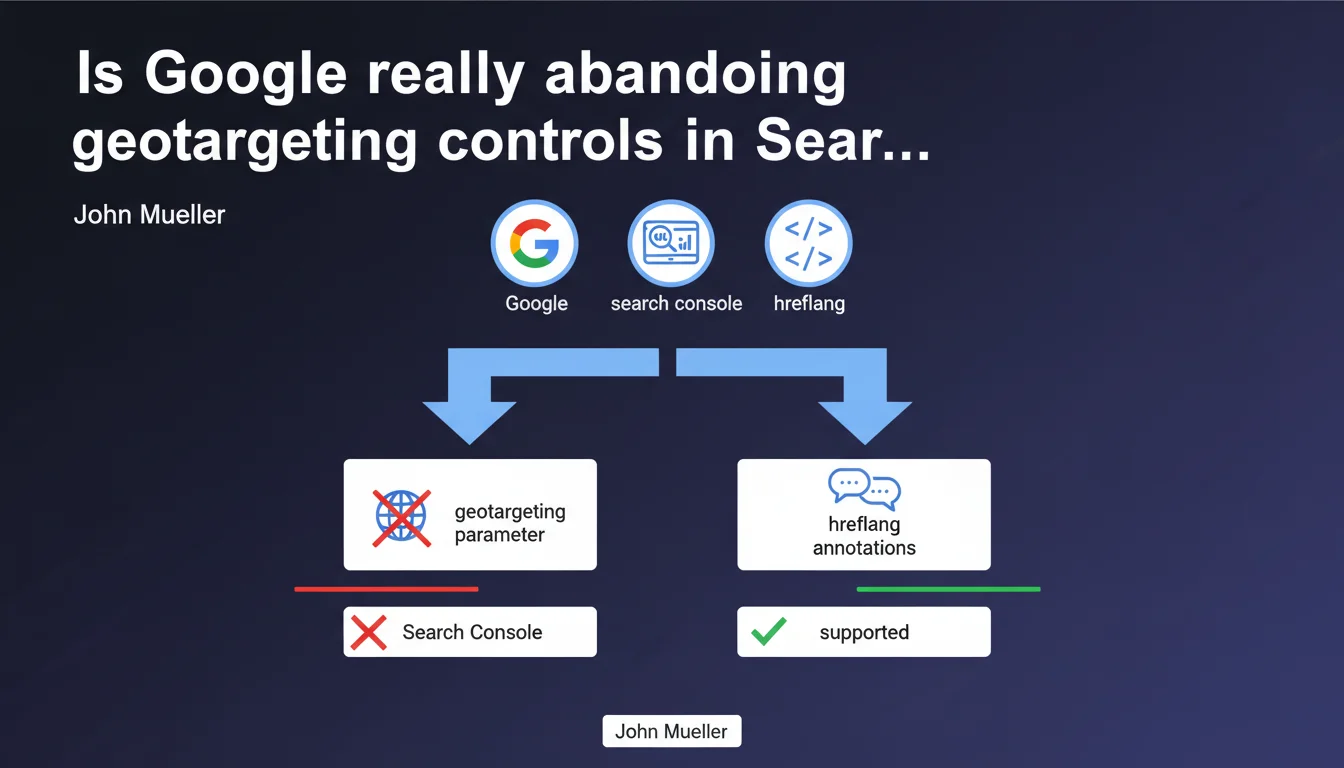
Google is removing the geotargeting parameter and hreflang report from Search Console. Hreflang tags remain functional and considered by the algorithm — only the monitoring tools disappear. Concretely: less visibility into implementation errors, but no direct impact on international SEO.
What you need to understand
Why is Google removing these Search Console tools?
Google has not provided a detailed explanation for this decision. The removal of the geotargeting parameter and hreflang report comes at a time when Search Console is constantly evolving, with certain tools being discontinued in favor of other features.
The geotargeting parameter allowed you to manually specify the target country for a generic domain (.com, .net, etc.). The hreflang report, meanwhile, listed errors detected in the implementation of multilingual annotations. These two features were not critical for algorithm functionality — they served primarily for diagnostics.
Do hreflang tags stop working?
No. This is the crucial point to understand: hreflang annotations continue to be supported by Google. The algorithm still reads them, interprets them, and uses them to determine which language or regional version to display in search results.
What disappears is solely visibility in Search Console. You will no longer see alerts if an hreflang tag is misconfigured, if URLs are orphaned, or if language clusters are incomplete. Diagnostics become your exclusive responsibility.
What happens to sites using the geotargeting parameter?
Sites with a generic extension (.com, .org, .net) that relied on this parameter to signal their geographic targeting lose this tool. Google will now have to deduce targeting from other signals: hosting, language content, local backlinks, physical address in legal notices.
For ccTLDs (.fr, .de, .co.uk), there is no change — geographic targeting is intrinsic to the domain name.
- Hreflang tags remain operational — only the diagnostic report disappears
- The manual geotargeting parameter in Search Console no longer exists
- Google relies on other signals to determine geographic targeting of generic domains
- No direct impact on rankings — this is an interface change, not an algorithm change
- The responsibility for quality control of hreflang implementations returns entirely to webmasters
SEO Expert opinion
Does this decision reflect Google's lack of interest in international SEO?
Not necessarily. Google has historically removed several Search Console tools that were redundant or had marginal usage. The geotargeting parameter was rarely modified once configured, and its real impact remained unclear — difficult to measure its weight against other geographic signals.
The hreflang report, on the other hand, was valuable. Its removal raises questions. Either Google believes webmasters now sufficiently master implementation, or maintaining this tool cost too much relative to its use. [To verify]: no public data on the actual usage rate of this report.
Should we expect indexation issues for multilingual sites?
No, if hreflang implementation was correct before the announcement. The algorithm has not changed — only the monitoring layer is disappearing. Errors that went unnoticed will continue to go unnoticed, and those that were visible in Search Console will need to be detected another way.
The real risk concerns sites that relied on the report to correct their errors continuously. Without this crutch, a faulty configuration can persist for months without being noticed. Third-party tools (Screaming Frog, OnCrawl, SEMrush) become essential.
Is Google planning to replace these tools with something else?
Nothing has been announced. History shows that Google sometimes removes features without direct replacement — see the disappearance of the bulk disavow tool, detailed AMP report, or keyword data in Search Console.
It's possible that Google will eventually integrate hreflang error detection into the "Coverage" or "Page Experience" report, but that's pure speculation. For now, quality control responsibility has been transferred to webmasters.
Practical impact and recommendations
What should you do concretely before removal?
If you are still using the geotargeting parameter, document the target country you had configured. Verify that other signals confirm this targeting: content language, hosting location, backlinks from sites in the target country, physical address in legal notices.
For multilingual sites, export data from the hreflang report while it is still accessible. Correct all errors listed — this is your last chance to get free and direct diagnosis from Google.
How to audit your hreflang implementation without Search Console?
Third-party tools become mandatory. Screaming Frog detects common hreflang errors: orphaned tags, loops, missing URLs, targeting conflicts. OnCrawl and SEMrush offer more advanced audits, particularly on complex structures.
Manual verification remains possible for small sites: each URL with hreflang must point to all its language alternatives, and each alternative must point back (reciprocity principle). x-default tags must be consistent.
What errors should you avoid in this context?
Don't remove your hreflang tags on the grounds that the report is disappearing. They remain functional and essential for correct international SEO. Don't rely on Google to automatically detect language versions either — without hreflang, you risk duplicate content and cannibalization between versions.
Avoid neglecting alternative geographic signals if you lose the geotargeting parameter. A .com site targeting France must display clear signals: French language, legal notices with FR address, backlinks from .fr sites, possibly European hosting.
- Export hreflang report data before its final removal
- Correct all errors reported in Search Console
- Audit hreflang implementation with a third-party tool (Screaming Frog minimum)
- Verify reciprocity of tags between all language versions
- Document geographic targeting for generic domains (.com, .net)
- Strengthen alternative geographic signals (content, backlinks, legal notices)
- Establish regular monitoring of hreflang errors via third-party tools
- Test display of language versions in SERPs from different countries
❓ Frequently Asked Questions
Les balises hreflang vont-elles cesser de fonctionner après cette suppression ?
Comment détecter les erreurs hreflang sans le rapport Search Console ?
Mon site .com ciblait la France via le paramètre de géociblage — que faire maintenant ?
Cette suppression impacte-t-elle les sites avec un ccTLD (.fr, .de, .co.uk) ?
Faut-il auditer mon implémentation hreflang dès maintenant ?
🎥 From the same video 13
Other SEO insights extracted from this same Google Search Central video · published on 28/09/2022
🎥 Watch the full video on YouTube →
💬 Comments (0)
Be the first to comment.