
Official statement
Other statements from this video 13 ▾
- □ Les données structurées produits peuvent-elles vraiment transformer votre visibilité Google ?
- □ Le nouveau rapport Merchant Listings de Search Console change-t-il la donne pour l'e-commerce ?
- □ Le Helpful Content Update pénalise-t-il vraiment tout le site ou juste certaines pages ?
- □ Faut-il vraiment oublier le SEO technique pour plaire à Google avec du contenu « people-first » ?
- □ Pourquoi le Helpful Content Update ne ciblait-il initialement que l'anglais ?
- □ Pourquoi Google maintient-il une page dédiée au suivi des mises à jour de ranking ?
- □ Comment utiliser le nouveau rapport Video Indexing de Search Console pour débloquer vos vidéos ?
- □ Comment exploiter les nouvelles données vidéo de l'outil d'inspection d'URL ?
- □ Le rapport HTTPS de Search Console peut-il vraiment booster votre ranking ?
- □ Search Console simplifie sa classification : faut-il revoir votre méthode de priorisation ?
- □ Search Console va-t-elle vraiment abandonner le ciblage géographique ?
- □ Googlebot impose-t-il vraiment une limite de 15 Mo au crawl HTML ?
- □ Comment optimiser vos feeds pour la fonctionnalité Follow de Google Discover ?
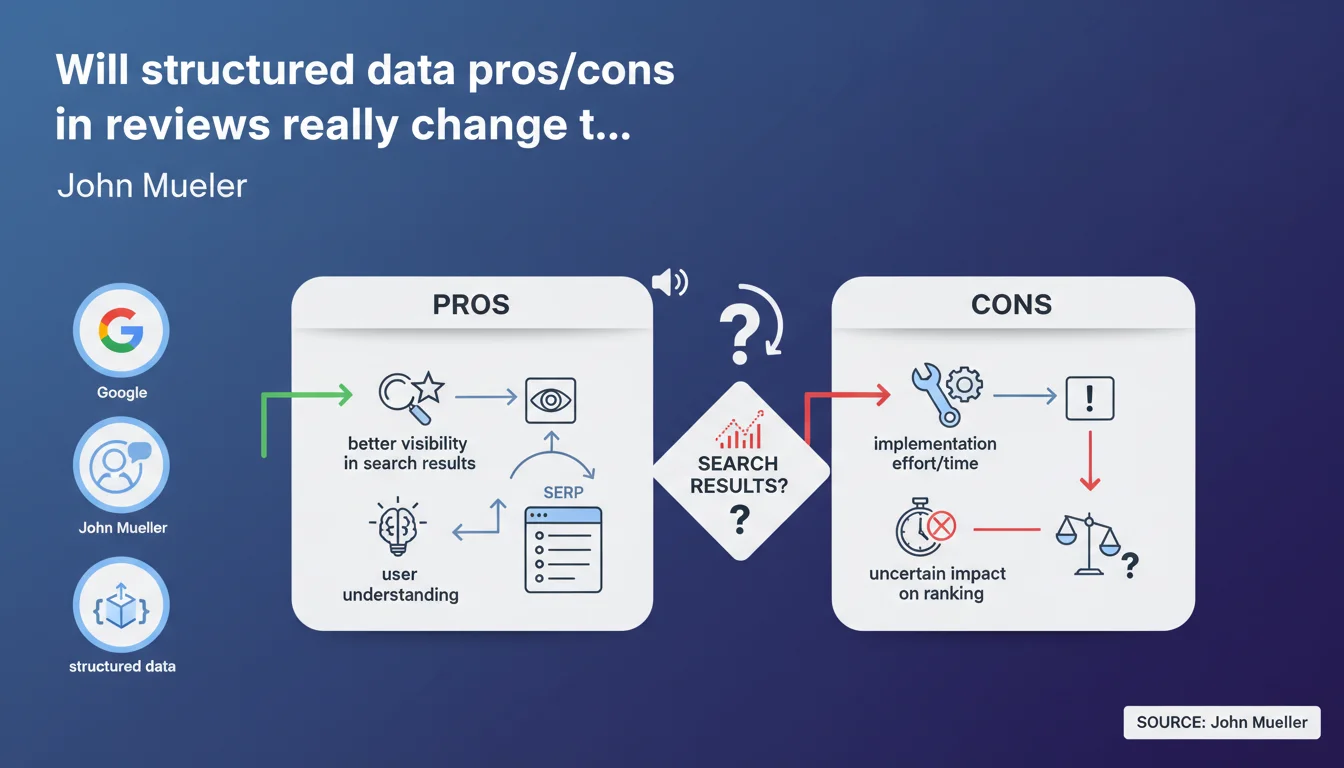
Google now supports structured data markup to display advantages and disadvantages (pros/cons) directly in review snippets. This annotation allows users to see a high-level summary without clicking — which can boost your CTR as much as it can cannibalize it if the snippet is enough for the user. The challenge: capture attention in search results while driving clicks.
What you need to understand
What does this new pros/cons markup actually change?
Google is enriching its search results by displaying the strengths and weaknesses of a product or service mentioned in a review directly in the snippet. Instead of simple text excerpt, the user sees a structured summary: a list of advantages and disadvantages, clearly separated.
On the crawl side, nothing changes — Google continues to read your pages. The difference? It can now identify and extract these elements if you mark them up correctly with the dedicated Schema.org vocabulary. Without this markup, your pros/cons remain plain text, buried in the content.
Why is Google pushing this format now?
The answer comes down to one word: user experience. The internet user looking for a review wants a quick overview, without scrolling. Displaying pros and cons in search results reduces friction — and conveniently keeps the user in Google's ecosystem longer.
For publisher sites, it's a double-edged sword. Your content gains visibility, but part of its value is consumed before the click. Hence the importance of carefully crafting the wording of these points to entice further exploration.
What types of content are affected?
Mainly product reviews, comparative tests, service reviews. If you publish content like "Our review of X", "Complete test of Y", you're on the front line. E-commerce sites with customer review sections can also benefit, provided they structure these feedback properly.
- Editorial reviews: test/review articles written by your team
- User reviews: customer comments if you aggregate them in a structured manner
- Comparisons: tables or lists of advantages/disadvantages in a comprehensive article
- Excluded: general opinion content without a specific product/service (e.g., blog post about a trend)
SEO Expert opinion
Will this feature really impact CTR?
Let's be honest: we still lack real-world data to settle this. Google just rolled out this support. But past experience with other rich snippets (FAQ, HowTo, Recipes) shows two possible scenarios.
Optimistic scenario: your results take up more vertical space, catch the eye, and your CTR climbs. Pessimistic scenario: the user reads your pros/cons directly in the search results, feels they have the information they need, and moves on. Click-through rate can stagnate or drop, even if your visibility increases. [To verify] on your own data once you've implemented the markup.
Do you really need to list all the disadvantages?
Here's a nuance that Mueller doesn't address, and it's a shame. Displaying a product's flaws in search results can discourage clicks before users even land on your page — especially if your competitors aren't using this markup and only show positive aspects.
On the other hand, a balanced review generates more trust. A 100% positive snippet sounds fake, especially for a complex product. The trick: phrase the cons factually, not as deal-breakers. "Learning curve requires some adaptation time" goes over better than "Catastrophic interface". And if your content only mentions advantages, don't force it — partial markup is better than fabricated markup.
Is this markup a priority compared to other structured data?
It depends on your business model. If you live off traffic from product review pages, yes, it's a priority. If your reviews are a secondary section of a service site, focus first on Organization, LocalBusiness, or FAQ depending on your audience.
Keep in mind that Google never guarantees the display of a rich snippet, even with perfect markup. Algorithms prioritize certain content based on the query, competition, and criteria we don't fully control. In other words: do the job right, but don't rely solely on this for visibility.
Practical impact and recommendations
How do you implement this markup in practice?
You need to use the Schema.org Review type vocabulary, adding the positiveNotes and negativeNotes properties. These properties accept a list of strings — each item corresponds to an advantage or disadvantage.
The markup goes in JSON-LD in the <head> or just before the closing </body> tag. Then verify with Google's Rich Results Test that your structure is recognized. If errors appear, fix them before rolling out at scale.
What mistakes should you avoid at all costs?
First common mistake: marking up invisible or truncated content. If the user lands on the page and can't find the pros/cons displayed in the search snippet, that's degraded user experience — and Google may deindex the markup.
Second trap: duplicating the same review across dozens of pages to artificially inflate rich snippets. Google detects these patterns and can ignore the markup or even apply a manual penalty. Each review must be unique and contextual to the page where it appears.
Third pitfall: failing to update markup when content changes. A product that gets a new version, a service that improves — your pros/cons must follow suit. Outdated markup damages your credibility and relevance.
What should you monitor after deployment?
- Check the appearance of rich snippets in Search Console (Enhancements > Reviews report)
- Monitor CTR before/after implementation to measure real impact
- Track any markup errors reported by Google (often related to missing or incorrectly formatted properties)
- Analyze bounce rate: if users arrive and leave immediately, it may be that the snippet in search results already answered their question
- Compare against competitors: who's already displaying this type of snippet on your target keywords?
❓ Frequently Asked Questions
Le balisage pros/cons fonctionne-t-il pour les avis clients agrégés ?
Dois-je obligatoirement lister autant de pros que de cons ?
Ce balisage peut-il remplacer les étoiles d'avis dans les snippets ?
Combien de temps avant que Google affiche mon rich snippet pros/cons ?
Puis-je baliser des avis en plusieurs langues sur la même page ?
🎥 From the same video 13
Other SEO insights extracted from this same Google Search Central video · published on 28/09/2022
🎥 Watch the full video on YouTube →
💬 Comments (0)
Be the first to comment.