
Official statement
Other statements from this video 13 ▾
- □ Will structured data pros/cons in reviews really change the game in search results?
- □ Can structured product data really transform your Google visibility?
- □ Is Google's new Merchant Listings report a game-changer for e-commerce SEO?
- □ Does the Helpful Content Update really penalize your entire site, or just problem pages?
- □ Should you really forget technical SEO to please Google with 'people-first' content?
- □ Why did Google roll out the Helpful Content Update exclusively in English at first?
- □ Why does Google finally maintain a dedicated page to track ranking algorithm updates?
- □ How can you unlock your videos with Google's new Video Indexing Report in Search Console?
- □ How can you leverage the new video data in Google's URL Inspection Tool to boost your rankings?
- □ Can Google's new HTTPS report really prevent your rankings from dropping?
- □ Is Google's Search Console classification update changing how you should prioritize your SEO tasks?
- □ Is Google really abandoning geotargeting controls in Search Console?
- □ Does Google really enforce a strict 15 MB HTML crawl limit per page?
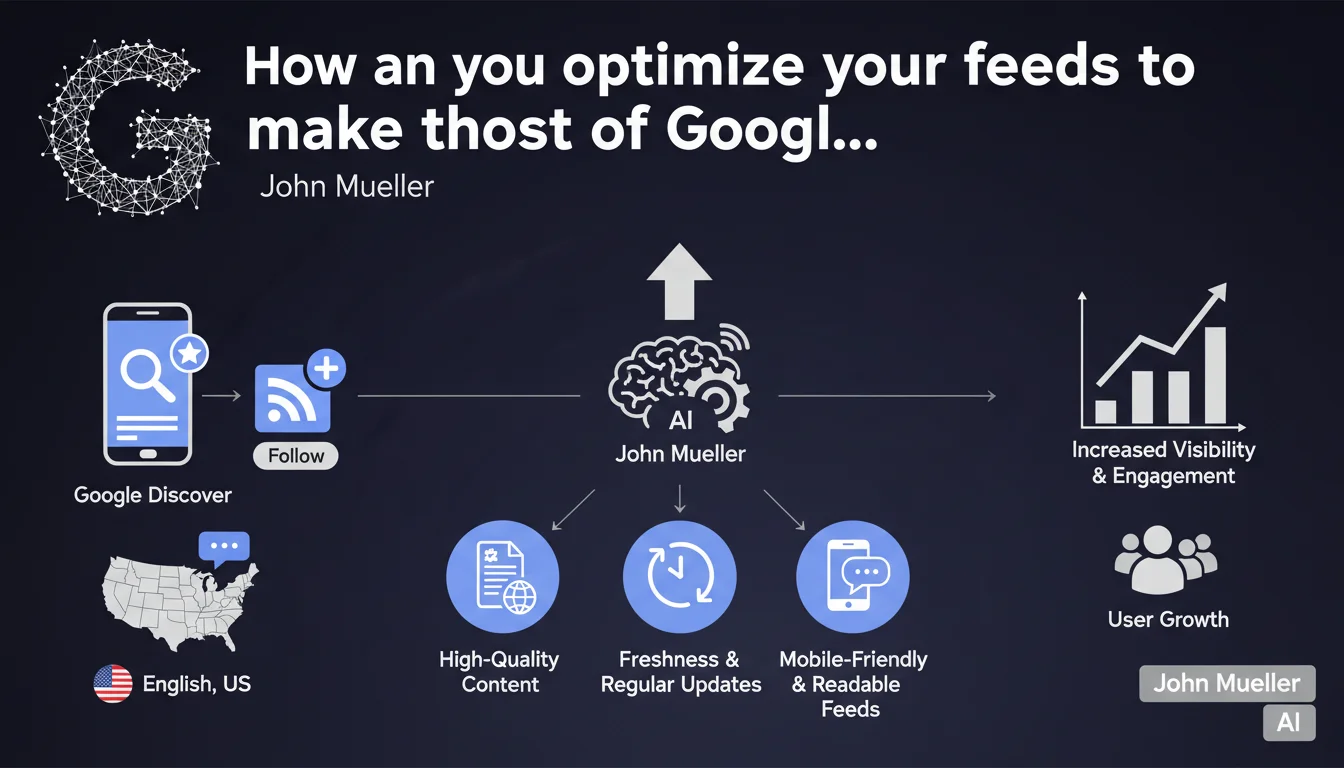
Google has published technical recommendations for structuring RSS/Atom feeds intended for the Follow feature in Discover. This feature, currently available only in English in the United States, allows users to subscribe directly to sites from the Google app. Best practices focus on XML structure, update frequency, and editorial consistency.
What you need to understand
What exactly is the Follow feature in Google Discover?
Follow is a subscription option built into Google Discover that lets users add a site to their personalized feed. Unlike the classic algorithmic feed, this feature guarantees that content from a publisher will consistently appear in their subscribers' feeds.
The mechanism relies on an RSS or Atom feed that Google crawls on a regular basis. This approach is fundamentally different from how traditional Discover works, where the algorithm solely decides what content deserves to be displayed.
Why does Google enforce specific best practices?
Google's goal is to preserve the user experience within Discover. A poorly structured feed or one filled with spam would degrade feed quality and push users to unsubscribe — weakening adoption of the feature.
The guidelines cover three main areas: technical feed structure, publishing frequency, and thematic consistency. Google wants to prevent sites from exploiting Follow to push off-topic or over-optimized content.
What are the key takeaways you should remember?
- The Follow feature is limited geographically (United States) and linguistically (English) for now
- A valid RSS/Atom feed is required — no proprietary formats or approximate structures
- Google prioritizes editorial consistency: feed content must match the declared topic of your site
- Update frequency should be reasonable — neither too aggressive (spam) nor too sparse (leading to unsubscribes)
- Metadata (titles, descriptions, images) must be descriptive and accurate, not clickbait
SEO Expert opinion
Is this guidance consistent with what we observe on Discover?
Overall, yes. Google has applied a editorial quality logic on Discover for years, and Follow is no exception. Sites that perform well in the classic feed — established media, specialized press — will be the ones benefiting most from Follow.
But there's a paradox. Discover runs on an opaque algorithm that favors sensationalism and short-form content, while Follow relies on an explicit subscription that should theoretically reward loyalty and depth. Google's guidelines don't resolve this ambiguity — they remain vague on what constitutes a "good" feed. [Needs verification]
What are the gray areas in this announcement?
Google doesn't specify the eligibility criteria for appearing in Follow. Can any site with an RSS feed be followed? Do you first need an established presence in classic Discover? There's no clear answer.
Another point: the crawl frequency of feeds. Google mentions you need to "update regularly," but without providing specific numbers. One article per day? Five? Twenty? This lack of benchmark makes optimization difficult. [Needs verification]
When is this feature's value proposition actually limited?
Let's be honest: Follow currently only applies to a narrow geographic (United States) and linguistic niche (English). For a French-language or European site, the impact is zero in the short term.
Even for eligible sites, Follow doesn't replace a classic SEO strategy. It's a complementary channel, not a primary traffic source. Subscriber volumes remain small compared to the reach of Discover's algorithmic feed.
Practical impact and recommendations
What concrete steps should you take to optimize your feed?
First step: audit the technical structure of your RSS/Atom feed. Use a validator (Feed Validator, Podbase) to spot XML errors, missing tags, or encoding issues. An invalid feed simply won't be crawled by Google.
Next, check thematic consistency. If your site covers SEO, don't push articles about cryptocurrency or personal finance in your feed. Google detects these inconsistencies and may penalize or deindex your feed.
Optimize your metadata: explicit titles (no clickbait), accurate descriptions, high-resolution images (minimum 1200x675px per AMP specs). These elements directly influence click-through rates in Discover.
What mistakes must you avoid at all costs?
Don't overload your feed. Publishing 50 articles per day will overwhelm subscribers and cause mass unsubscriptions. Google monitors these metrics and can downgrade or blacklist aggressive feeds.
Avoid duplicate content. If every article in your feed already exists under three different URLs (AMP, mobile, desktop), Google may filter your feed for spam. Consolidate your canonicals and use one URL per piece of content.
Don't neglect update frequency. A feed that stays inactive for weeks signals disengagement. Maintain a consistent publishing rhythm, even if modest (1-2 articles/week minimum).
How can you verify your site complies with the guidelines?
- Validate your RSS/Atom feed with a third-party tool (W3C Feed Validation Service)
- Verify each entry contains: title, description, canonical URL, image, publication date
- Ensure images meet AMP specs (16:9 ratio, resolution ≥1200px wide)
- Check editorial consistency: all articles must align with your site's declared topic
- Monitor feed crawl frequency via server logs or Google Search Console
- Test display in the Google app on a US device in English (VPN + language change)
❓ Frequently Asked Questions
La fonctionnalité Follow est-elle disponible en France ?
Faut-il un feed RSS spécifique pour Follow ou le flux principal suffit-il ?
Quel impact Follow a-t-il sur le trafic comparé au flux algorithmique de Discover ?
Google peut-il retirer l'accès à Follow arbitrairement ?
Les images du feed doivent-elles respecter les specs AMP ?
🎥 From the same video 13
Other SEO insights extracted from this same Google Search Central video · published on 28/09/2022
🎥 Watch the full video on YouTube →
💬 Comments (0)
Be the first to comment.