
Official statement
Other statements from this video 13 ▾
- □ Les données structurées pros/cons dans les avis vont-elles changer la donne en SERP ?
- □ Les données structurées produits peuvent-elles vraiment transformer votre visibilité Google ?
- □ Le nouveau rapport Merchant Listings de Search Console change-t-il la donne pour l'e-commerce ?
- □ Le Helpful Content Update pénalise-t-il vraiment tout le site ou juste certaines pages ?
- □ Faut-il vraiment oublier le SEO technique pour plaire à Google avec du contenu « people-first » ?
- □ Pourquoi le Helpful Content Update ne ciblait-il initialement que l'anglais ?
- □ Pourquoi Google maintient-il une page dédiée au suivi des mises à jour de ranking ?
- □ Comment utiliser le nouveau rapport Video Indexing de Search Console pour débloquer vos vidéos ?
- □ Comment exploiter les nouvelles données vidéo de l'outil d'inspection d'URL ?
- □ Le rapport HTTPS de Search Console peut-il vraiment booster votre ranking ?
- □ Search Console va-t-elle vraiment abandonner le ciblage géographique ?
- □ Googlebot impose-t-il vraiment une limite de 15 Mo au crawl HTML ?
- □ Comment optimiser vos feeds pour la fonctionnalité Follow de Google Discover ?
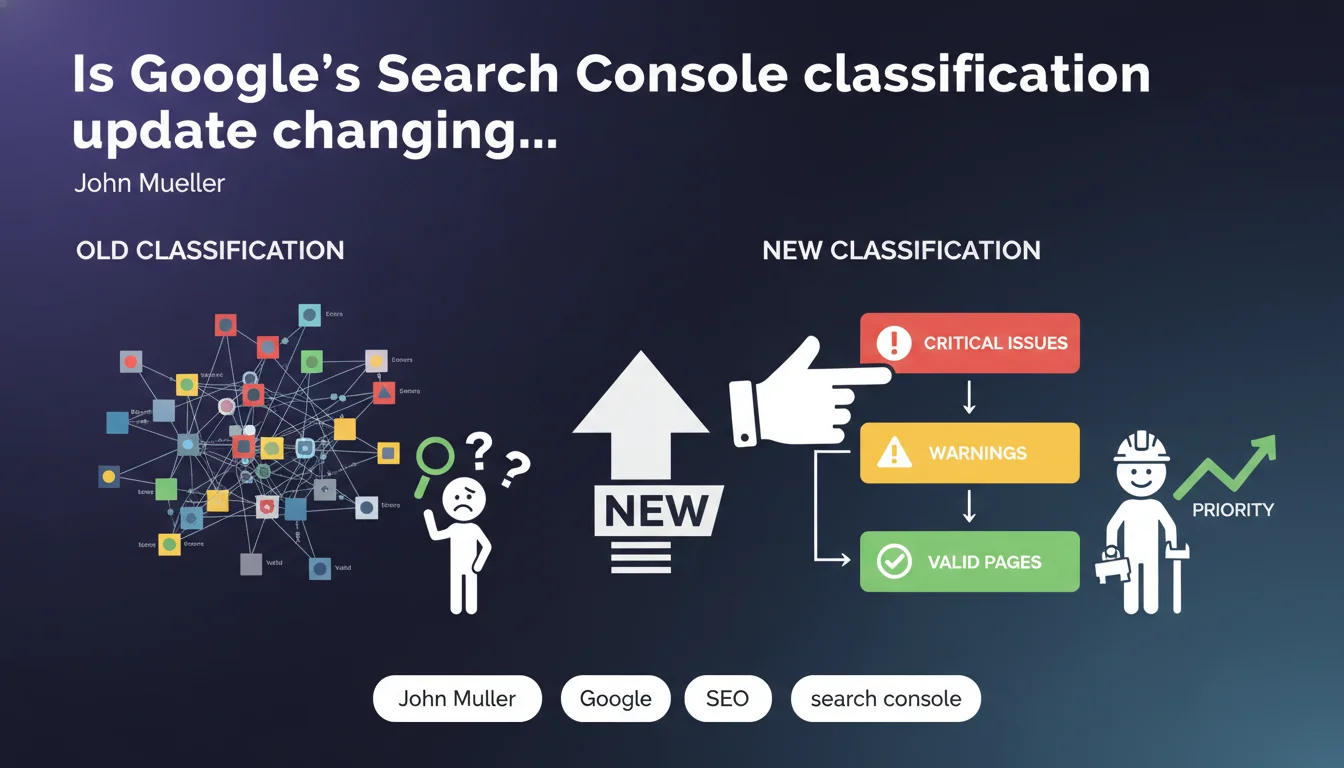
Google has overhauled page, element, and issue classification in Search Console to make it easier to identify critical problems. The goal: help SEO professionals prioritize actions that actually impact visibility. This evolution aims to reduce information noise and focus efforts on what truly matters.
What you need to understand
What's actually changing in Search Console?
Google has revamped how it categorizes pages, elements, and issues reported in Search Console. The interface now more clearly distinguishes critical alerts from secondary information.
The stated goal: prevent SEOs from getting lost in low-priority notifications while major structural issues affect indexation or crawling. This simplification should theoretically help identify high-impact actions more quickly.
Why is Google making this change now?
Search Console has long frustrated practitioners: too much disparate data, inconsistent granularity across reports, and difficulty isolating urgent issues. Google is finally responding to recurring feedback from the field.
The platform is also evolving with the ecosystem: more complex sites, JavaScript frameworks, Core Web Vitals... The volume of potential information has exploded. Simplification was necessary to keep the tool actionable.
- Reduced information noise in coverage and indexation reports
- Clearer hierarchy between critical errors, warnings, and neutral statuses
- Better readability for prioritizing technical fixes
- Progressive alignment with professional SEO audit tool standards
SEO Expert opinion
Does this simplification actually change the game?
On paper, the intention is sound. In practice, everything depends on actual implementation. Google has already tried to « simplify » Search Console several times — with mixed results. [To be verified]: are we really gaining clarity or is this just cosmetic reorganization?
Experienced SEOs know that a Search Console alert doesn't automatically mean a business problem. Conversely, some sites suffer from structural defects that GSC doesn't clearly flag. Simplification doesn't replace critical analysis.
What are the limitations of this approach?
Google classifies issues according to its own hierarchy of importance, not necessarily yours. An e-commerce site with 10,000 product variants marked as « Excluded — duplicate » might have a legitimate strategic issue, not a blind correction error.
Similarly, issues classified as « non-critical » by GSC can have major business impact depending on your model: poorly managed pagination on a media blog, filtered facets mishandled on a marketplace, etc.
Is this change part of a larger trend?
Yes. Google has been pushing for standardization of best practices for several years: Core Web Vitals, mandatory structured data for certain rich results, increasingly precise technical guidelines.
This GSC simplification aligns with this logic: guiding webmasters down a « marked path » rather than letting them drown in complexity. It's convenient for beginners, potentially limiting for advanced strategies.
Practical impact and recommendations
What should you do right now?
Start by familiarizing yourself with the updated Search Console interface. Explore the new labels, issue categorization, and compare with your old reports to understand what has changed.
Next, perform a reprioritization audit: are issues you had queued now classified as critical? Conversely, is what you were treating urgently now lower in the hierarchy?
How do you adjust your monitoring workflow?
Integrate this new classification into your alerts and dashboards. If you're using the Search Console API to automate reports, verify that taxonomy changes haven't broken your scripts.
Never rely exclusively on Google's classification. Maintain your own business criticality framework: which issues affect your strategic pages? Which signals degrade your qualified traffic?
- Review Coverage and Indexation reports with the new classification
- Identify issues reclassified as « critical » that weren't being addressed
- Verify that your automated alerts (email, Slack, etc.) still work correctly
- Cross-reference GSC data with your server logs and analytics tools
- Document the new taxonomy for your team or clients
- Reassess the prioritization of your SEO technical backlog
What strategy should you adopt long-term?
Use this simplification as a first-level filter, but never stop there. A high-performing site requires multi-source analysis: logs, internal crawl, behavioral data, A/B tests.
❓ Frequently Asked Questions
La nouvelle classification affecte-t-elle l'indexation réelle des pages ?
Dois-je revoir toutes mes corrections SEO déjà effectuées ?
Les anciens rapports sont-ils encore accessibles ?
Cette simplification impacte-t-elle l'API Search Console ?
Faut-il traiter en priorité tous les problèmes classés critiques ?
🎥 From the same video 13
Other SEO insights extracted from this same Google Search Central video · published on 28/09/2022
🎥 Watch the full video on YouTube →
💬 Comments (0)
Be the first to comment.