
Official statement
Other statements from this video 13 ▾
- □ Should you really be worried about your SEO provider?
- □ Should you really stop measuring SEO success by SERP positions?
- □ What questions should a competent SEO provider really be asking before diving in?
- □ Why should your SEO provider understand your business before optimizing your website?
- □ Why can't anyone guarantee your Google rankings?
- □ What are the real consequences when a website violates Google's guidelines?
- □ How can you verify that an SEO provider truly delivers sustainable, long-term results?
- □ Should you really embed SEO into your business strategy instead of treating it as just another acquisition channel?
- □ Should you grant your SEO provider complete Search Console access?
- □ Should you really trust an external provider to audit your site's SEO performance?
- □ Should you really optimize for users instead of Google?
- □ How can you accurately estimate SEO investment and measure real business impact from an audit?
- □ Should you really define precise objectives before launching an SEO strategy?
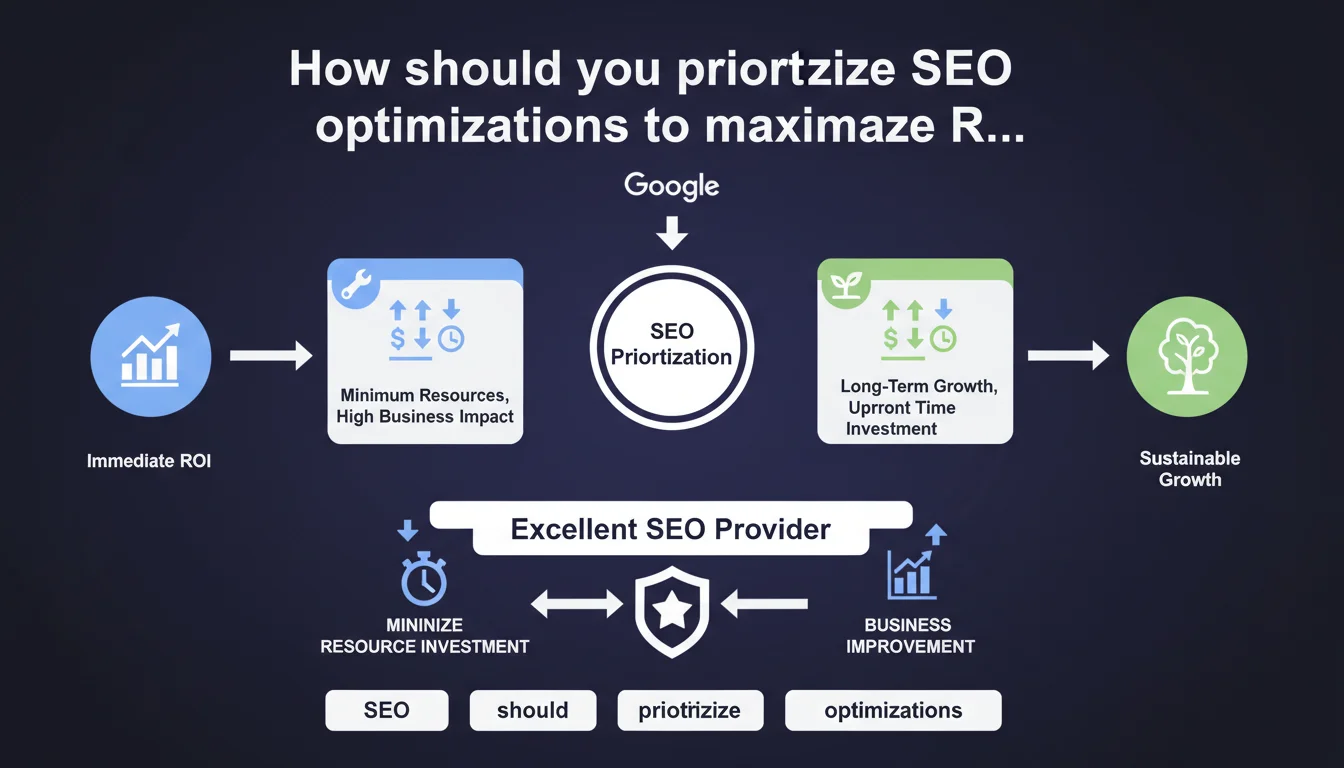
Google claims that a good SEO provider must prioritize low-resource actions while investing in structural improvements for long-term growth. This statement emphasizes the balance between quick wins and sustainable strategy—a classic discourse, but one that remains vague on concrete prioritization criteria.
What you need to understand
What does "low-resource" really mean in an SEO context?
Google is describing a permanent trade-off between costs and benefits here. Resources aren't just about financial budget—they include developer time, editorial effort, technical complexity, and implementation timelines.
A typical example of a low-resource quick win: fixing duplicate title tags across 50 pages with a simple script. Measurable potential impact, limited effort. By contrast, overhauling an entire 10,000-URL site architecture takes weeks—or even months—of cross-functional work.
Why does Google emphasize long-term growth?
The search engine has been pushing a logic of evergreen content and user experience for years. Cosmetic optimizations—keyword stuffing, aggressive link building—produce short-lived results and expose sites to penalties.
Structural improvements demand initial time investment but create a cumulative effect: internal linking overhauls, Core Web Vitals improvements, authoritative content production. These initiatives build a solid foundation that withstands algorithm updates.
Does a universal prioritization method exist?
No—and that's precisely what Google fails to clarify. Every site has its own context: SEO maturity, competitive landscape, available resources. A pure-play e-commerce platform won't have the same priorities as an editorial media outlet.
What works: an effort/impact matrix tailored to your context. But beware of bias: an action that's "easy" for a tech-savvy site can be a nightmare on a locked proprietary CMS.
- Resources = time, budget, technical skills, editorial effort
- Quick wins: simple technical fixes, rapid on-page optimizations
- Long-term: architecture overhaul, content strategy, UX improvement
- Prioritization: contextual cost/benefit analysis, no magic formula
- Balance: mix immediate actions with structural investments
SEO Expert opinion
Does this statement reflect real-world practice?
Yes and no. The principle is sound—but Google oversimplifies. On paper, everyone wants quick results without heavy investment. In reality, quick wins become scarce as a site gains SEO maturity.
An already well-optimized site has no more "low-hanging fruit." Marginal gains then demand disproportionate effort. Conversely, a neglected site is full of low-cost opportunities—making this statement highly context-dependent.
What nuances should we add to this narrative?
Google omits that certain "long" actions are actually essential and urgent. Example: a site with catastrophic loading times can't afford to "prioritize quick wins" while waiting for technical budget to arrive. The structural problem undermines everything else.
Another blind spot: the concept of SEO technical debt. Accumulating quick wins without addressing foundations creates growing fragility. Eventually, you must pay the bill—and it becomes exponentially more expensive.
[To verify]: Google provides no objective criteria for evaluating the effort/impact ratio. Each provider applies their own framework—and the methodological gaps between agencies are massive.
When does this logic become counterproductive?
When it serves as justification for inaction. Some clients interpret "low-resource" as "free and immediate." Result: they refuse any structural project because it "costs too much," while demanding results worthy of a complete overhaul.
Another trap: focusing only on vanity metrics. Mass-optimizing 200 meta descriptions may feel productive—but if the real problem is weak topical authority, impact will remain marginal.
Practical impact and recommendations
How do you concretely identify low-resource optimizations?
Start with a technical debt audit: 404 errors, redirect chains, duplicate content, missing tags. These fixes require minimal developer time but often generate immediate crawl efficiency gains.
Next, analyze high-potential underperforming pages: positions 6-15 on volume keywords. Targeted rewriting, a few additional internal backlinks, and you can push these pages to page one with limited effort.
What mistakes should you avoid in prioritization?
Never sacrifice strategic coherence for scattered actions. Fixing 10 unrelated minor issues consumes energy without building momentum.
Another classic mistake: underestimating the maintenance cost of quick wins. Automating a repetitive task takes upfront investment but saves dozens of hours over time. Sometimes the "slow" solution is fastest at a 12-month scale.
How do you balance short and long term in an action plan?
Apply the 70/20/10 rule: 70% of resources on structural foundations, 20% on tactical opportunities, 10% on experimentation. This ratio varies by context but prevents extremes.
Systematically document the measured impact of each action type. This refines your prioritization ability—and justifies heavy investments to decision-makers.
- Audit quick technical fixes (404s, redirects, tags)
- Identify page positions 6-15 on strategic keywords
- Build a contextual effort/impact matrix, not a generic one
- Avoid scattered actions: group optimizations by coherent theme
- Document gains from each optimization type to refine prioritization
- Plan 70% of time on structural work, 20% on tactical, 10% on experimentation
- Automate repetitive tasks even if initial investment is heavy
❓ Frequently Asked Questions
Qu'est-ce qu'une optimisation SEO « à faible ressource » concrètement ?
Comment savoir si je dois privilégier le court ou le long terme ?
Un audit SEO peut-il vraiment identifier les quick wins efficaces ?
Pourquoi certaines actions « faciles » ne donnent-elles aucun résultat ?
Faut-il systématiquement automatiser les tâches SEO répétitives ?
🎥 From the same video 13
Other SEO insights extracted from this same Google Search Central video · published on 24/02/2022
🎥 Watch the full video on YouTube →
💬 Comments (0)
Be the first to comment.