
Official statement
Other statements from this video 11 ▾
- □ Le H1 a-t-il vraiment l'impact SEO que Google prétend ?
- □ Pourquoi la Search Console est-elle la seule source de vérité sur votre performance réelle ?
- □ Le sitemap est-il vraiment indispensable pour le crawl de Google ?
- □ Google indexe-t-il vraiment le JavaScript aussi bien que le HTML classique ?
- □ Faut-il vraiment forcer le rendu côté serveur pour toutes les applications JavaScript ?
- □ Faut-il vraiment migrer ses microdata en JSON-LD pour les données structurées ?
- □ Combien de liens faut-il vraiment placer sur votre page d'accueil pour optimiser le crawl ?
- □ Pourquoi Google insiste-t-il sur la collaboration entre développeurs et SEO ?
- □ Pourquoi tester votre site sur différents navigateurs peut-il sauver votre SEO ?
- □ View Source et DevTools suffisent-ils vraiment pour diagnostiquer vos problèmes SEO ?
- □ Faut-il vraiment attendre un an avant d'évaluer les performances SEO d'un site saisonnier ?
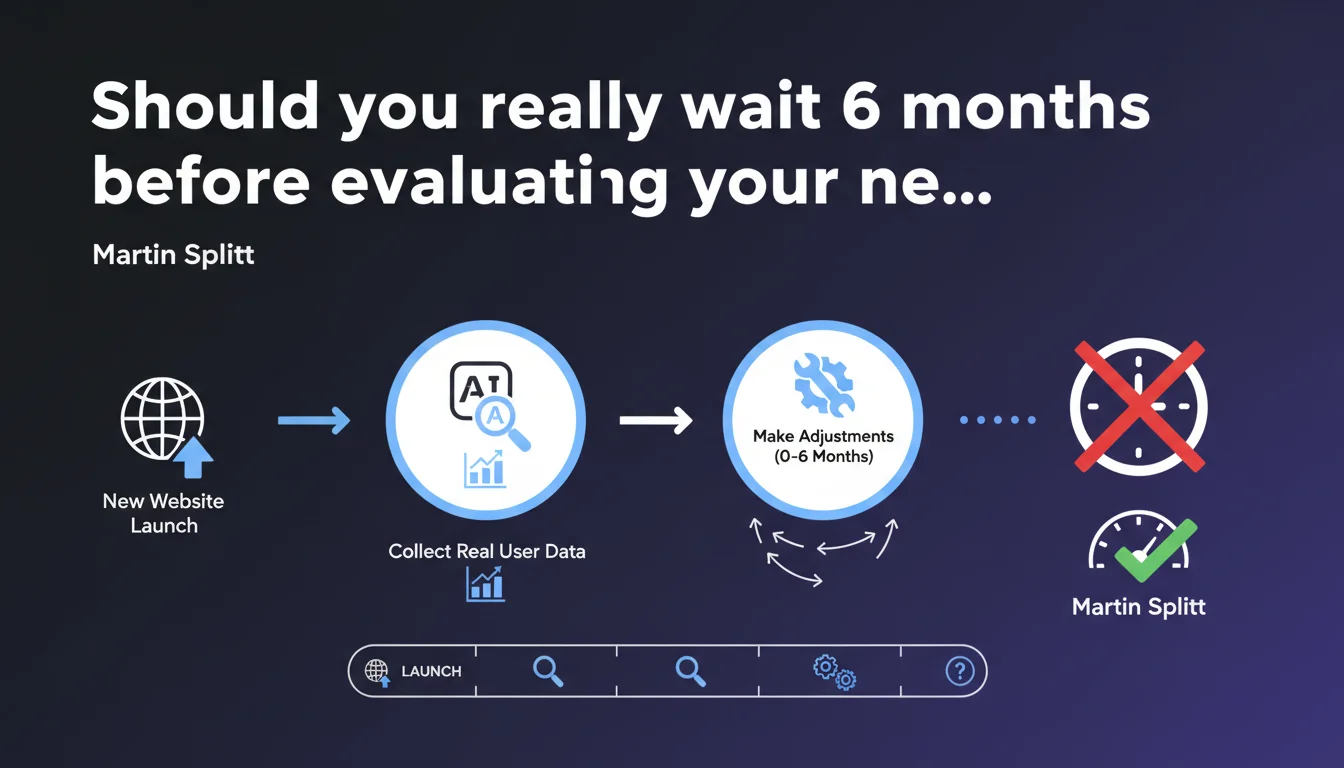
Martin Splitt confirms that a freshly launched website requires continuous adjustments for approximately six months, the time needed to accumulate sufficient real behavioral data. Initial performance does not reflect the final state — it's a learning period for both the algorithm and the SEO team.
What you need to understand
Why does Google mention this 6-month period?
When a website arrives on the web, Google has no historical data whatsoever: no click-through rates, no session duration, no user behavior on specific queries. The algorithm must therefore observe how internet users actually react to the content offered.
This observation phase allows Google to refine page positioning based on concrete behavioral signals. Content can appear optimized on paper, but trigger a catastrophic bounce rate in practice — and vice versa.
What data does Google collect during this period?
Google relies on behavioral metrics: organic CTR, time on page, bounce rate, navigation path, scroll depth. These signals tell it whether users are actually finding what they're looking for.
The engine also evaluates thematic consistency: do the queries triggering your pages truly match their content? Are users bouncing to reformulate their search elsewhere?
Does this period apply to all types of websites?
Yes, but with significant variations. An e-commerce site with 10,000 products will generate volume quickly. A B2B blog on an ultra-specialized niche will take longer to accumulate exploitable data.
Already-known sites (migrations, redesigns) have partial historical data transferred via redirects. Adjustment remains necessary, but less drastic than a launch from scratch.
- The 6 months represents a ballpark figure, not a fixed deadline
- Data collection depends on the traffic volume generated
- A low-traffic site will mechanically take longer to stabilize its rankings
- Adjustments should be iterative: observe, correct, measure, repeat
- Google does not penalize modifications — quite the opposite, it expects you to react to signals
SEO Expert opinion
Does this recommendation match real-world observations?
Absolutely. We regularly observe significant fluctuations in the first three months following a launch — Google literally tests pages at different positions to measure reactions.
What surprises some clients: a page can climb to page 1, then drop to page 3, before stabilizing on page 2. This isn't a bug, it's the algorithm gradually building confidence.
What common mistakes does this statement help avoid?
First common mistake: panicking over ranking fluctuations during the first weeks. Many clients want to reoptimize everything immediately, when they simply need to let data accumulate.
Second trap: assuming a site launched in January will perform well by March. If your industry is seasonal, you may need to wait for the full cycle to have a reliable picture.
Third point rarely mentioned: Google doesn't specify what happens if you make massive content changes during this period. [To verify] Do structural changes reset the counter to zero?
In what cases doesn't this 6-month rule really apply?
For a site that immediately generates massive traffic (known brand, large media campaign), the adjustment period can be shorter — Google quickly accumulates enough behavioral data.
Conversely, a highly specialized site with 100 visitors/month may need 12 to 18 months before Google has enough signals to refine rankings. Let's be honest: 6 months is a comfortable average to reassure people, but reality depends on traffic volume and quality.
Practical impact and recommendations
What should you concretely do during these 6 months?
First, install measurement tools from day 1: Search Console, Analytics (GA4), conversion tracking. Without clean data, it's impossible to know what Google is observing.
Next, establish a weekly analysis routine: which pages generate impressions without clicks? Which queries trigger your content unexpectedly? Which content has abnormal bounce rates?
Finally, document each adjustment. If you modify a title tag in week 8, note it — otherwise, it's impossible to correlate ranking variations with your actions.
What mistakes should you avoid during this observation phase?
Don't touch technical structure without solid reasons. A change in site architecture or URL system during Google's learning period unnecessarily disrupts it.
Also avoid massive content modifications based on hunches. If a page underperforms after 3 weeks, it's not necessarily a content problem — maybe Google simply hasn't tested it on the right queries yet.
And that's where it gets tricky: many clients want fast results, when they need to accept a phase of productive uncertainty.
How do you know if adjustments are actually working?
Compare behavioral metrics before/after each modification: did organic CTR improve? Average time on page? Conversion rate if applicable?
Also monitor query changes: if you adjust content to better target an intent, verify that the new triggering queries actually match this intent.
- Enable Search Console and GA4 before launch
- Define realistic KPIs by page type
- Analyze performance by segment (landing pages, category pages, blog articles)
- Identify quick wins: pages with high potential but poor CTR optimization
- Prioritize adjustments based on expected impact, not urgency felt
- Document each modification to trace cause/effect relationships
- Wait at least 2-3 weeks before judging a change's effect
- Monitor Core Web Vitals — they directly influence user experience
❓ Frequently Asked Questions
Les 6 mois commencent-ils au lancement technique ou à la première indexation ?
Un site qui migre depuis un ancien domaine subit-il aussi cette période d'ajustement ?
Peut-on ajouter de nouvelles pages pendant cette période sans perturber l'apprentissage ?
Comment savoir si mon site a suffisamment de trafic pour que Google collecte des données exploitables ?
Google pénalise-t-il les sites trop récents dans les classements ?
🎥 From the same video 11
Other SEO insights extracted from this same Google Search Central video · published on 22/03/2022
🎥 Watch the full video on YouTube →
💬 Comments (0)
Be the first to comment.