
Official statement
Other statements from this video 11 ▾
- □ Le H1 a-t-il vraiment l'impact SEO que Google prétend ?
- □ Pourquoi la Search Console est-elle la seule source de vérité sur votre performance réelle ?
- □ Le sitemap est-il vraiment indispensable pour le crawl de Google ?
- □ Google indexe-t-il vraiment le JavaScript aussi bien que le HTML classique ?
- □ Faut-il vraiment forcer le rendu côté serveur pour toutes les applications JavaScript ?
- □ Combien de liens faut-il vraiment placer sur votre page d'accueil pour optimiser le crawl ?
- □ Pourquoi Google insiste-t-il sur la collaboration entre développeurs et SEO ?
- □ Pourquoi tester votre site sur différents navigateurs peut-il sauver votre SEO ?
- □ View Source et DevTools suffisent-ils vraiment pour diagnostiquer vos problèmes SEO ?
- □ Faut-il vraiment attendre un an avant d'évaluer les performances SEO d'un site saisonnier ?
- □ Faut-il vraiment attendre 6 mois avant de juger les performances d'un nouveau site ?
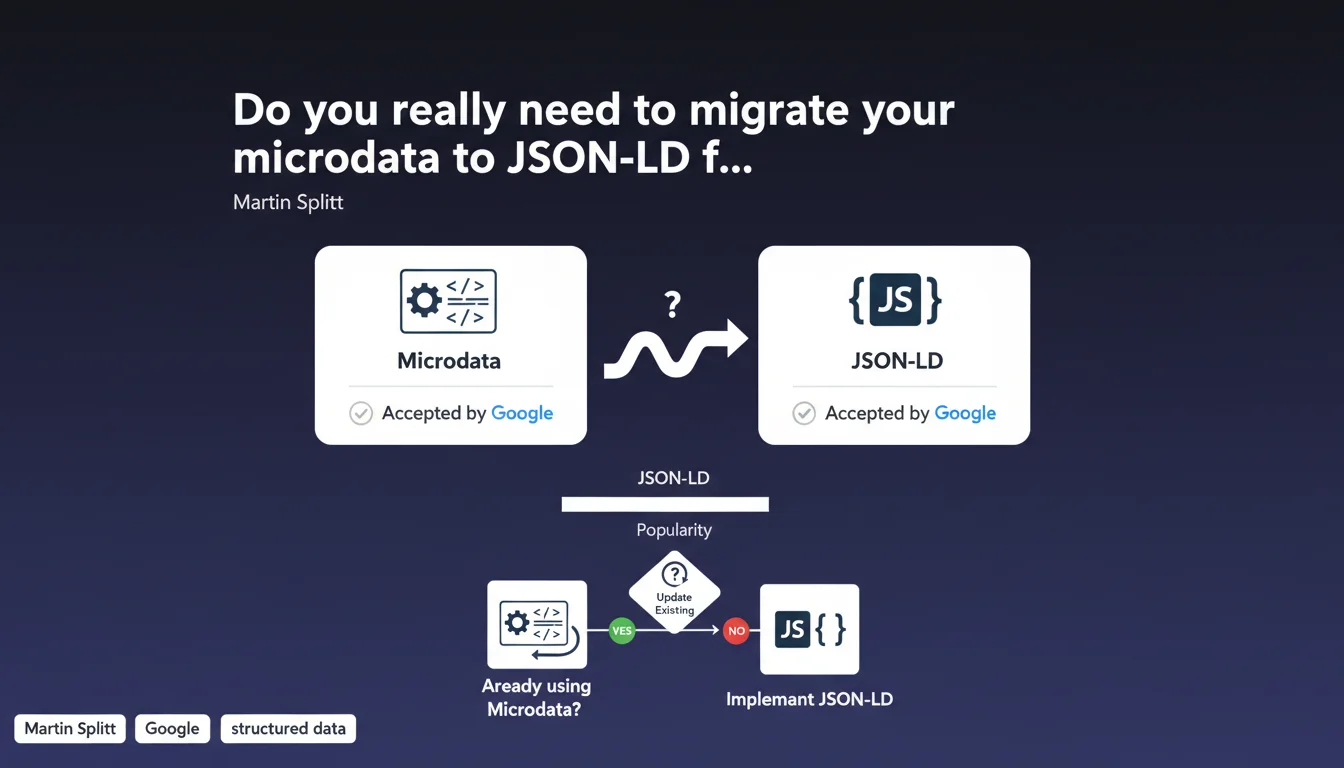
Google accepts both microdata and JSON-LD for structured data equally. If your site already uses microdata, there's no need to convert everything: updating your existing markup is often more efficient than a complete migration to JSON-LD, despite its growing popularity.
What you need to understand
Why does Google take a stance on structured data formats?
For years, SEO professionals have debated the optimal format for implementing structured data. JSON-LD has taken a dominant position in recommendations, to the point where some practitioners consider it a mandatory standard.
Martin Splitt clarifies here that Google doesn't impose any technical preference between microdata and JSON-LD. Both formats are read and interpreted the same way by search engines. This statement aims to stop unnecessary migrations driven by misconceptions.
What's the technical difference between these two formats?
Microdata integrates directly into HTML via attributes (itemscope, itemprop), making it inherently linked to the page structure. JSON-LD, on the other hand, is inserted in an independent script block, typically placed in the head.
This separation makes JSON-LD a format that's easier to generate dynamically and maintain via content management systems. But this convenience doesn't translate into an SEO advantage.
When is an update better than a conversion?
If your site already displays functional rich snippets with microdata, the ROI of migrating to JSON-LD is nearly zero. Development effort would be better invested in enriching your existing markup.
Conversion is mostly justified during a complete technical overhaul or if your architecture makes maintaining microdata particularly complex.
- Google treats microdata and JSON-LD equivalently — no SEO advantage to either one
- JSON-LD's popularity comes from ease of implementation, not superior performance
- Migration only makes sense if it genuinely simplifies technical maintenance
- Sites with functional microdata can focus on enrichment rather than conversion
SEO Expert opinion
Does this statement match real-world observations?
Absolutely. Comparative tests show that Google indexes and displays rich snippets without distinguishing between formats. Sites using microdata achieve the same SERP results as those using JSON-LD, at equal markup quality.
What matters is the completeness and accuracy of structured data, not its encoding format. Poorly filled JSON-LD never outperforms comprehensive microdata.
Why does JSON-LD dominate recommendations then?
The technical ecosystem favors JSON-LD for practical reasons. Modern CMS platforms, SEO plugins, and schema generators prioritize this format because it decouples data from HTML structure.
This approach prevents conflicts when modifying templates and facilitates automated implementations. But it's a web architecture choice, not an SEO requirement. [To verify]: some claim JSON-LD would be better interpreted during algorithm updates — no public data confirms this.
When should you still prefer JSON-LD?
On sites with intensive dynamic content generation (large-catalog e-commerce, aggregators), JSON-LD significantly simplifies implementation. Development teams appreciate its modularity.
For static sites or small structures already equipped with microdata, the status quo remains the most rational decision. Let's be honest: the development time saved can go toward far more profitable optimizations.
Practical impact and recommendations
What should I do if my site already uses microdata?
First audit the quality of your existing markup using Search Console and the rich results test. If data is correctly extracted and your snippets are displaying, you have your answer.
Focus your efforts on enriching missing properties rather than migrating. Add reviews, prices, availability — everything that improves your SERP results.
When should you consider migrating to JSON-LD?
During a technical overhaul, if your stack is evolving toward a modern framework (React, Vue, Next.js), JSON-LD will integrate more naturally. Take the opportunity to standardize.
If your technical team struggles with maintaining microdata tangled in complex templates, migration can streamline workflows. But it's a organizational choice, not an SEO one.
How do you verify your implementation stays performant?
- Regularly test your pages with Google's rich results test tool
- Monitor the "Enhancements" reports in Search Console to detect markup errors
- Compare your snippet displays in SERPs with direct competitors
- Document the Schema.org properties used to facilitate future updates
- Only migrate if you identify a measurable technical or organizational gain
❓ Frequently Asked Questions
Google favorise-t-il JSON-LD par rapport à microdata ?
Puis-je mélanger microdata et JSON-LD sur la même page ?
Dois-je migrer mon microdata existant vers JSON-LD ?
Quel format choisir pour un nouveau projet ?
Le format influence-t-il la vitesse d'indexation des données structurées ?
🎥 From the same video 11
Other SEO insights extracted from this same Google Search Central video · published on 22/03/2022
🎥 Watch the full video on YouTube →
💬 Comments (0)
Be the first to comment.