
Official statement
Other statements from this video 11 ▾
- □ Le H1 a-t-il vraiment l'impact SEO que Google prétend ?
- □ Pourquoi la Search Console est-elle la seule source de vérité sur votre performance réelle ?
- □ Le sitemap est-il vraiment indispensable pour le crawl de Google ?
- □ Google indexe-t-il vraiment le JavaScript aussi bien que le HTML classique ?
- □ Faut-il vraiment forcer le rendu côté serveur pour toutes les applications JavaScript ?
- □ Faut-il vraiment migrer ses microdata en JSON-LD pour les données structurées ?
- □ Combien de liens faut-il vraiment placer sur votre page d'accueil pour optimiser le crawl ?
- □ Pourquoi Google insiste-t-il sur la collaboration entre développeurs et SEO ?
- □ Pourquoi tester votre site sur différents navigateurs peut-il sauver votre SEO ?
- □ View Source et DevTools suffisent-ils vraiment pour diagnostiquer vos problèmes SEO ?
- □ Faut-il vraiment attendre 6 mois avant de juger les performances d'un nouveau site ?
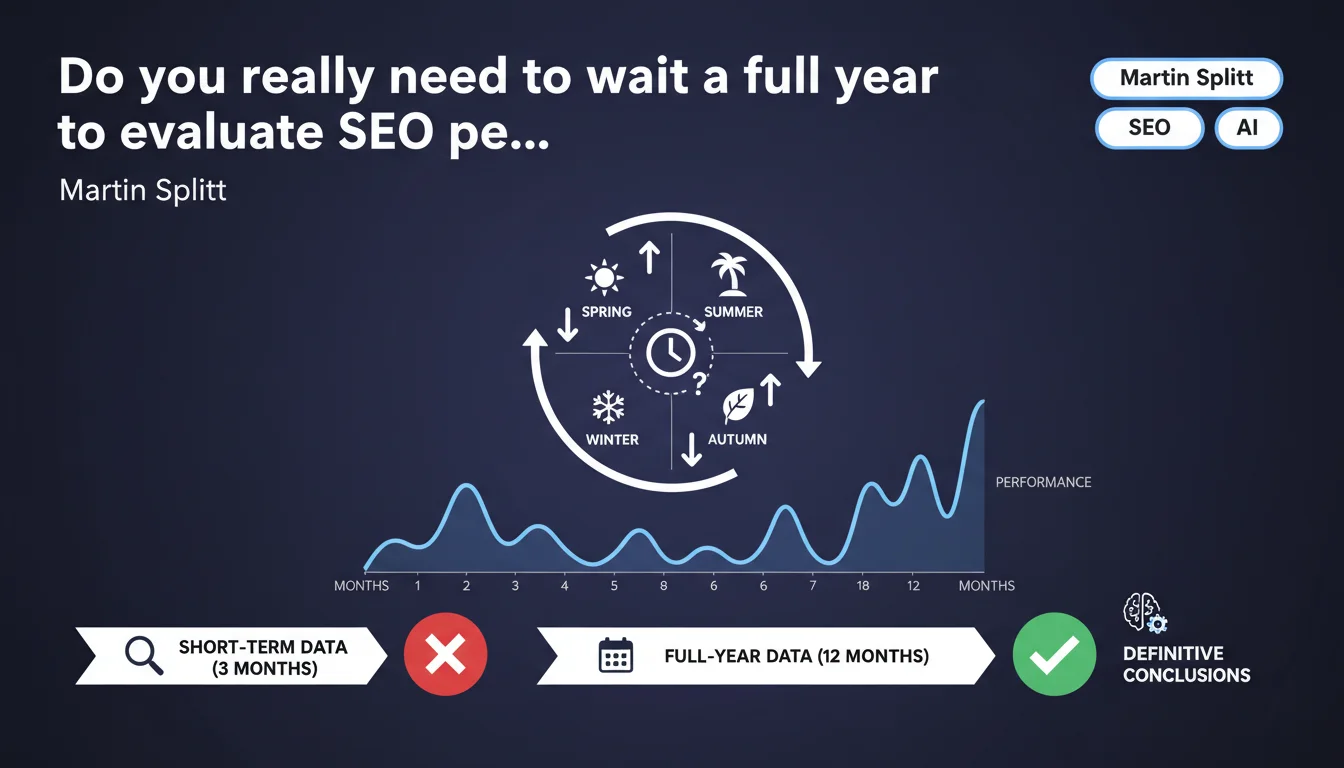
Google recommends collecting data over 12 complete months for websites with seasonal activity before drawing conclusions about their performance. Natural traffic fluctuations depending on periods can skew analysis if you rely on too short an observation window. This recommendation aims to prevent strategic decisions based on partial or time-biased data.
What you need to understand
Why does Google insist on this minimum observation period?
Seasonal sites — toy e-commerce, tourism, gardening, fashion — experience drastic traffic variations depending on the months. A ski rental site might generate 90% of its traffic between December and March, while a swimming pool site peaks in April-August.
If you launch SEO changes in February and measure results in April, you risk attributing a traffic increase to your optimizations when it simply stems from the natural cycle of demand. Conversely, a summer decline could be misinterpreted as a strategic failure.
Which data does this recommendation cover?
Google is targeting all performance metrics here: organic traffic, conversion rate, user behavior (bounce rate, session duration), rankings for key queries. But also technical signals like crawl budget or Core Web Vitals, which can vary with server load during peak seasons.
This approach applies as much to redesign evaluation as to ongoing optimization tracking. Without a full year, it's impossible to distinguish seasonal correlation from SEO causality.
Does this rule only apply to heavily seasonal sites?
No. Even moderately seasonal sites experience behavioral fluctuations: informational queries increase in January (New Year's resolutions), e-commerce explodes in November-December (Black Friday, Christmas), B2B slows down in July-August.
Google's recommendation therefore applies to any site showing predictable and recurring audience variations, even if they aren't extreme.
- Complete cycle required: 12 months minimum to capture all seasonal variations
- Year-over-year comparison (YoY): the only reliable method to isolate the impact of SEO optimizations
- Multiple metrics: traffic, conversion, and technical signals must all be observed over the entire cycle
- Avoiding interpretation bias: don't confuse natural seasonal increases with SEO success
SEO Expert opinion
Is this statement consistent with field practices?
Absolutely. It's actually a basic principle in web analytics for years. Every experienced analyst compares year-over-year performance rather than month-over-month for seasonal sites.
The problem — and this is where Google's statement becomes interesting — is that many clients and decision-makers lack this patience. They want results in 3 months, which pushes some SEOs to oversell traffic increases that simply result from the calendar. Google is reminding everyone of a methodological principle too often forgotten.
What nuances should be added to this recommendation?
Waiting a year doesn't mean staying idle for 12 months. You can — and should — track intermediate indicators: ranking evolution, crawl growth, Core Web Vitals improvement, internal linking expansion.
Let's be honest: for a new site or complete redesign, even 12 months might not be enough if the site hasn't yet reached semantic maturity. And conversely, certain technical changes (fixing 5xx errors, HTTPS migration, fixing canonicals) produce measurable effects in just weeks, even on seasonal sites.
The real nuance is that this rule applies mainly to overall strategy evaluation, not to every micro-optimization. [To verify]: Google doesn't specify whether this recommendation also covers sites with micro-seasons (sales, recurring one-off events), where multiple short cycles may overlap.
In which cases does this rule not apply?
For non-seasonal sites or those with stable year-round demand (B2B SaaS, financial services, certain media outlets), observation can be shorter. A quarter is often enough to identify exploitable trends.
And that's where it gets tricky: Google provides no objective criteria to determine a site's seasonality level. Should there be a 20% gap between high and low season? 50%? This imprecision leaves interpretation open-ended.
Practical impact and recommendations
What concretely should you do to apply this recommendation?
First step: map your site's seasonality. Analyze the last 2-3 years in Google Analytics or Search Console to identify recurring peaks and troughs. Segment by page category if needed — some sections may be stable while others vary greatly.
Next, configure your monitoring dashboards in year-over-year (YoY) mode rather than sequential. Systematically compare January N with January N-1, not December N-1. This lets you see whether your optimizations amplify or not performance at equivalent periods.
How do you avoid common interpretation errors?
Never draw definitive conclusions from a short isolated period. If your traffic increases 30% in March after a redesign in January, don't celebrate — wait to see if this increase repeats in March N+1.
Document precisely every SEO action with its date: migration, redesign, linking changes, content additions. This lets you correlate (cautiously) observed variations after a complete cycle with actions taken.
Watch out for confirmation bias: if you're trying to prove an action worked, you'll always find an indicator that seems to validate it. Multiply your angles of analysis and stay critical.
What tools and processes should you set up for rigorous tracking?
Use annotations in Google Analytics to mark every significant SEO change. Create custom segments by page type (category, product, editorial content) to track differentiated performance.
In Search Console, leverage period comparison filters to analyze impression and click evolution over equivalent windows. Regularly export data to build usable historical records.
- Analyze at least 2 years of history to identify recurring seasonal patterns
- Set up dashboards with systematic year-over-year (YoY) comparison
- Document every SEO action with precise date and scope
- Segment analyses by page type and query category
- Use annotations in analytics tools to track changes
- Never draw definitive conclusions before observing a complete 12-month cycle
- Cross-reference multiple data sources (Analytics, Search Console, crawl tools) to avoid bias
- Schedule quarterly checkpoints to adjust strategy without waiting for cycle completion
❓ Frequently Asked Questions
Un site e-commerce avec plusieurs pics saisonniers dans l'année doit-il attendre 12 mois avant d'évaluer ses performances ?
Peut-on quand même optimiser et ajuster la stratégie SEO pendant cette période d'observation ?
Comment identifier si mon site est suffisamment saisonnier pour appliquer cette règle ?
Cette recommandation s'applique-t-elle aussi aux sites d'actualité ou médias ?
Faut-il attendre un an avant de réagir à une baisse de trafic sur un site saisonnier ?
🎥 From the same video 11
Other SEO insights extracted from this same Google Search Central video · published on 22/03/2022
🎥 Watch the full video on YouTube →
💬 Comments (0)
Be the first to comment.