
Official statement
Other statements from this video 5 ▾
- □ Does Google really require structured data to display rich results?
- □ Does structured data really help Google understand your content better?
- □ Which implementation method should you choose for structured data on your website?
- □ Is the Rich Results Test really enough to validate your structured data?
- □ Why don't structured data always display as rich results in Google search?
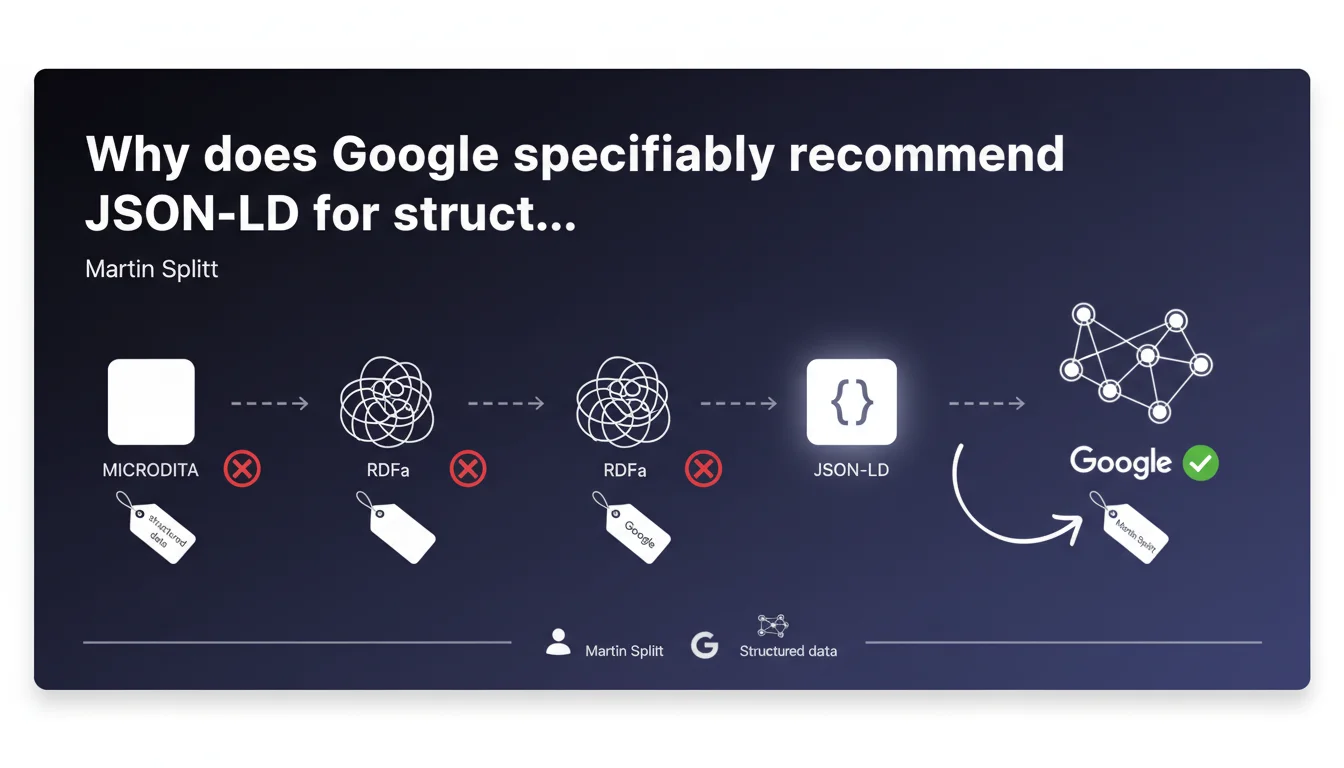
Google officially recommends JSON-LD among the three accepted formats (microdata, RDFa, JSON-LD). This preference is based on implementation simplicity and the separation of structured code from visible HTML. In practice, JSON-LD remains the safest format to avoid markup errors and facilitate maintenance.
What you need to understand
What are the three structured data formats accepted by Google?
Google supports three syntaxes for structured data: microdata, RDFa, and JSON-LD. These three formats allow you to mark up your content so that search engines better understand your pages — products, recipes, events, articles, FAQs, and more.
Microdata is inserted directly into the HTML via attributes like itemscope and itemprop. RDFa works on a similar principle with vocab and property attributes. JSON-LD, on the other hand, is placed in a <script type="application/ld+json"> tag, completely separated from the visible HTML.
Why does Google recommend JSON-LD over the other two?
The main reason: simplicity of implementation. With JSON-LD, you don't need to touch your existing HTML. You inject a block of structured code in the <head> or at the end of <body>, and you're done.
Microdata and RDFa require you to enrich each relevant HTML element. If your template changes, you risk breaking the markup. With JSON-LD, the structured code remains isolated — fewer conflicts with CSS, JavaScript, or design updates. Google can parse the JSON without depending on your DOM structure.
Does this recommendation mean that microdata and RDFa are discouraged or penalized?
No. Google explicitly states that it accepts and processes all three formats equivalently. No format provides a direct SEO advantage if the markup is correct.
The JSON-LD recommendation is an implementation guidance, not a requirement. If your CMS or technology stack requires microdata (WordPress, for example, often uses microdata for certain plugins), you won't be penalized. But if you're starting from scratch or redesigning your site, JSON-LD is the most rational choice.
- Three accepted formats: microdata, RDFa, JSON-LD
- JSON-LD recommended for its simplicity and separation from HTML
- No penalty if you use microdata or RDFa correctly
- Easier maintenance with JSON-LD in case of redesign or migration
SEO Expert opinion
Is this recommendation consistent with practices observed in the field?
Yes, and it's actually one of the rare points where Google's discourse and real-world practice converge. JSON-LD has become the de facto standard among the majority of well-optimized sites — e-commerce, media, content sites. Third-party tools (GTM, WordPress plugins, headless solutions) offer almost exclusively JSON-LD.
Microdata remains present on legacy sites or older CMS platforms. RDFa has become marginal, except in a few niche academic or government sectors. However, no documented cases of penalties related to format choice have been observed, as long as the markup is valid.
What nuances should be added to this recommendation?
The JSON-LD recommendation is based on one assumption: that you have control over your source code or a flexible system. If you're stuck with a proprietary CMS that automatically generates microdata, there's no point breaking everything to switch to JSON-LD.
Second nuance: JSON-LD can be harder to debug if you're not comfortable with JSON syntax. With microdata, you see directly in the HTML what's marked up. With JSON-LD, you need to inspect the script and verify that the data matches the visible content. [To verify]: Google states that all three formats are treated equivalently, but some field reports suggest that JSON-LD is sometimes crawled faster — no official confirmation from Google on this point.
In what cases would JSON-LD not be the best choice?
If you're generating dynamic content on the client side (React, Vue, Angular), microdata might be simpler to maintain as it's integrated directly into components. JSON-LD then requires synchronizing the script with displayed content, which can create inconsistencies if not handled properly.
Another case: if you're using a static site generator (Gatsby, Hugo, Jekyll) that automatically injects microdata via templates, switching to JSON-LD can complicate your stack for no benefit. Let's be honest: clean microdata is better than poorly synchronized JSON-LD.
Practical impact and recommendations
What should you do concretely if you're starting or redesigning a site?
Favor JSON-LD by default. Create your structured data scripts in a separate file or via a Tag Manager, inject them at the end of <body>. Use a JSON-LD generator (like Merkle's Technical SEO Tool) to avoid syntax errors.
If you already have microdata in place and it's working, don't touch it. Migrating to JSON-LD brings no measurable SEO gain if your current markup is correct. Focus your efforts on enriching data types (adding FAQs, HowTo, products, etc.).
What errors should you avoid with JSON-LD?
Classic mistake: duplicating structured data. If you have historical microdata AND you add JSON-LD, Google might see the same entity twice and ignore one or the other. Do a complete audit before adding JSON-LD to an existing site.
Second pitfall: JSON-LD disconnected from visible content. Google cross-references structured data with crawled content. If your JSON-LD announces a price of €49 while the HTML displays €59, you risk rejection of the rich snippet. Data must be synchronized and verifiable.
- Use JSON-LD by default for any new project or redesign
- Test each JSON-LD script with Google's Rich Results Test
- Verify the absence of duplication with any existing microdata markup
- Ensure that JSON-LD data matches visible content
- Favor injection via Tag Manager to facilitate updates
- Document the Schema.org types used for each page template
❓ Frequently Asked Questions
Puis-je mélanger JSON-LD et microdata sur le même site ?
JSON-LD apporte-t-il un avantage SEO direct par rapport à microdata ?
Où placer le code JSON-LD dans la page ?
Comment vérifier que mon JSON-LD est pris en compte par Google ?
Faut-il absolument migrer de microdata vers JSON-LD ?
🎥 From the same video 5
Other SEO insights extracted from this same Google Search Central video · published on 01/02/2024
🎥 Watch the full video on YouTube →
💬 Comments (0)
Be the first to comment.