
Official statement
Other statements from this video 5 ▾
- □ Les données structurées sont-elles vraiment obligatoires pour obtenir des résultats enrichis ?
- □ Les données structurées aident-elles vraiment Google à comprendre votre contenu ?
- □ Pourquoi Google recommande-t-il spécifiquement JSON-LD pour les données structurées ?
- □ Quelle méthode choisir pour implémenter les données structurées sur votre site ?
- □ Pourquoi les données structurées n'affichent-elles pas toujours des résultats enrichis dans Google ?
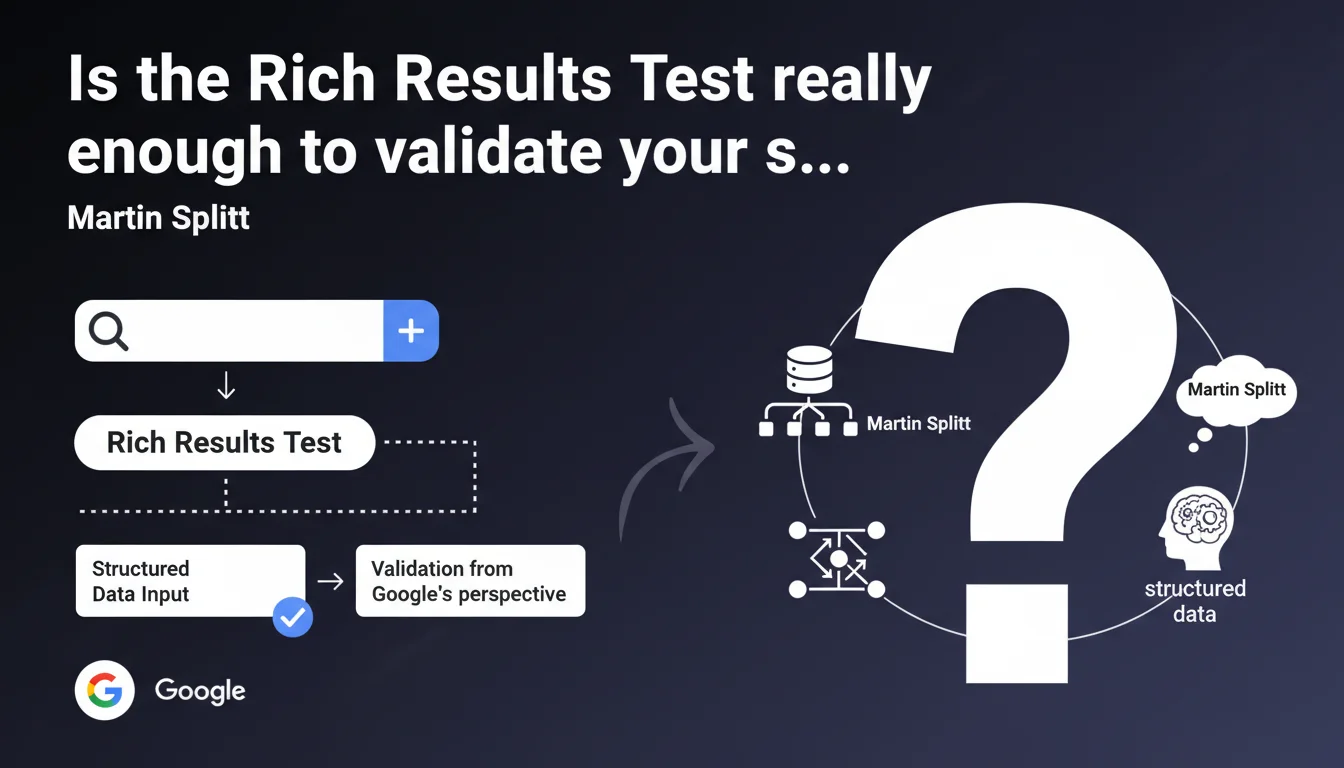
Google officially recommends the Rich Results Test to verify that your structured data is correctly interpreted by its search engine. The tool allows you to see exactly what Googlebot reads and validates technical compliance. A basic approach, but one that doesn't cover all the subtleties of implementation.
What you need to understand
Why does Google insist on this specific tool?
The Rich Results Test simulates Googlebot's behavior when faced with your Schema.org tags. Unlike a generic JSON-LD validator, this tool shows what Google actually sees and which data is usable for generating rich results.
The nuance is important: a Schema can be technically valid according to W3C standards without triggering a rich result in the SERPs. The Rich Results Test clarifies this by explicitly indicating which types of enhancements are eligible.
What does this tool check exactly?
The tool analyzes the syntax, semantics, and compliance with Google's guidelines. It detects JSON-LD/Microdata structure errors, missing mandatory properties, and inconsistencies in declared entity types.
It doesn't just say "it's good" or "it's bad". It displays warnings for recommended but non-mandatory properties — those which, if added, increase your chances of getting a rich result display.
Does this tool replace other validators?
No. The Rich Results Test focuses on what impacts rich results, not on the general validity of your Schema.org. If you implement Schema for other search engines or for Knowledge Graph crawling, you'll need to cross-check with validator.schema.org or third-party tools.
Google only validates what it exploits. Properties that are perfectly valid according to Schema.org can be ignored or flagged as unsupported in the Rich Results Test.
- The Rich Results Test shows what Googlebot interprets, not what a theoretical validator considers compliant
- It detects blocking errors AND warnings that limit eligibility for rich results
- "Recommended" properties are not mandatory, but they increase the chances of rich result display
- This tool does not replace verification on other engines or for non-Google contexts
SEO Expert opinion
Does this recommendation cover all use cases?
Honestly, no. The Rich Results Test is limited to types of structured data that Google exploits for rich results — FAQs, Recipes, Products, Jobs, Events, Articles, etc. If you're implementing Schema for Knowledge Graph, business entities, or complex relationships, this tool won't help you.
Another point: the tool tests an isolated URL. It does not detect inconsistencies between pages, nor scaling problems with Schema duplication across the site. [To verify] with a complete audit using scraping + automated validation.
Should you blindly trust the tool's results?
No. The tool can display "eligible for rich results" without guaranteeing they'll actually appear in the SERPs. Google reserves the right to not display a rich result even if the markup is perfect — especially if the content is deemed low relevance, if the overall site quality is poor, or if the competition on the query doesn't justify enrichments.
Conversely, some warnings flagged by the tool don't always prevent display. It's a partial black box: Google indicates what's technically correct, but the actual triggering criteria remain opaque.
Does the Rich Results Test detect spam attempts?
Partially. The tool flags structured data invisible to the user (content hidden in CSS, for example), which is a violation of guidelines. But it cannot judge whether your Schema tags are misleading or whether they oversell the actual page content.
A Product Schema with a fake price or a fake rating will pass technical validation. It's at the point of manual action or an algorithmic signal that Google will penalize. The automated test does not replace a human review of consistency.
Practical impact and recommendations
How do you integrate this tool into your SEO workflow?
Test each strategic page type after deploying a new Schema. Verify product pages, blog articles with FAQs, category pages, event landing pages. Don't settle for testing a single representative URL.
Set up automated validation if you manage an e-commerce or editorial site with thousands of pages. Tools like OnCrawl, Screaming Frog, or Python scripts can call the Rich Results API to audit at scale.
What critical errors should you fix first?
Blocking errors must be fixed immediately — missing mandatory properties, incompatible entity types, broken JSON-LD syntax. Without correction, you lose any chance of a rich result.
Warnings deserve attention next: missing image, absent recommended property, incorrect date format. Even though Google can display a rich result without these elements, adding them significantly increases your chances.
Should you react to tool fluctuations?
Google regularly updates its validation criteria. A Schema that's valid today may generate a warning tomorrow if guidelines evolve. Monitor Search Console for notifications of structured data errors detected during actual crawling.
Don't panic if a warning appears: first verify if it impacts your rich results in the SERPs. Sometimes Google flags "issues" that have no visible effect on display.
- Test each page type with the Rich Results Test after every Schema modification
- Fix blocking errors first, then warnings on recommended properties
- Automate validation at scale with the Rich Results API or crawl tools
- Cross-reference results with validator.schema.org if you're targeting other engines or Knowledge Graph usage
- Monitor Search Console to detect errors flagged during actual crawling
- Don't rely solely on "eligible" mention — verify actual display in the SERPs
❓ Frequently Asked Questions
Le Rich Results Test remplace-t-il l'ancien outil de test des données structurées ?
L'outil détecte-t-il les données structurées injectées en JavaScript ?
Faut-il tester chaque URL individuellement ou l'outil peut-il crawler un site entier ?
Un avertissement dans le Rich Results Test empêche-t-il l'affichage d'un résultat enrichi ?
L'outil valide-t-il les formats Microdata et RDFa ou uniquement JSON-LD ?
🎥 From the same video 5
Other SEO insights extracted from this same Google Search Central video · published on 01/02/2024
🎥 Watch the full video on YouTube →
💬 Comments (0)
Be the first to comment.