
Official statement
Other statements from this video 5 ▾
- □ Les données structurées aident-elles vraiment Google à comprendre votre contenu ?
- □ Pourquoi Google recommande-t-il spécifiquement JSON-LD pour les données structurées ?
- □ Quelle méthode choisir pour implémenter les données structurées sur votre site ?
- □ Le Rich Results Test est-il suffisant pour valider vos données structurées ?
- □ Pourquoi les données structurées n'affichent-elles pas toujours des résultats enrichis dans Google ?
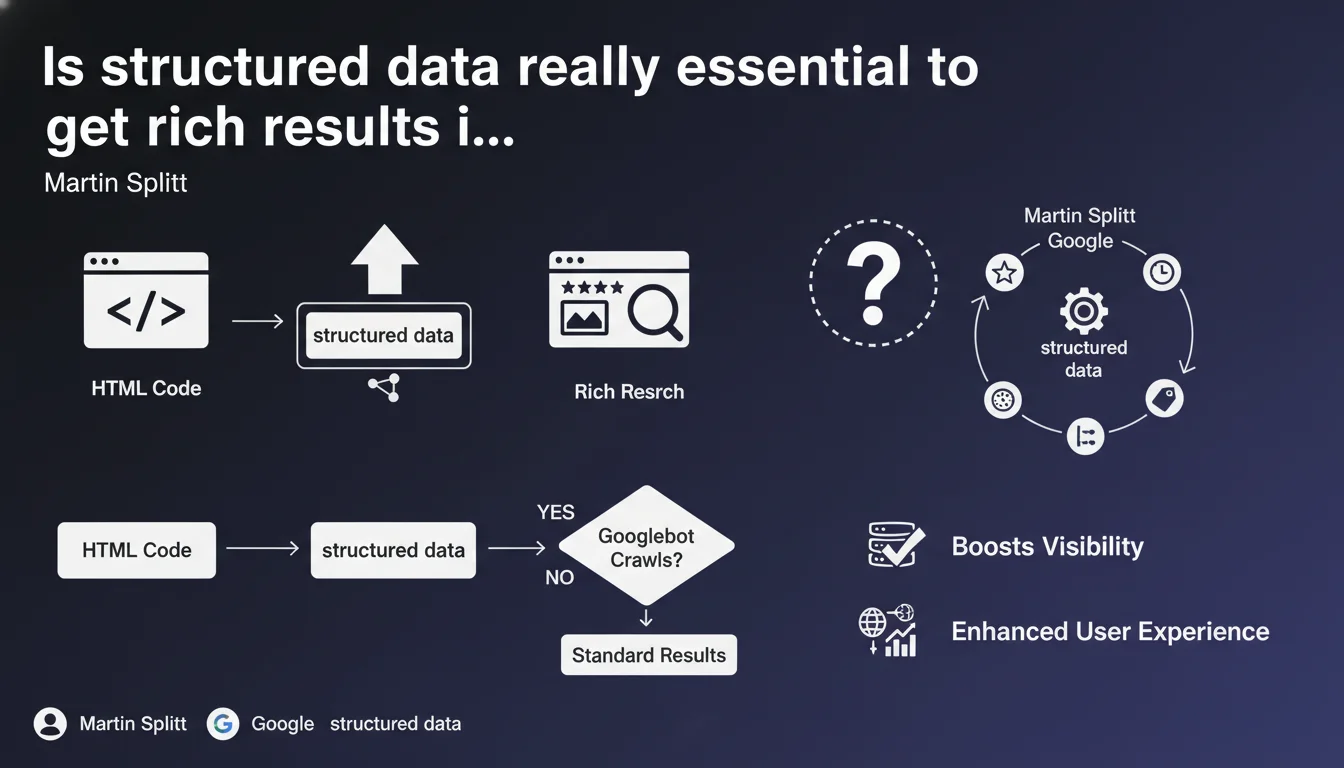
Martin Splitt is crystal clear: every rich result displayed by Google relies on structured data. Without proper schema.org markup, there's no way to appear in these premium formats. It's a non-negotiable technical requirement, not just a recommendation.
What you need to understand
What exactly does Google mean by "rich results"?
Rich results refer to all search formats that go beyond the traditional blue link. Recipes with ratings and cooking times, events with dates and locations, expandable FAQs, products with prices and availability, aggregated reviews, embedded videos — the list goes on.
These formats take up more visual space in the SERPs and generate significantly higher click-through rates. For many e-commerce or media sites, it's become a critical visibility lever.
Why does Google emphasize this dependency on structured data?
Google needs explicit and structured signals to understand page content with enough confidence to display it in a rich format. Natural language processing and AI have their limits — especially when extracting precise information like a price, date, or rating.
Structured data acts as a reading contract: you clearly tell Google "here's a product, here's its price, here's its availability." Without this markup, even if your content is excellent, Google won't risk displaying a potentially incorrect rich result.
Does this statement cover all types of special results?
No, and that's where it gets tricky. Featured snippets (position zero) are not considered rich results in the strict sense. Google generates them without mandatory structured data, extracting relevant content directly from the page.
The same confusion can apply to knowledge panels or certain carousels that sometimes get their data from other sources (Knowledge Graph, Wikidata, etc.). Splitt's statement specifically targets rich results officially documented in Google's Search Gallery.
- Every rich result requires appropriate schema.org markup
- Without structured data, zero chance of appearing in these premium formats
- Featured snippets and knowledge panels follow different rules
- Google prioritizes explicit signals to minimize display errors
- Markup acts as a trust filter, not just a simple aid
SEO Expert opinion
Does this claim match what we observe in practice?
Yes, and it's one of the most consistent Google statements with actual practice that you can find. Thousands of tests confirm it: remove schema.org markup from a page generating rich results, and these displays disappear within 48-72 hours.
Conversely, correctly adding structured data to eligible content often triggers rich result appearance within 1-2 weeks. The causal link is direct and verifiable.
Should we understand that structured data guarantees rich result appearance?
No, and that's the classic trap. Splitt says rich results are powered by structured data, not that this data guarantees their display. Critical distinction.
Even with technically perfect markup, Google may choose not to display a rich result if content lacks quality, competition is too strong, or the algorithm determines a standard format is better suited to the query. Structured data is a necessary but not sufficient condition.
Are all of Google's statements on this topic equally clear?
Far from it. Google often communicates in a deliberately vague way about the exact eligibility criteria for rich results. Why do some sites with flawless markup never get rich results? Complete mystery.
Splitt provides the basic rule here — the technical prerequisite — but completely sidesteps the qualitative criteria that then determine actual display. [To verify]: What exact weight do domain authority, content freshness, or click-through rate play in the decision to display a rich result?
Practical impact and recommendations
What concrete actions should you take to maximize your chances?
Start by identifying rich result types relevant to your business. Consult Google's Search Gallery to see available formats: recipes, products, events, FAQs, how-tos, articles, jobs, and more.
Then implement the corresponding schema.org markup in JSON-LD (the format Google recommends). Use official tools — Rich Results Test, Schema Markup Validator — to verify technical compliance. But don't stop there.
Monitor actual appearance in Search Console, under the Enhancements tab. This is where Google signals eligible pages, detected errors, and generated impressions. Perfect markup generating zero impressions after 3-4 weeks often signals a quality or content relevance issue.
What critical mistakes must you absolutely avoid?
Never markup invisible content to users. Google severely penalizes markup spam — adding Recipe markup to a page with no actual recipe exposes you to manual action.
Also avoid inconsistencies between markup and visible content. If your schema.org indicates a price of €49 but the page displays €59, Google may ignore your structured data or, worse, consider it manipulation.
Last pitfall: incomplete or poorly nested markup. A product without a price, an event without a start date, a recipe without cooking time — these omissions prevent rich result eligibility even if everything else is correct.
- Audit priority pages to identify rich result opportunities
- Implement schema.org markup in JSON-LD (preferred format)
- Validate technically with Google's Rich Results Test
- Verify strict consistency between structured data and visible content
- Monitor performance in Search Console > Enhancements
- Never markup absent or invisible content to users
- Immediately correct errors flagged by Google
- Test impact on click-through rates after deployment
❓ Frequently Asked Questions
Les données structurées améliorent-elles directement le positionnement dans Google ?
Peut-on obtenir des résultats enrichis sans balisage schema.org ?
Quel format de données structurées privilégier : JSON-LD, Microdata ou RDFa ?
Combien de temps faut-il attendre après l'implémentation pour voir apparaître des résultats enrichis ?
Un balisage validé par le Rich Results Test garantit-il l'apparition en résultat enrichi ?
🎥 From the same video 5
Other SEO insights extracted from this same Google Search Central video · published on 01/02/2024
🎥 Watch the full video on YouTube →
💬 Comments (0)
Be the first to comment.