
Official statement
Other statements from this video 5 ▾
- □ Does Google really require structured data to display rich results?
- □ Why does Google specifically recommend JSON-LD for structured data over other formats?
- □ Which implementation method should you choose for structured data on your website?
- □ Is the Rich Results Test really enough to validate your structured data?
- □ Why don't structured data always display as rich results in Google search?
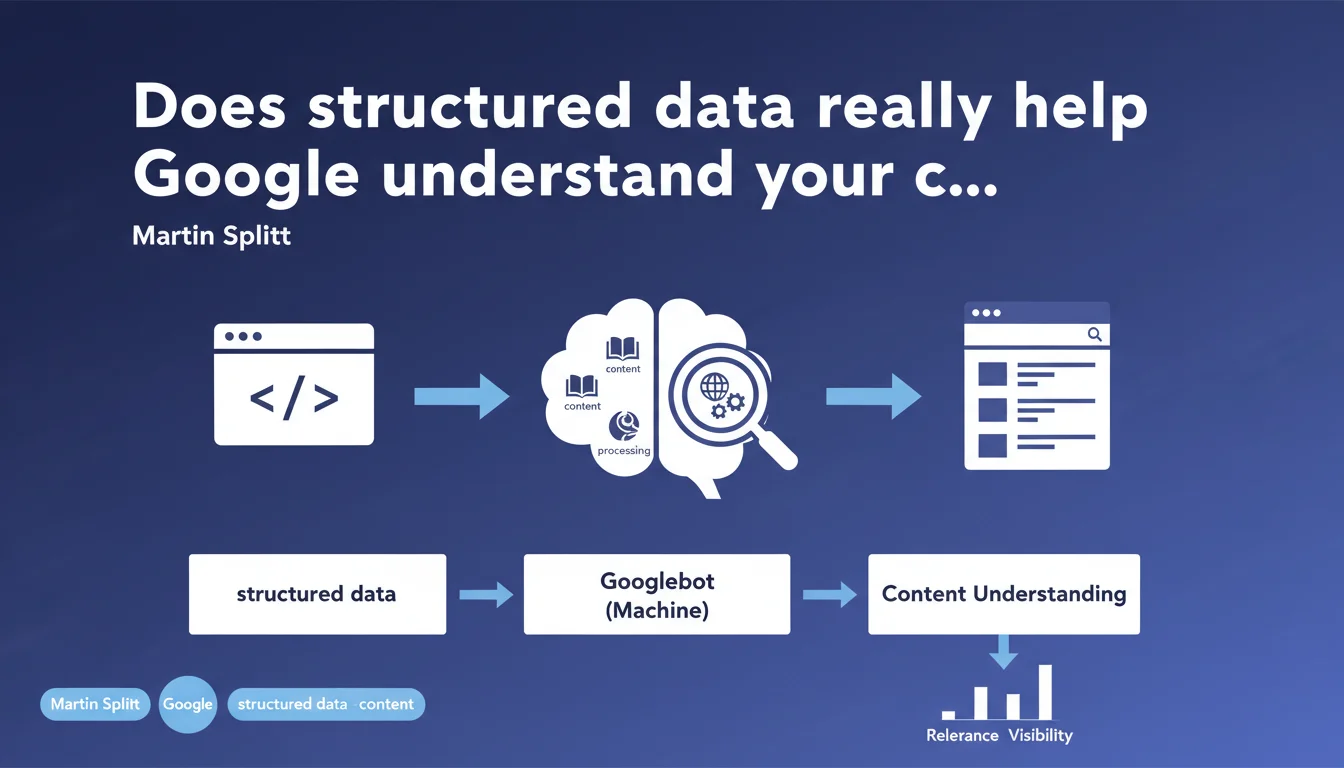
Google confirms that structured data facilitates content understanding by Googlebot and machines. This statement from Martin Splitt reinforces an obvious truth: semantic markup remains a key optimization lever to improve algorithmic interpretation of pages, even though its impact on ranking remains indirect.
What you need to understand
Why does Google insist so much on structured data?
Martin Splitt's statement doesn't revolutionize anything, it reaffirms a fundamental principle: machines need structure to interpret content. Without explicit markup, Googlebot has to guess the type of information presented — a product, an event, a recipe — which increases the risk of interpretation errors.
Structured data acts as metadata that eliminates all ambiguity. It indicates precisely: "Here's a price," "Here's an availability date," "Here's the author of this article." This clarification facilitates indexing and the display of rich snippets in SERPs.
Does this improved understanding translate into better rankings?
No, not directly. Google has repeated this: structured data is not a ranking factor. It doesn't mechanically improve a page's position in search results.
On the other hand, it can increase CTR through rich snippets (review stars, prices, availability). A better CTR leads to potentially more traffic, which can — indirectly — send positive signals to Google. But the link remains correlational, not causal.
What types of structured data does Google prioritize?
Google recommends the JSON-LD format, inserted in the <head> tag or at the end of <body>. Microdata and RDFa formats are still supported, but JSON-LD is explicitly preferred because it separates markup from visible HTML, which simplifies maintenance.
The most useful Schema.org types vary by industry: Product, Article, LocalBusiness, Event, Recipe, FAQ, HowTo. Each allows Google to display specific features in SERPs.
- Structured data clarifies content for Googlebot and reduces interpretation ambiguities
- It doesn't boost ranking directly, but improves visibility through rich snippets
- JSON-LD is the recommended format by Google for its implementation simplicity
- Not all Schema.org types trigger rich snippets — only certain types are eligible for rich results
- Validation via Rich Results Test is essential to verify implementation
SEO Expert opinion
Is this statement consistent with what we observe in the field?
Yes, completely. Sites that correctly implement structured data obtain more rich snippets in SERPs. This is observable daily: an e-commerce site with properly configured Schema Product displays price, availability, and reviews directly in Google.
Where it gets tricky is that Google never guarantees ever the display of a rich snippet, even with perfect markup. The algorithm decides case by case, based on opaque criteria — content quality, relevance, competition on the query. [To verify]: Google has never precisely documented these selection criteria.
What nuances should be added to this assertion from Google?
"Better understand" doesn't mean "rank better." Splitt deliberately remains vague about actual impact. Structured data aids interpretation, but doesn't compensate for mediocre content or a weak backlink profile.
Another nuance: certain Schema.org types are purely informational and trigger no specific display. Implementing WebPage or BreadcrumbList markup brings no direct SERP visibility — it's useful for algorithmic understanding, that's all.
In what cases is this lever strictly useless?
On ultra-competitive queries dominated by established brands, adding Schema.org changes nothing if the site lacks authority. Rich snippets don't compensate for a position on page 3.
Same for purely informational content without an obvious structured element — a standard blog article without FAQ, without HowTo, without recognized author. The potential gain is marginal.
Practical impact and recommendations
What should you implement as a priority on your site?
Start with the Schema.org types that match your activity. E-commerce? Product and Offer. Blog? Article and Person (author). Restaurant or retail location? LocalBusiness with hours and contact information.
Next, add secondary types that enrich the experience: FAQ to capture featured snippets, BreadcrumbList to clarify site structure, AggregateRating to display review stars.
How do you verify that the implementation is correct?
Use Google's Rich Results Test to validate each page. This tool detects syntax errors and indicates whether the markup is eligible for rich snippets.
Complement with Google Search Console, Enhancements section, which reports markup errors detected during crawling. Systematically fix warnings — Google flags them for a reason.
- Identify Schema.org types relevant to each page category
- Implement JSON-LD in the
<head>or before the closing<body>tag - Validate each page with Rich Results Test and Search Console
- Verify that structured data exactly reflects visible content
- Monitor the appearance of rich snippets in SERPs using a rank tracking tool
- Never duplicate the same markup across all pages — each URL should have its own contextualized markup
- Document the implementation to facilitate future updates
❓ Frequently Asked Questions
Les données structurées améliorent-elles directement le classement dans Google ?
Quel format de données structurées Google recommande-t-il ?
Comment savoir si mes données structurées sont correctement implémentées ?
Pourquoi mes données structurées ne déclenchent-elles pas de rich snippets ?
Peut-on implémenter plusieurs types de Schema.org sur une même page ?
🎥 From the same video 5
Other SEO insights extracted from this same Google Search Central video · published on 01/02/2024
🎥 Watch the full video on YouTube →
💬 Comments (0)
Be the first to comment.