
Official statement
Other statements from this video 5 ▾
- □ Les données structurées sont-elles vraiment obligatoires pour obtenir des résultats enrichis ?
- □ Les données structurées aident-elles vraiment Google à comprendre votre contenu ?
- □ Pourquoi Google recommande-t-il spécifiquement JSON-LD pour les données structurées ?
- □ Le Rich Results Test est-il suffisant pour valider vos données structurées ?
- □ Pourquoi les données structurées n'affichent-elles pas toujours des résultats enrichis dans Google ?
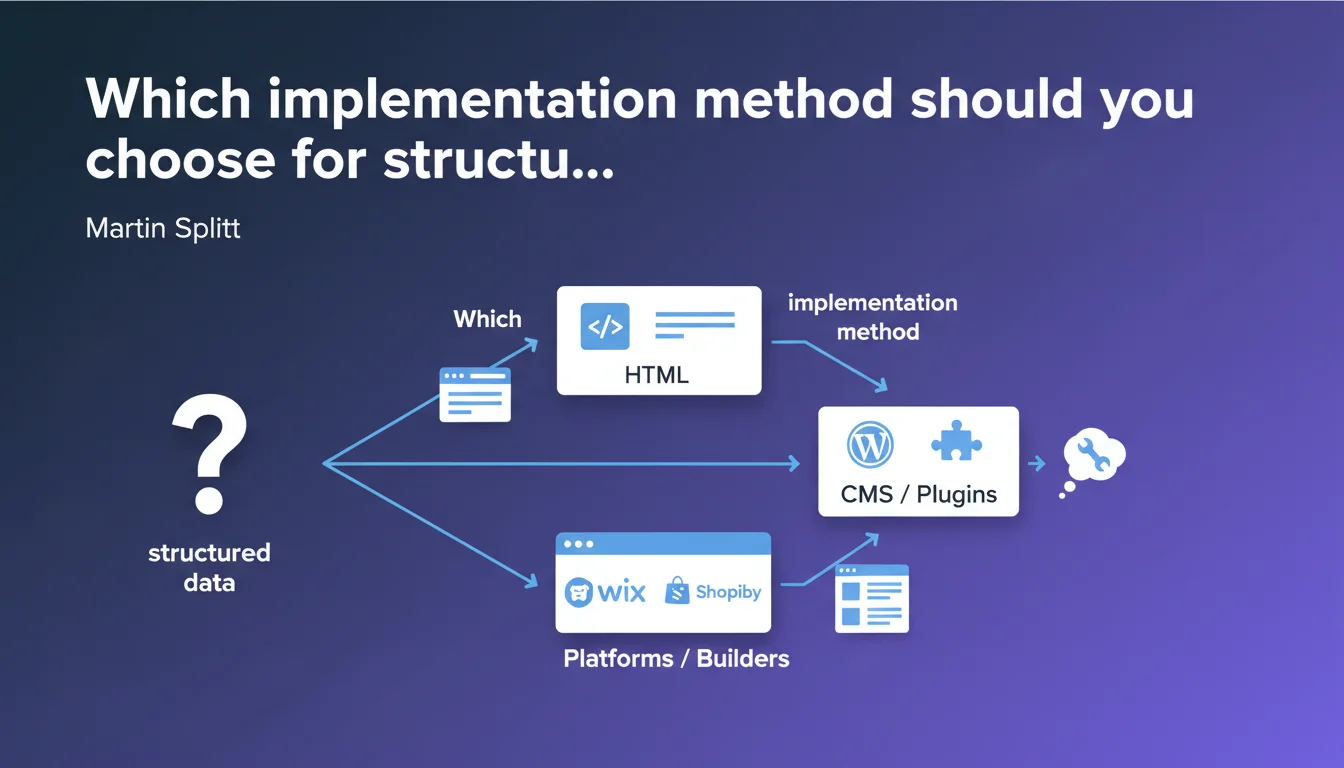
Google confirms there are multiple valid ways to add structured data: direct HTML editing, CMS plugins, or native platform tools. No single method is officially favored — what matters is the final result and the validity of the generated markup.
What you need to understand
Why does Google clarify that multiple implementation methods exist?
This statement addresses a recurring question among SEO practitioners: must you hard-code structured data or can you rely on third-party tools? Martin Splitt clarifies here that Google does not impose a single method.
The goal is to dispel doubts about the validity of automated solutions. As long as the Schema.org markup is correctly generated and accessible to crawlers, the implementation method matters little to the search engine.
What are the concrete options available?
The first option is to edit the HTML code directly on your pages. This method offers maximum control, but it requires technical skills and slows down updates.
CMS plugins like those available for WordPress (Yoast, Rank Math, Schema Pro) automatically generate markup according to predefined rules. Practical for sites with large amounts of content.
Finally, SAAS platforms like Wix or Shopify integrate their own interfaces to configure structured data without touching the code. An ideal solution for non-technical profiles, but with less flexibility.
Does this flexibility have practical limits?
The freedom of method doesn't mean all implementations are equal. A poorly configured plugin can generate invalid, incomplete, or contradictory markup. Likewise, SAAS tools can impose overly rigid schemas that don't match your specific needs.
What remains important is compliance with Schema.org specifications and consistency between visible content and structured data. Google doesn't judge the tool — it judges the result.
- Multiple methods are officially recognized by Google for adding structured data
- Direct HTML editing offers maximum control but requires technical skills
- CMS plugins automate the process but require rigorous configuration
- SAAS platforms integrate native interfaces suited for non-technical profiles
- The validity and consistency of final markup matter more than the method chosen
SEO Expert opinion
Is this methodological neutrality truly without consequences?
On paper, it's reassuring: Google doesn't penalize one method over another. But in real-world practice, not all implementations are equal. I've audited dozens of sites using plugins that generate technically valid but semantically poor markup.
A plugin configured by default will often create minimalist schemas — just enough to pass validation, not enough to maximize rich snippet opportunities. Manual editing allows you to fully exploit optional properties that make the difference.
Do third-party tools introduce specific risks?
Yes, and it's rarely documented. Some WordPress plugins inject duplicate markup if you have multiple extensions active. Others generate JSON-LD that contradicts microddata already present in the HTML — Google hates that.
SAAS platforms like Shopify or Wix sometimes impose rigid structures that don't match the most recent Schema.org specifications. [To verify]: their update frequency isn't always synchronized with Schema vocabulary evolution.
When is it better to code manually?
For high-value SEO sites — premium e-commerce, news sites, service platforms — manual coding remains the gold standard. You can integrate advanced properties like aggregateRating, offers with real-time availability, or complex nested entities.
Plugins and SAAS tools quickly reach their limits once you move beyond basic schemas (Article, Product, Organization). For fine control and competitive differentiation, direct editing remains essential.
Practical impact and recommendations
Which method should you adopt based on your technical context?
If you have an in-house development team or external support, prioritize manual HTML editing. Integrate structured data directly into your templates — it's more maintainable long-term and you keep total control.
For a WordPress site without dedicated technical resources, opt for a recognized plugin like Yoast SEO or Rank Math. But don't settle for default configuration: audit the generated markup and adjust advanced settings.
On a SAAS platform (Wix, Shopify, Squarespace), use the native tools offered — they're generally well integrated. Supplement if necessary with custom JSON-LD injected via customizable header sections.
How do you verify your implementation is correct?
First step: run your key pages through Google's Rich Results Test. Look for critical errors (missing properties, incompatible types) but also warnings — they often signal possible optimizations.
Next, verify semantic consistency. Does the marked-up content match the visible content? Are prices, dates, authors identical in the HTML and in the Schema? Google detects inconsistencies and may ignore the markup.
Finally, monitor the Search Console Enhancements section. Google reports issues detected on your structured data with a level of detail no external validator provides.
- Choose the implementation method suited to your technical resources
- Never blindly trust a plugin or SAAS tool
- Validate the generated markup with Google's Rich Results Test
- Verify consistency between visible content and structured data
- Regularly audit Search Console enhancement reports
- Avoid duplicate markup if you combine multiple tools
- Exploit optional properties to maximize rich snippet opportunities
❓ Frequently Asked Questions
Un plugin WordPress peut-il suffire pour implémenter correctement les données structurées ?
Faut-il privilégier JSON-LD ou les microdonnées intégrées au HTML ?
Les plateformes SAAS comme Shopify génèrent-elles un balisage suffisant pour le SEO ?
Peut-on mélanger plusieurs méthodes d'implémentation sur un même site ?
Comment savoir si mes données structurées sont effectivement exploitées par Google ?
🎥 From the same video 5
Other SEO insights extracted from this same Google Search Central video · published on 01/02/2024
🎥 Watch the full video on YouTube →
💬 Comments (0)
Be the first to comment.