
Official statement
Other statements from this video 5 ▾
- □ Les données structurées sont-elles vraiment obligatoires pour obtenir des résultats enrichis ?
- □ Les données structurées aident-elles vraiment Google à comprendre votre contenu ?
- □ Pourquoi Google recommande-t-il spécifiquement JSON-LD pour les données structurées ?
- □ Quelle méthode choisir pour implémenter les données structurées sur votre site ?
- □ Le Rich Results Test est-il suffisant pour valider vos données structurées ?
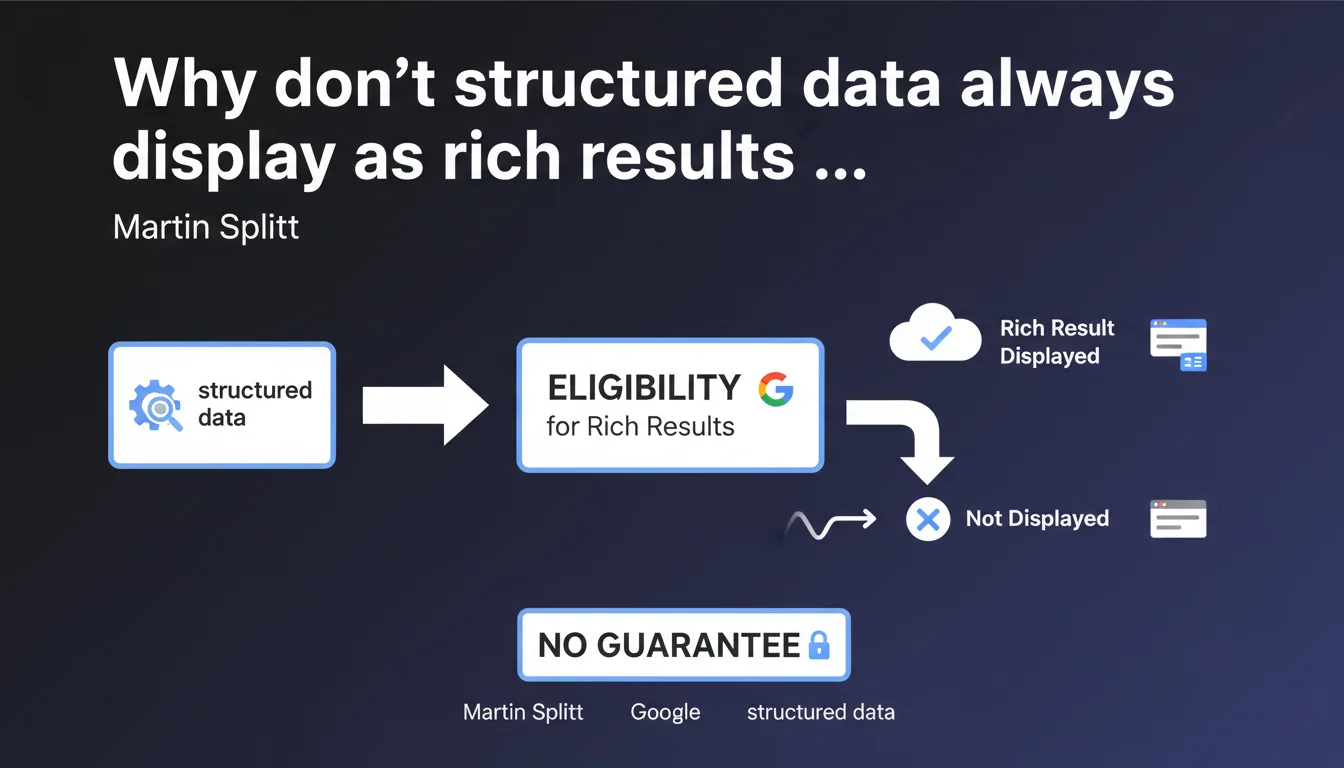
Implementing structured data does not guarantee it will appear in rich snippets. Google reserves the right to choose which pages deserve a rich result, even if the markup is technically correct. Technical eligibility is only a first step — not a promise of display.
What you need to understand
What's the difference between eligibility and guaranteed display?
Martin Splitt lays down a simple principle: your structured data makes your page eligible, nothing more. It's like passing an audition — you can check all the technical boxes without getting the role.
Google applies additional filters after validating the markup. Content quality, relevance to the query, user behavior, domain authority — so many opaque criteria that determine whether your rich snippet will actually appear.
Why doesn't Google guarantee anything despite valid markup?
The official reason? Preserving user experience. Google wants to prevent SERPs from turning into a rich snippet fair where anyone gets outsized visibility just by adding JSON-LD.
Concretely, the algorithm evaluates whether your rich result truly adds value in the context of the query. An unreliable site with perfect FAQ markup will probably never have its questions displayed in the SERPs.
Which types of structured data are affected?
All of them. Recipes, reviews, events, FAQs, products, articles — no type of schema.org markup escapes this rule. Even the tags Google prioritizes remain subject to this algorithmic selection.
- Correct technical implementation is a necessary but not sufficient condition
- Google applies opaque quality filters beyond simple validation
- No type of structured data benefits from guaranteed automatic display
- Contextual relevance takes precedence over technical compliance
SEO Expert opinion
Is this position consistent with what we observe in the field?
Absolutely. For years, SEOs have observed inexplicable disparities in rich snippet display. Two sites with identical, valid markup get radically different results.
The problem? Google never communicates the precise selection criteria. We know they exist, but it's impossible to know exactly what tips the balance between eligibility and actual display. [To verify]: domain authority probably plays a role, but Google will never officially confirm it.
What nuances should we add to this statement?
Splitt doesn't specify that certain types of rich results display much more systematically than others. Breadcrumbs and organization logos, for example, appear almost systematically when the markup is clean.
Conversely, FAQs and HowTo snippets undergo much more aggressive filtering — particularly since the updates that drastically reduced their presence in the SERPs. The level of demand varies depending on the type of structured data.
In what cases does this rule seem less strict?
Large e-commerce sites and established platforms generally obtain more regular display of their rich snippets. Coincidence? Unlikely.
Practical impact and recommendations
What should you do concretely with this information?
First, implementing structured data remains essential. Without it, you have no chance of getting rich results. It's the entry price, not a guarantee of outcome.
Next, focus on the quality signals that accompany your structured data. High-quality content, solid user experience, thematic authority — these elements probably influence Google's decision to display results.
What mistakes should you avoid after this statement?
Don't fall into the trap of obsessive markup optimization. If your JSON-LD is valid and rich snippets still aren't appearing, adding more properties won't change anything.
Also avoid stuffing your pages with every available schema.org type hoping to maximize your chances. Google detects these practices and can penalize excessive irrelevant markup.
- Validate your markup using Google's Rich Results Test tool
- Prioritize the types of structured data most relevant to your content
- Monitor Search Console to identify markup errors
- Work on the overall quality of the page beyond just the technical aspect
- Test different content formats to identify what works in your niche
- Never rely on rich snippets as your sole visibility lever
How should you adjust your strategy facing this reality?
Integrate structured data as one brick in an overall strategy, not as a miracle solution. They contribute to Google's understanding of your content, even without visible display.
Consider rich results as a potential bonus rather than a given. Measure your SEO performance on more stable metrics — organic rankings, qualified traffic, conversions.
❓ Frequently Asked Questions
Si mes données structurées sont valides mais n'apparaissent pas en rich snippets, que faire ?
Tous les types de données structurées ont-ils la même probabilité d'affichage ?
L'autorité du domaine influence-t-elle l'affichage des résultats enrichis ?
Faut-il quand même implémenter les données structurées si l'affichage n'est pas garanti ?
Peut-on forcer Google à afficher nos résultats enrichis ?
🎥 From the same video 5
Other SEO insights extracted from this same Google Search Central video · published on 01/02/2024
🎥 Watch the full video on YouTube →
💬 Comments (0)
Be the first to comment.