
Official statement
Other statements from this video 10 ▾
- □ Pourquoi robots.txt suffit-il (presque toujours) à bloquer l'indexation d'un site de staging ?
- □ La protection par mot de passe est-elle vraiment la solution pour bloquer l'indexation d'un site de staging ?
- □ La balise no-index bloque-t-elle vraiment toute indexation sans exception ?
- □ Les pages orphelines sont-elles vraiment invisibles pour Google ?
- □ Google peut-il vraiment découvrir tous vos sous-domaines ?
- □ Faut-il vraiment soumettre manuellement ses pages importantes au lancement d'un site ?
- □ Faut-il vraiment craindre de publier 7000 articles d'un coup ?
- □ La qualité du contenu bloque-t-elle réellement l'indexation de masse ?
- □ Un nom de domaine propre améliore-t-il vraiment la mémorisation de votre marque ?
- □ Les listes blanches IP suffisent-elles vraiment à protéger vos sites de staging du crawl Google ?
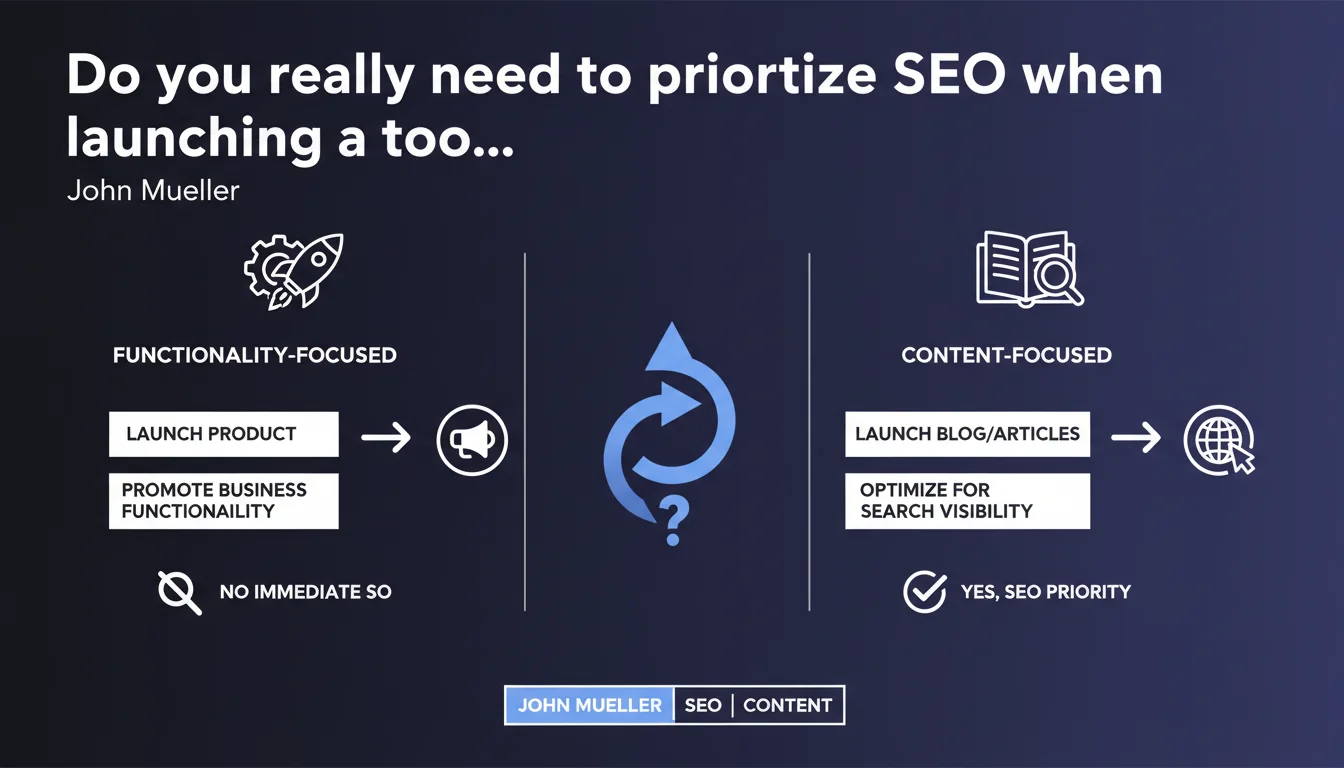
John Mueller argues that functionality-focused sites (tools, SaaS, web applications) don't need to prioritize SEO at launch. Promotion should focus on the business value of the tool rather than immediate organic visibility. A position that deserves nuance depending on your acquisition model.
What you need to understand
What does Google mean by a "functionality-based site"?
Google distinguishes here between utility sites — calculators, SaaS tools, converters, project management platforms — and traditional editorial sites. The idea: when value resides in what your product does (generate invoices, compress images, manage projects), organic search isn't necessarily the priority acquisition channel.
Mueller suggests these sites first gain their audience through direct referrals, word-of-mouth, targeted advertising, or partnerships — not by ranking on generic queries. SEO would come later, once proof of concept is established.
Why does this distinction change everything?
Because quality signals differ radically. An editorial site must demonstrate expertise through content, thematic backlinks, authority built over time. A tool, on the other hand, is judged first on its technical functionality: speed, reliability, UX, conversion rate.
Google implicitly acknowledges that trying to rank immediately on "PDF generator" or "online CRM" with a new product and no user base is a waste of time. Better to convert early users acquired through other channels and let usage signals gradually feed into SEO.
Does this approach apply to all tools?
No. The nuance lies in the acquisition model. A B2B tool sold via sales force has no real interest in investing heavily in SEO at launch. A mass-market freemium tool that lives on organic acquisition — even delayed — cannot ignore technical fundamentals.
- Pure functionality sites (internal tools, closed B2B SaaS) can defer SEO
- Freemium tools with content component (templates, resources, blog) must integrate SEO from design phase
- Marketplaces and platforms live on organic traffic — SEO is structural from day one
- Mueller's distinction mainly concerns sites with no indexable inventory: no product pages, no listings, no catalog
SEO Expert opinion
Is this statement consistent with real-world observations?
Yes and no. Mueller is right on one point: many SaaS startups waste time optimizing for competitive queries they'll never rank for in the short term. Better to validate product-market fit through controllable channels (ads, outbound, partnerships) before tackling SEO.
But the wording is misleading. Saying "no need for SEO promotion" doesn't mean "ignore technical fundamentals". A slow site, poorly structured, with a catastrophic architecture, will be penalized by the algorithm even if it's not trying to rank now. Core Web Vitals, HTTPS security, mobile-first — all that remains mandatory.
What nuances should be added to this rule?
The risk is underestimating SEO debt. Deferring SEO at launch, okay — but building a technically unsound site because you think "SEO will come later" is an expensive mistake. Refactoring architecture, migrating URLs, fixing indexing issues afterward costs 10x more than anticipating them.
[To verify] Mueller doesn't specify when SEO becomes relevant for these sites. Six months after launch? After 10,000 users? When revenue hits a threshold? This lack of concrete benchmark makes the statement unhelpful for founders who need to prioritize.
In what cases does this rule absolutely not apply?
As soon as there's an editorial or transactional dimension. If your tool offers downloadable templates, free resources, a directory, a comparator — in short, indexable content that answers queries — SEO is central. Ignoring this is letting competitors capture all qualified traffic.
Another edge case: tools with freemium organic virality. Canva, Figma, Notion… their growth relies partly on the fact that user creations (designs, docs, boards) generate natural backlinks and referral traffic. SEO may not have been priority on day one, but it was in the product DNA.
Practical impact and recommendations
What should you do concretely when launching a tool?
Separate technical SEO and SEO promotion. The first is non-negotiable: ensure your site loads fast, is mobile-friendly, important pages are indexable, HTML structure is clean. No need for aggressive content marketing, but basics must be solid.
Next, prioritize controllable acquisition channels: Google Ads on your branded keywords, partnerships, Product Hunt, niche communities. Let organic traffic build naturally through mentions, spontaneous backlinks, user sharing. Don't force ranking on hyper-competitive generic queries.
What mistakes should you absolutely avoid?
Don't confuse "no need for SEO promotion" with "we'll handle SEO later". If you build a site without sitemap, with unreadable dynamic URLs, without meta tags, with pure client-side JavaScript — you're creating technical debt that will cost you dearly.
Another trap: ignoring engagement signals. Google measures user behavior even on functionality sites. If your tool has a 90% bounce rate because UX is catastrophic, this will hurt your future visibility — even if you're not trying to rank now.
How do you know if your site meets the fundamentals?
- Verify that Google Search Console correctly indexes your key pages (homepage, product landing pages, conversion pages)
- Test Core Web Vitals via PageSpeed Insights — LCP < 2.5s, FID < 100ms, CLS < 0.1
- Ensure the site is crawlable: no JavaScript blocks preventing indexing, robots.txt correctly configured
- Implement schema.org SoftwareApplication to describe your tool to search engines
- Create a /help or /documentation page with structured FAQ — this content ranks easily on useful long-tail queries
- Set up Google Analytics 4 to track conversions and product events — this data will be valuable when you shift to active SEO
Mueller's recommendation is valid for B2B tools or closed SaaS without editorial component. But never underestimate SEO technical debt: building clean from the start costs less than fixing it afterward.
If you're torn between investing in SEO now or later, the right answer is often "a bit of both": secure technical fundamentals from day one, defer aggressive content creation and link-building until product-market fit is validated. These trade-offs may seem simple in theory, but executing them requires sharp hands-on expertise — which is why many startups choose to bring in an SEO agency from the design phase to avoid costly structural mistakes and keep all options open for future organic growth.
❓ Frequently Asked Questions
Un site SaaS peut-il ranker sans créer de contenu éditorial ?
Faut-il quand même installer Google Search Console au lancement ?
À partir de quel moment un outil doit-il investir dans le SEO ?
Les Core Web Vitals comptent-elles pour un site sans trafic organique ?
Peut-on ignorer le maillage interne sur un site à fonctionnalité ?
🎥 From the same video 10
Other SEO insights extracted from this same Google Search Central video · published on 05/04/2023
🎥 Watch the full video on YouTube →
💬 Comments (0)
Be the first to comment.