
Official statement
Other statements from this video 10 ▾
- □ Pourquoi robots.txt suffit-il (presque toujours) à bloquer l'indexation d'un site de staging ?
- □ La protection par mot de passe est-elle vraiment la solution pour bloquer l'indexation d'un site de staging ?
- □ La balise no-index bloque-t-elle vraiment toute indexation sans exception ?
- □ Les pages orphelines sont-elles vraiment invisibles pour Google ?
- □ Google peut-il vraiment découvrir tous vos sous-domaines ?
- □ Faut-il vraiment soumettre manuellement ses pages importantes au lancement d'un site ?
- □ Faut-il vraiment craindre de publier 7000 articles d'un coup ?
- □ La qualité du contenu bloque-t-elle réellement l'indexation de masse ?
- □ Les listes blanches IP suffisent-elles vraiment à protéger vos sites de staging du crawl Google ?
- □ Faut-il vraiment faire du SEO pour un site à fonctionnalité ?
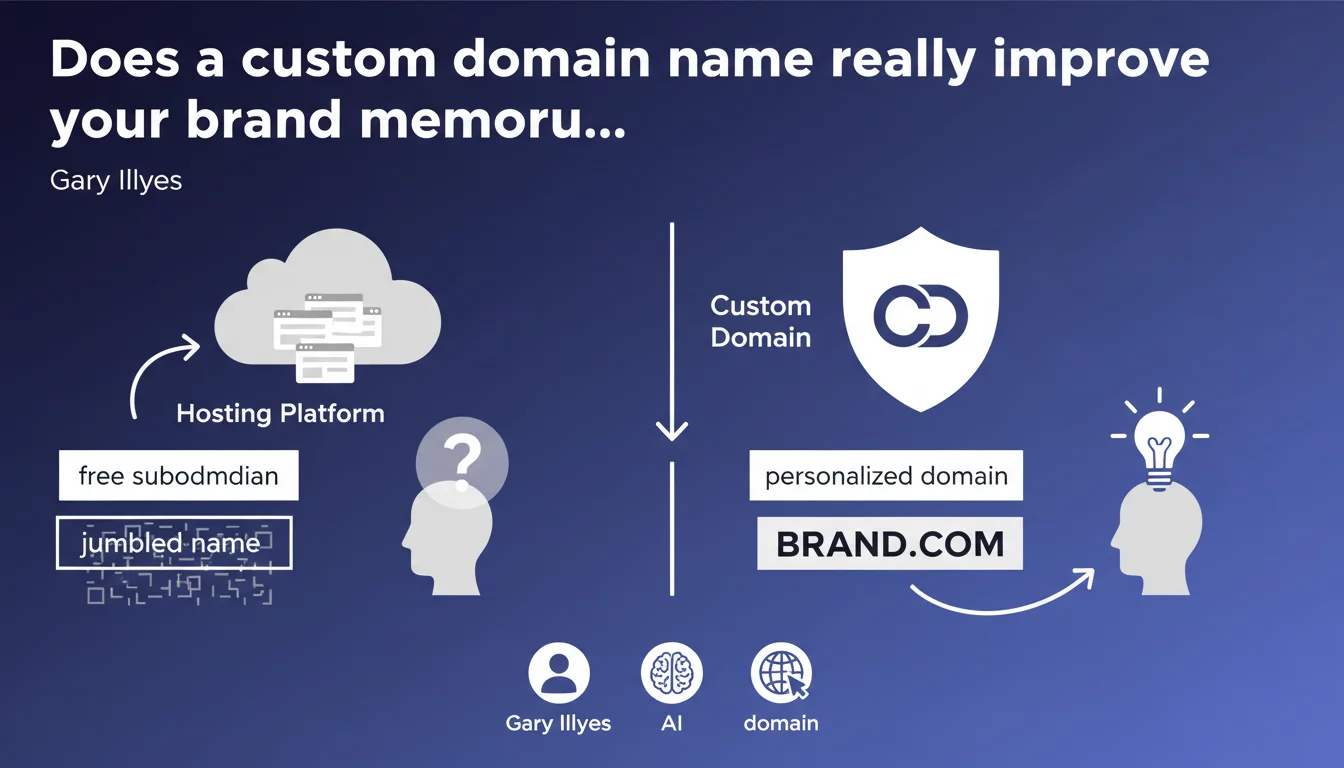
Gary Illyes confirms that a personalized domain name strengthens brand memorability compared to a free hosting platform subdomain. Users remember the domain name, not the hosting platform. It's a clear signal: investing in a custom domain remains fundamental, even for small projects.
What you need to understand
Why does Google take a stance on branding rather than technical SEO?
Gary Illyes' statement goes beyond the purely algorithmic framework to touch on user experience and brand perception. But let's be honest: if Google is talking about it, it's because memorization and recognition indirectly influence measurable signals — direct traffic, bounce rate, retention.
A user who remembers yoursite.com will return directly. A user who only remembers "blogspot" or "wixsite" will search Google again, or worse, won't try at all. The link between branding and SEO is not direct in the algorithm, but it exists in user behavior.
What is a free subdomain and why is it problematic?
Hosting platforms (Wix, Blogger, WordPress.com, Shopify) offer free or entry-level plans with URLs like mysite.blogspot.com or store.wixsite.com/myproduct. The root domain belongs to the platform; you are merely a tenant.
Result: the user associates the content with the platform, not with you. Brand identity dilution is real. And if you migrate later to a custom domain, you lose the history, backlinks, accumulated authority — a complete reset.
What are the concrete risks for an SEO professional who recommends a free subdomain?
Beyond branding, it's a matter of technical control. On a free subdomain, you are subject to platform constraints: limitations on redirects, canonical tags, robots.txt file, sometimes even source code access.
You control neither the architecture nor the indexing velocity. If the platform changes its rules or raises prices, you are tied hand and foot. A serious client deserves a custom domain from the start — it's an investment of €10-15/year, negligible compared to the risks.
- User memorability: a custom domain anchors the brand in the visitor's mind
- Technical control: full mastery of SEO configurations (redirects, canonicals, robots.txt)
- Portability: easy migration to another host without loss of authority
- Credibility: a free subdomain sends an amateur signal, especially in B2B
- Ownership: you own the domain, not the platform
SEO Expert opinion
Is this statement consistent with practices observed in the field?
Absolutely. Sites with a custom domain perform better over time, not through a direct algorithmic boost, but via stronger user metrics: return rate, session time, social sharing. Google measures these indirect signals.
In fifteen years of practice, I've seen dozens of migrations from free subdomains. In every case, the switch to a custom domain is accompanied by improved KPIs — provided redirects are handled correctly. The problem is that many wait too long before making the leap.
What nuances should be added to this Google recommendation?
Gary Illyes doesn't say that a free subdomain penalizes ranking. He's talking about brand memorability. Let's not turn this statement into "Google penalizes Wix or Blogger" — that's false.
If you're testing a concept, a side project, or an MVP, a free subdomain can work temporarily. But as soon as you aim for serious organic traffic or monetization, switch to a custom domain. The gap between these two phases should be as short as possible.
Another nuance: certain platform subdomains (Medium, LinkedIn, even GitHub Pages) benefit from inherited domain authority. But this authority remains fragile and non-transferable. You're building on sand.
In what cases does this rule not apply?
Honestly? Very few. The only contexts where a free subdomain remains acceptable: ephemeral projects (event marketing, seasonal landing page), temporary A/B tests, or content intended to be syndicated on a parent platform.
For any long-term project — website, e-commerce, professional blog, SaaS service — a custom domain is non-negotiable. The cost is trivial, the gain in credibility and control is massive.
Practical impact and recommendations
What should you do concretely to maximize brand memorability through your domain?
Choose a domain name that is short, memorable, and aligned with your brand. Avoid hyphens, numbers, complex spellings. If possible, prioritize a .com or .fr depending on your geographic target.
Make sure the domain is easy to pronounce and to spell — a simple test: say it to someone over the phone, can they write it without error? If not, look for an alternative.
What mistakes should you avoid when choosing or migrating a domain?
Don't underestimate the importance of 301 redirects if you're migrating from a subdomain. Each old URL should point to its new version. One oversight = loss of SEO juice and broken traffic.
Also avoid changing domains too often. Each migration dilutes accumulated authority. If you're unsure between two names, decide quickly — inaction costs more than the wrong choice.
Another pitfall: buying an expired domain with a questionable history. Check via Wayback Machine and tools like Ahrefs or Majestic that the domain wasn't used for spam or black hat practices.
How do you verify that your domain is properly configured for SEO and memorability?
Test HTTPS consistency: your domain should automatically redirect to the secure version. Also verify that www and non-www redirect to a single canonical version (avoid duplicate content).
Properly configure Search Console and Google Analytics on the custom domain from day 1. If you're migrating, submit an address change request in Search Console — it speeds up the transition.
- Choose a short, memorable domain name without hyphens or numbers
- Prioritize a .com or relevant local extension (.fr, .de, etc.)
- Configure HTTPS and redirect www to non-www (or vice versa) consistently
- When migrating, set up 301 redirects for each URL
- Check domain history if expired (spam, past penalties)
- Declare the domain in Google Search Console and Analytics from launch
- If migrating, use the address change tool in Search Console
- Test domain pronunciation and spelling with third parties
❓ Frequently Asked Questions
Un sous-domaine gratuit pénalise-t-il mon référencement Google ?
Puis-je migrer d'un sous-domaine gratuit vers un domaine propre sans perdre mon trafic ?
Quel type d'extension de domaine choisir pour optimiser la mémorisation ?
Un domaine avec tirets ou chiffres impacte-t-il négativement le SEO ?
Combien de temps faut-il à Google pour reconnaître un nouveau domaine après migration ?
🎥 From the same video 10
Other SEO insights extracted from this same Google Search Central video · published on 05/04/2023
🎥 Watch the full video on YouTube →
💬 Comments (0)
Be the first to comment.