
Official statement
Other statements from this video 10 ▾
- □ Pourquoi robots.txt suffit-il (presque toujours) à bloquer l'indexation d'un site de staging ?
- □ La protection par mot de passe est-elle vraiment la solution pour bloquer l'indexation d'un site de staging ?
- □ La balise no-index bloque-t-elle vraiment toute indexation sans exception ?
- □ Google peut-il vraiment découvrir tous vos sous-domaines ?
- □ Faut-il vraiment soumettre manuellement ses pages importantes au lancement d'un site ?
- □ Faut-il vraiment craindre de publier 7000 articles d'un coup ?
- □ La qualité du contenu bloque-t-elle réellement l'indexation de masse ?
- □ Un nom de domaine propre améliore-t-il vraiment la mémorisation de votre marque ?
- □ Les listes blanches IP suffisent-elles vraiment à protéger vos sites de staging du crawl Google ?
- □ Faut-il vraiment faire du SEO pour un site à fonctionnalité ?
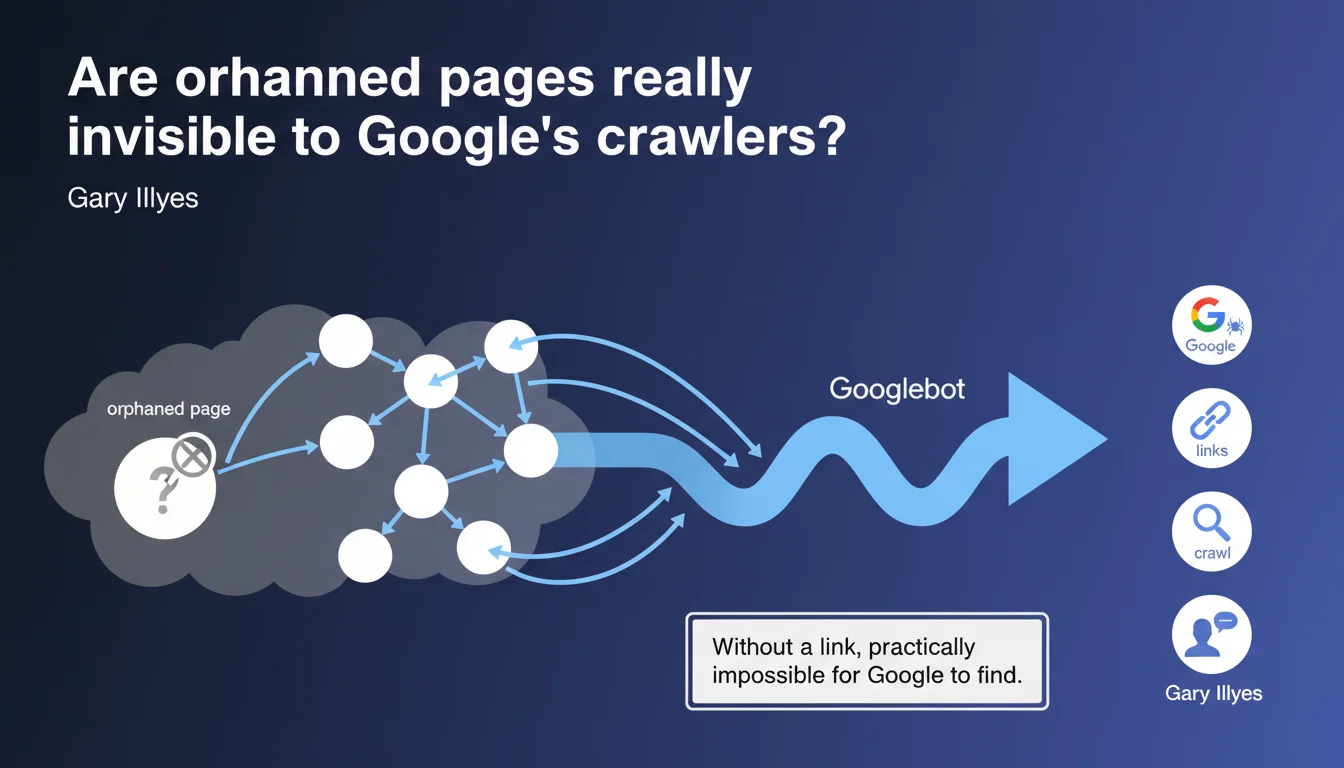
Gary Illyes reiterates a fundamental crawling rule: without a link pointing to a page, Google can barely discover it. URL indexation primarily depends on its connectivity — no internal link, no external link, no mention in a sitemap or elsewhere? The page remains invisible, regardless of its quality. The principle is simple but its implications are vast for site architecture and internal linking strategy.
What you need to understand
Why does Google compare the internet to deep space?
The image used by Illyes is striking: without a link, a resource is lost in vastness. Google discovers most of the Web by following links — from page to page, site to site. An isolated URL that doesn't appear in any crawl path has no chance of being detected by Googlebot.
This comparison highlights the fundamentally graphical nature of the Web: robots navigate by following arcs in a graph of links. A page that has no incoming arcs remains out of reach.
What exactly is an unlinked page?
An unlinked page — called an 'orphaned' page — appears nowhere: not in the menu, not in internal linking, not in a sitemap, not referenced by an external link. It technically exists on the server, but no path leads to it.
Even if the URL is technically accessible, Google will probably never crawl it — except by manually submitting it via Search Console, which remains an exception and not a strategy.
What are the direct consequences for indexation?
- No crawl = no indexation: if Google never visits the page, it cannot enter the index.
- The sitemap is not enough: an XML sitemap guides the crawl, but an orphaned page without any links remains suspicious or low priority.
- Internal linking becomes critical: each important page must be linked from at least one other crawled page, preferably several.
- External backlinks count too: an external mention can trigger the discovery of an otherwise invisible page.
SEO Expert opinion
Is this statement consistent with real-world observations?
Completely. SEO audits regularly confirm that orphaned pages are absent from the index. Even on sites with high crawl budget, if a URL is never linked to, it remains off the radar. The miraculous indexation of an orphaned page without manual intervention is exceptional.
The one caveat: a well-configured XML sitemap can be sufficient provided the site enjoys a good crawl budget and the page is deemed relevant. But counting on the sitemap alone to index hundreds of orphaned pages is naive.
In what cases does this rule seem to be contradicted?
Some SEOs report orphaned pages indexed after manual submission in Search Console. Others observe that URLs discovered via server logs or mentions in external databases sometimes end up crawled.
But these cases remain marginal. [To verify]: Google doesn't communicate the exact extent of these alternative discoveries. Experience shows you should never count on it as an indexation strategy.
Should you delete all orphaned pages?
Not necessarily — some pages can legitimately remain unlinked: post-form confirmation pages, temporary URLs, test content. The challenge is distinguishing involuntary orphans (architecture problem) from intentional ones.
Practical impact and recommendations
How do you identify orphaned pages on your site?
Cross-reference two sources: URLs present in Search Console or your crawl tool, and those present in your sitemap or Analytics. URLs that appear nowhere in internal crawls but exist on the server are orphaned.
Tools like Screaming Frog, OnCrawl, or Botify allow you to compare actual crawling with known URL lists. Any difference reveals potential orphans.
What should you do concretely to fix the problem?
- Audit your site architecture regularly to detect pages with no incoming links.
- Integrate each strategic page into internal linking — at minimum from one higher-level page.
- Enrich XML sitemaps and verify their submission in Search Console.
- Prioritize important pages: if a page matters for business or SEO, it must be linked from several places.
- Avoid creating content without planning its integration into the site structure — each new page must have a crawl path.
- Monitor server logs to identify crawled but unindexed URLs, a possible sign of a discovery problem.
What mistakes should you absolutely avoid?
Never publish strategic content counting only on the sitemap for it to be discovered. The sitemap guides, but internal linking remains the royal road. Another frequent trap: removing internal links during a redesign without planning redirects or alternative paths.
Also avoid multiplying excessive depth levels — a page accessible in 6 clicks from the homepage has little chance of being regularly crawled, even if technically it isn't orphaned.
❓ Frequently Asked Questions
Une page orpheline peut-elle être indexée si elle est dans le sitemap XML ?
Si je soumets manuellement une URL orpheline dans Search Console, sera-t-elle indexée ?
Les backlinks externes peuvent-ils suffire à faire découvrir une page orpheline ?
Combien de niveaux de profondeur maximums pour qu'une page reste crawlable ?
Une page orpheline peut-elle nuire au SEO du reste du site ?
🎥 From the same video 10
Other SEO insights extracted from this same Google Search Central video · published on 05/04/2023
🎥 Watch the full video on YouTube →
💬 Comments (0)
Be the first to comment.