
Official statement
Other statements from this video 10 ▾
- □ Pourquoi robots.txt suffit-il (presque toujours) à bloquer l'indexation d'un site de staging ?
- □ La protection par mot de passe est-elle vraiment la solution pour bloquer l'indexation d'un site de staging ?
- □ La balise no-index bloque-t-elle vraiment toute indexation sans exception ?
- □ Les pages orphelines sont-elles vraiment invisibles pour Google ?
- □ Faut-il vraiment soumettre manuellement ses pages importantes au lancement d'un site ?
- □ Faut-il vraiment craindre de publier 7000 articles d'un coup ?
- □ La qualité du contenu bloque-t-elle réellement l'indexation de masse ?
- □ Un nom de domaine propre améliore-t-il vraiment la mémorisation de votre marque ?
- □ Les listes blanches IP suffisent-elles vraiment à protéger vos sites de staging du crawl Google ?
- □ Faut-il vraiment faire du SEO pour un site à fonctionnalité ?
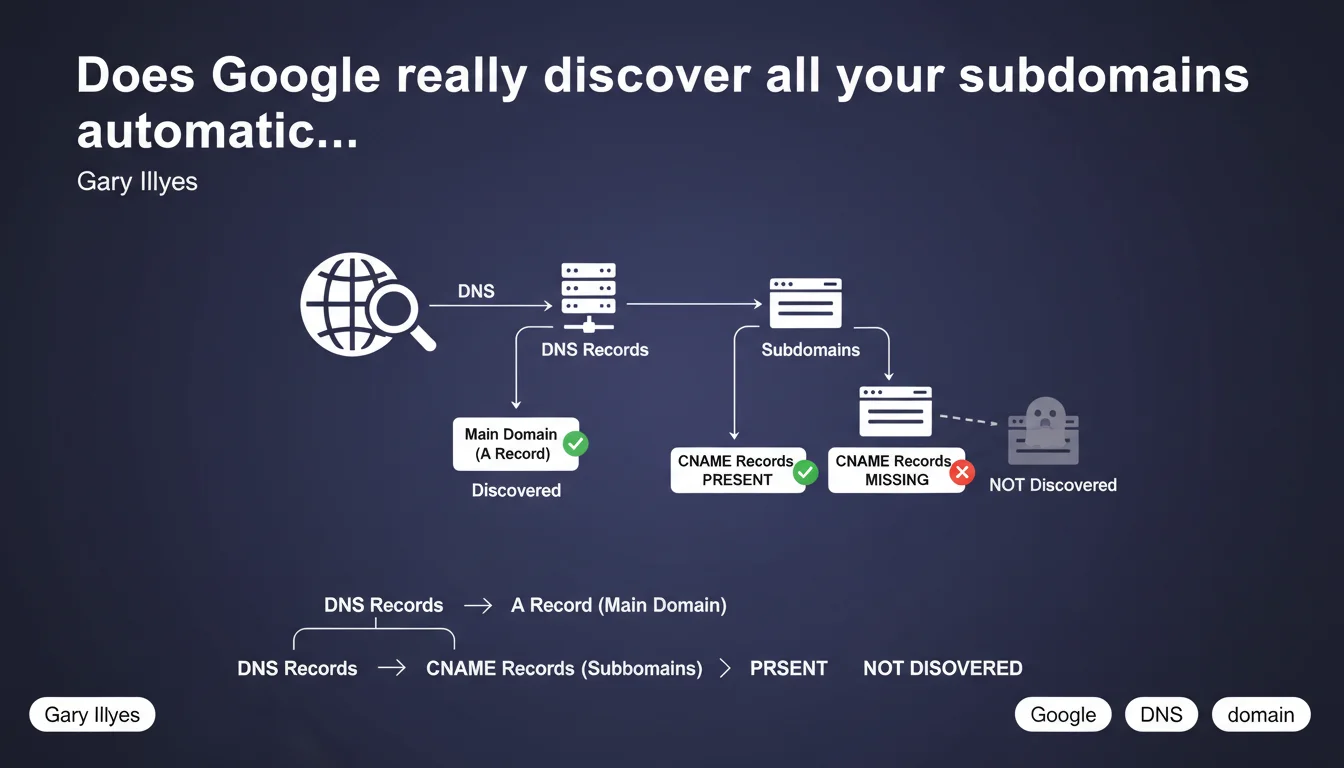
Google discovers websites primarily through A DNS records, which means it finds your main domain first. Subdomains configured as CNAMEs are not automatically discovered if DNS doesn't expose them publicly. In practice: a subdomain invisible at the DNS level remains invisible to Google, even if it technically exists.
What you need to understand
What's this story about A records versus CNAME records really about?
A DNS records point directly to an IP address. This is the type of record Google scans during its discovery phases. Your main domain (example.com) typically has an A record.
CNAME records, on the other hand, create an alias: blog.example.com can point to example.com via CNAME. The problem? If this CNAME isn't publicly exposed in DNS responses, Google will never see it during its automatic discovery phase.
How does Google normally discover a website?
Google uses several methods: external links, sitemaps, Search Console, and indeed DNS queries. But Gary Illyes's statement clarifies a point often overlooked: autonomous discovery via DNS is limited to A records.
A subdomain can exist, be perfectly functional, but remain completely unknown to Google if no links point to it and it doesn't appear in publicly exposed DNS records.
Why does this technical limitation exist?
Google can't guess the existence of subdomains. It doesn't run exhaustive searches through your internal DNS infrastructure. The bot relies on what is publicly announced or discovered through links.
This approach limits the load on DNS servers and avoids invasive discovery attempts. Google expects you to signal the existence of your content, either through links or through your public DNS configuration.
- Google discovers primarily through A DNS records, not hidden CNAMEs
- Unlinked subdomains not exposed in public DNS remain invisible
- Automatic discovery doesn't replace sitemaps and internal links
- A functional subdomain isn't necessarily a discoverable subdomain
SEO Expert opinion
Is this statement consistent with real-world observations?
Absolutely. We regularly observe perfectly configured subdomains that are absent from Google's index for months. The reason? Zero external links, no declared sitemap, and DNS configuration that doesn't expose them through direct A records.
What surprises people is that many professionals still assume Google "scans everything." It doesn't. Google discovers what you explicitly show or what emerges through external signals (links, mentions). [To verify] remains the question of whether Google ever explores CNAMEs indirectly, but Gary Illyes is clear: that's not the standard method.
What nuances should we add to this rule?
First point: an undiscovered subdomain can still be indexed if it receives links or if you declare it in Search Console. DNS discovery is just one channel among many.
Second nuance: this limitation mainly affects complex architectures (multi-site platforms, accessible staging environments, dynamic subdomains). For a typical site with blog.example.com linked from the homepage, no problem — the link is more than enough.
In which cases does this information become critical?
Where it gets tricky is with subdomain migrations, launches of new isolated content, or technical structures where subdomains operate in closed circuits. If you launch promo.example.com without any links from your main site and without a dedicated sitemap, Google could take forever to discover it.
Another classic case: poorly protected development environments. If dev.example.com is publicly accessible but not linked, Google theoretically might never find it via DNS. But watch out — a single accidental link (a forgotten footer, a forum mention) is enough to change everything.
Practical impact and recommendations
What should you actually do to guarantee subdomain discovery?
First step: check your DNS records. Make sure each strategic subdomain has an A record (or AAAA for IPv6), not just an internal CNAME. Use tools like dig or nslookup to confirm what's publicly visible.
Next, explicitly declare each subdomain in Google Search Console as a distinct property. Submit a specific XML sitemap for each one. Leave nothing to chance: passive discovery isn't enough for strategic launches.
What mistakes should you absolutely avoid?
Classic mistake: launching a subdomain with critical content (landing pages, campaigns, new products) without any internal links from the main domain. Even if DNS is correctly configured, the absence of links severely slows down discovery and indexing.
Another trap: assuming a subdomain inherits authority from the main domain. No. Each subdomain is treated as a distinct entity by Google. It must build its own popularity, its own link profile.
How do you verify your subdomains are properly discovered?
Use the site:subdomain.example.com search operator in Google to check indexation. Review index coverage reports in Search Console to identify URLs discovered but not indexed.
Also monitor server logs: if Googlebot never visits a subdomain, it probably hasn't discovered it. Compare crawl frequency between main domain and subdomains to spot anomalies.
- Configure A DNS records for each strategic subdomain
- Declare each subdomain as a distinct property in Search Console
- Submit a specific XML sitemap per subdomain
- Create internal links from the main domain to subdomains
- Verify indexation via
site:and coverage reports - Analyze server logs to confirm Googlebot visits
- Never rely on automatic DNS discovery as your only mechanism
❓ Frequently Asked Questions
Un sous-domaine peut-il être indexé même si le DNS ne l'expose pas via un enregistrement A ?
Faut-il créer une propriété Search Console séparée pour chaque sous-domaine ?
Les enregistrements CNAME empêchent-ils l'indexation d'un sous-domaine ?
Comment vérifier si mes sous-domaines sont découvrables via DNS ?
Un sous-domaine hérite-t-il de l'autorité du domaine principal ?
🎥 From the same video 10
Other SEO insights extracted from this same Google Search Central video · published on 05/04/2023
🎥 Watch the full video on YouTube →
💬 Comments (0)
Be the first to comment.