
Official statement
Other statements from this video 9 ▾
- □ Should you really rely on Search Console recommendations to optimize your website?
- □ Does Google Search Console finally remember your filters every time you switch between properties?
- □ Should you worry about Google removing the cache link and cache: operator?
- □ Should you really worry about the srsltid parameter in e-commerce URLs for SEO?
- □ Should you really build a separate page for every keyword variant out there?
- □ Why is Google suddenly refreshing its documentation on video SEO, title links, and crawlers?
- □ Should you really restrict the Indexing API to specific content types only?
- □ Can you really use URLs with hash symbols as canonical tags, or will Google ignore them?
- □ Should you switch to AVIF now that Google Images supports it?
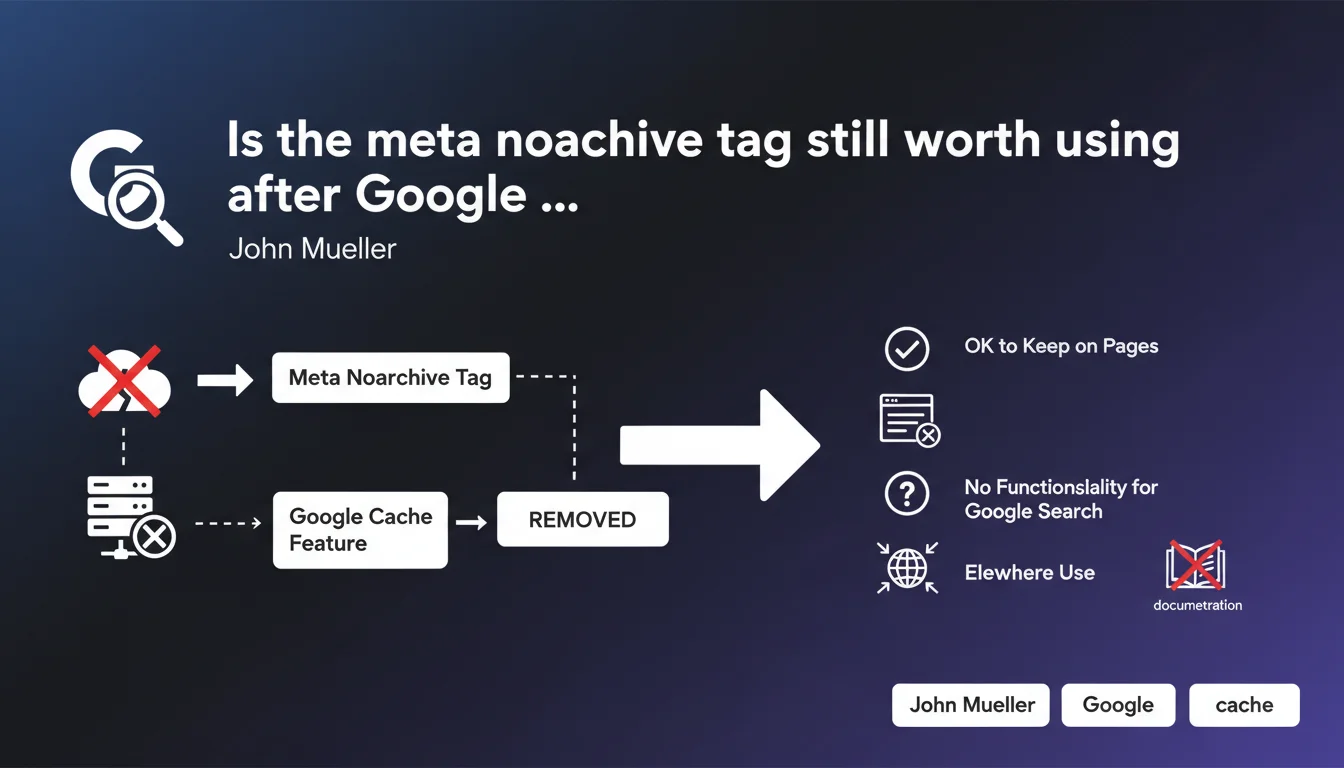
Google confirms that the meta noarchive tag is now completely useless for its search engine following the removal of cached pages. The tag has been removed from official documentation. You can safely leave it in place without any risk, but it no longer serves any purpose for Google.
What you need to understand
Why did this tag exist in the first place?
The meta noarchive tag allowed you to prevent Google from displaying a cached version of your pages in search results. When a user clicked on "Cached" in the SERPs, they accessed a static copy of the page as Googlebot had crawled it.
This functionality was primarily used to protect sensitive content or frequently changing pages — like news sites, real-time price platforms, or paywalled content. The cache could show an outdated version or reveal content that shouldn't be freely accessible.
What happened when the cache was removed?
Google quietly removed the "Cached" link from search results. No more visible cache equals no need for a tag to block it. The logic is undeniable.
John Mueller clarifies that this tag no longer has any functionality for Google Search. It has been removed from official documentation, which confirms that it is no longer taken into account by the algorithm.
Can this tag serve a purpose outside of Google?
Yes, and that's an important point. Other search engines or web services may still interpret this tag. Bing, for example, still offers a cache system in certain contexts.
Google explicitly states that it is "acceptable" to keep the tag if it serves other purposes. In other words: no penalty, no negative impact — just complete indifference.
- The meta noarchive tag does nothing anymore for Google Search since the cache removal
- It has been removed from official Google documentation
- You can leave it in place without risk if it serves other search engines or services
- Other platforms may still use it — verify on a case-by-case basis
SEO Expert opinion
Is this statement consistent with observed practices?
Yes, absolutely. Ever since the "Cached" link disappeared from SERPs, we knew this tag would lose its relevance. What Mueller confirms is that Google has officially abandoned it from a technical processing standpoint.
No surprise here. The consistency is perfect between the product evolution (removal of visible cache) and the technical directive (abandonment of the tag). It's logical housekeeping in the documentation.
What nuances should be added to this message?
First nuance: Google can still cache your pages internally for its crawl and indexation. The tag only prevented public cache display, not technical storage. This distinction has always existed.
Second nuance: if you use this tag for other search engines (Bing, Yandex, etc.), keep it. [To verify]: the actual impact of this tag on third-party search engines is not exhaustively documented. Test if you really depend on it.
Are there any cases where this rule could cause problems?
Frankly? No. This tag never had an impact on ranking or indexation. It only controlled a secondary display feature.
If your SEO strategy relied on noarchive to block the cache, that was probably a poor strategy from the start. The real control mechanisms — robots.txt, noindex, authentication — remain in place and function normally.
Practical impact and recommendations
What should you concretely do with this tag?
If it's present on your pages only for Google: you can remove it without risk. It serves no purpose anymore and unnecessarily clutters your HTML.
If you use it for other search engines or third-party services: leave it in place. Google ignores it, but it may still have a role elsewhere. Check the documentation of other platforms you're targeting.
What mistakes should you avoid when cleaning up your meta tags?
Don't confuse noarchive with noindex or nofollow. The latter still have a direct impact on indexation and link following. Removing noarchive changes nothing about your indexation.
Avoid launching a massive cleanup of all meta tags without prior audit. Some still have a function, even if discreet. Proceed methodically: identify, test, remove.
How can you verify that this removal has no side effects?
Use a crawling tool (Screaming Frog, Oncrawl, Botify) to list all pages containing the tag. Cross-reference this list with your analytics: verify that no strategic pages depend on specific cache-related behavior.
Monitor your logs after removal. If a third-party bot behaves differently (less crawling, errors), it may be interpreting this tag. Such cases are rare, but it's better to check.
- Audit your meta noarchive tags with an SEO crawler
- Check whether third-party search engines (Bing, Yandex) still use this directive on your pages
- Remove the tag from templates if it only serves Google
- Document the change in your SEO strategy to prevent accidental reintroductions
- Monitor your crawl logs for 2-4 weeks after removal
❓ Frequently Asked Questions
La suppression de la balise noarchive peut-elle affecter mon indexation ?
Dois-je remplacer noarchive par une autre balise ?
Bing et les autres moteurs utilisent-ils encore cette balise ?
Google stocke-t-il toujours mes pages en cache même sans affichage public ?
Y a-t-il un risque à laisser la balise en place ?
🎥 From the same video 9
Other SEO insights extracted from this same Google Search Central video · published on 13/11/2024
🎥 Watch the full video on YouTube →
💬 Comments (0)
Be the first to comment.