
Official statement
Other statements from this video 9 ▾
- □ Should you really rely on Search Console recommendations to optimize your website?
- □ Does Google Search Console finally remember your filters every time you switch between properties?
- □ Should you worry about Google removing the cache link and cache: operator?
- □ Is the meta noarchive tag still worth using after Google killed its cache feature?
- □ Should you really worry about the srsltid parameter in e-commerce URLs for SEO?
- □ Should you really build a separate page for every keyword variant out there?
- □ Why is Google suddenly refreshing its documentation on video SEO, title links, and crawlers?
- □ Can you really use URLs with hash symbols as canonical tags, or will Google ignore them?
- □ Should you switch to AVIF now that Google Images supports it?
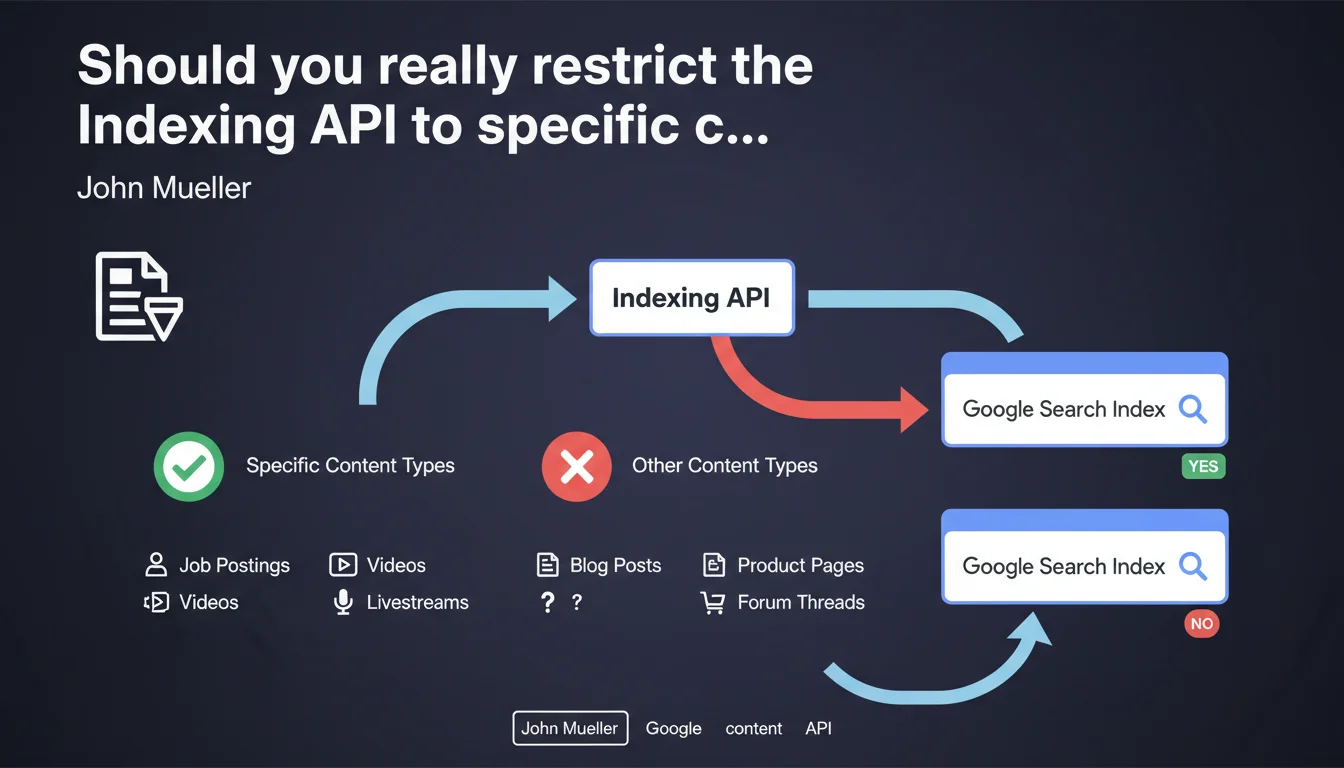
Google has officially clarified that the Indexing API is restricted to content types explicitly mentioned in its documentation (job postings and live-streamed events). Using this API to index other types of pages now constitutes a violation of the terms of service. SEOs exploiting it to accelerate the indexing of standard pages are taking a documented risk.
What you need to understand
Why is Google enforcing this restriction now?
The Indexing API has existed for several years, but its misuse has become widespread. Many practitioners use it to force rapid indexing of product pages, blog articles, or category pages — something it was never designed for.
Mueller's clarification comes at a time when Google is likely observing saturation of indexing resources dedicated to priority content. By refocusing the API on job postings and live events, Google is protecting verticals where freshness is critical.
What content types are actually allowed?
The official documentation lists two precise categories: JobPosting (job listings) and BroadcastEvent (livestreamed events). Nothing else.
This closed list means that all other content types — e-commerce products, editorial articles, service pages — must go through standard indexing channels: XML sitemaps, natural crawling, or submission via Search Console.
What are the concrete risks of circumventing this rule?
Google doesn't detail penalties, but violating an API's terms of service can result in access revocation. In the worst case, it could signal manipulative behavior and impact the trust given to your domain.
More practically, the actual effectiveness of the API on unauthorized content remains undocumented and likely degraded. In other words: the game is probably no longer worth the candle.
- The Indexing API is strictly reserved for job postings and live events
- Use on other page types violates the terms of service
- Risks include access revocation and potential negative signal
- Standard channels (sitemap, crawl) remain the official path for all other content
SEO Expert opinion
Is this limitation really new or just a reminder?
Let's be honest: this restriction was already in the original documentation. What's changing is the explicit tone from Mueller and the emphasis on this limitation in a context where misuse had become commonplace.
Many third-party SEO tools integrated the API as a feature to "boost indexing" without clarifying that it violated guidelines. Google is now closing the door — or at least clearly displaying the prohibition sign.
Does the API really work better than standard methods?
Field feedback is mixed. On compliant JobPosting sites, the API does accelerate appearance in Google for Jobs. For other content types, [To be verified] the actual impact remains anecdotal compared to a well-configured sitemap and optimized crawl budget.
The myth of "instant indexing" often rests on correlations: pages submitted via API are also those monitored closely, optimized more, and promoted through other channels. It's difficult to isolate the pure effect of the API.
What are the real alternatives for accelerating indexing?
Classic levers still work — and remain compliant: dynamic sitemap updated in real-time, manual submission via Search Console for critical pages, reinforced internal linking, immediate social sharing.
For large sites, the real work remains crawl budget optimization: reducing unnecessary pages, fixing redirect loops, improving server speed. It's less glamorous than a magic API, but infinitely more effective long-term.
Practical impact and recommendations
What should you do if you're already using the API outside authorized cases?
First step: audit your current usage. List the page types submitted via the API and verify their compliance (JobPosting or BroadcastEvent only).
If you're outside the rules, plan a gradual migration to standard channels. Test first on a sample of pages to measure the real impact on your indexing timelines — you may discover that the difference is negligible.
How to optimize indexing without the API?
Strengthen your XML sitemap: segment it by content type, update timestamps in real-time, actively submit new URLs via Search Console.
Work on your internal architecture: an important page should be accessible in 3 clicks maximum from the homepage, with contextual links from already well-crawled pages.
Monitor your crawl budget in Search Console reports. If Googlebot is wasting time on unnecessary pages (facet filters, infinite pagination), fix it via robots.txt or strategic noindex tags.
- Identify all current Indexing API usage on your domain
- Verify compliance: only JobPosting and BroadcastEvent are authorized
- Implement a dynamic sitemap updated in real-time
- Optimize internal linking to priority pages
- Clean up unnecessary URLs that consume crawl budget
- Monitor indexing timelines via Search Console after migration
❓ Frequently Asked Questions
Puis-je utiliser l'API d'indexation pour mes pages produits e-commerce ?
Que se passe-t-il si je continue à utiliser l'API hors cas autorisés ?
L'API d'indexation accélère-t-elle vraiment l'indexation comparée à un sitemap ?
Comment soumettre rapidement une nouvelle page sans l'API ?
Les outils tiers qui proposent l'indexation via API sont-ils conformes ?
🎥 From the same video 9
Other SEO insights extracted from this same Google Search Central video · published on 13/11/2024
🎥 Watch the full video on YouTube →
💬 Comments (0)
Be the first to comment.