
Official statement
Other statements from this video 9 ▾
- □ Faut-il vraiment compter sur les recommandations de la Search Console pour optimiser son site ?
- □ Pourquoi Google Search Console conserve-t-elle enfin vos filtres entre chaque changement de propriété ?
- □ Faut-il s'inquiéter de la suppression du cache Google et de l'opérateur cache: ?
- □ Faut-il encore utiliser la balise meta noarchive après la suppression du cache Google ?
- □ Le paramètre srsltid dans les URLs e-commerce : faut-il s'en préoccuper en SEO ?
- □ Faut-il vraiment créer une page pour chaque variante de mot-clé ?
- □ Faut-il vraiment limiter l'usage de l'API d'indexation aux types de contenu spécifiques ?
- □ Pourquoi les URLs avec symbole dièse ne peuvent-elles pas servir de canoniques ?
- □ Faut-il adopter le format AVIF maintenant que Google Images le supporte ?
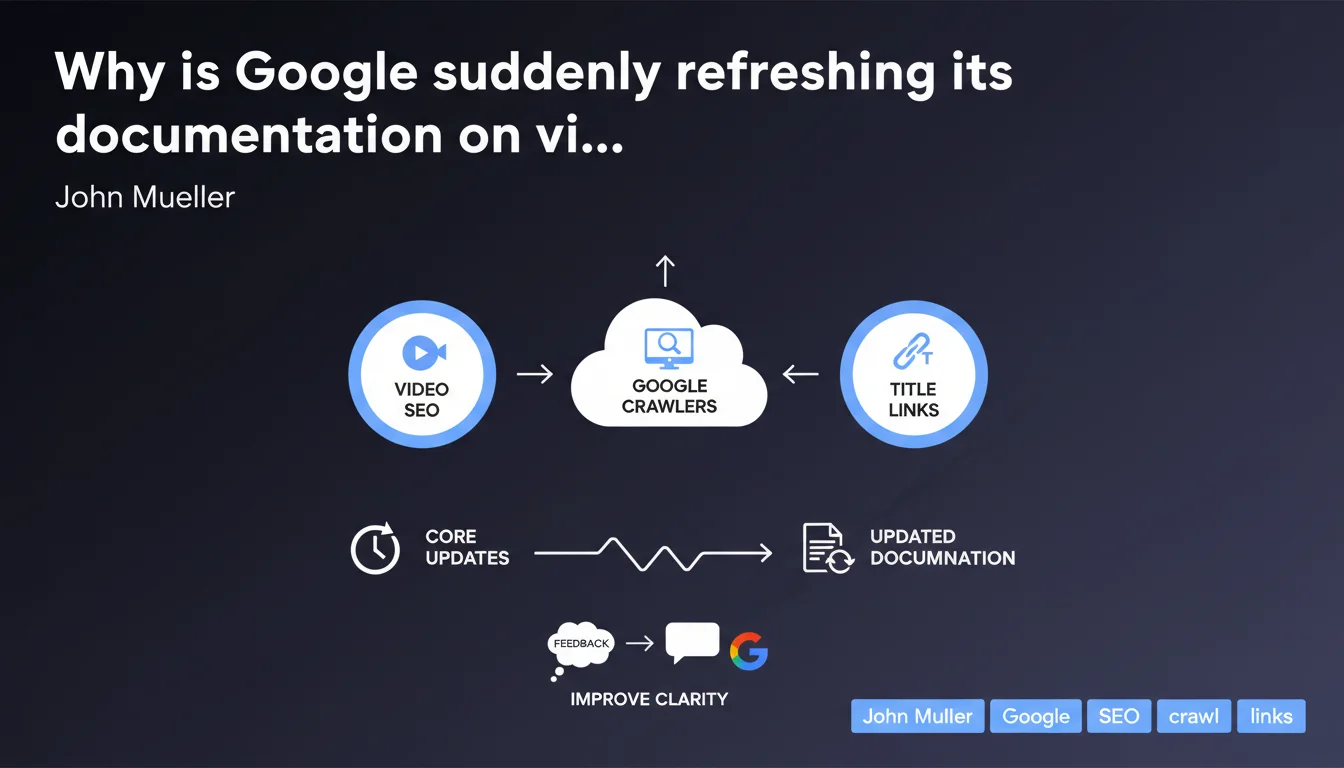
Google has refreshed several pages of its official documentation: video SEO, title links, crawlers, and core updates. The Search Central team is inviting professionals to submit feedback through dedicated forms to further refine the clarity of these resources. Nothing groundbreaking, but the timing and scope are worth a closer look.
What you need to understand
What exactly has changed in this documentation?
Google has revised four pillars of its technical documentation: video SEO (structured data, indexing), title links (how Google generates the titles displayed in SERPs), different crawlers (Googlebot, Googlebot-Image, etc.), and core updates (major algorithmic updates).
No revolutionary announcements — these are adjustments for clarity and consistency. Google hasn't detailed line-by-line what shifted, but the stated goal is to make these pages more readable for SEO practitioners and developers.
Why is Google updating these pages now?
Several hypotheses. First, all these topics have experienced algorithmic evolution or behavioral changes in recent months: video indexing optimization with the rise of YouTube Shorts and rich results, repeated adjustments to title link generation, multiplication of specialized crawlers.
Second, Google probably receives many vague or redundant questions on these subjects — clarifying the documentation upfront reduces noise in official support channels and forums.
What are the key takeaways?
- Broad scope: video, titles, crawlers, core updates — four different pillars, but all linked to indexing and SERP display.
- No new algorithmic update announced: this is documentation, not a rollout or new directive.
- Invitation for feedback: Google is actively seeking to improve clarity — a signal that the current documentation was lacking on certain points.
- Pay attention to details: even if no major changes are flagged, nuances in wording can reveal shifts in practice or recommendations.
SEO Expert opinion
Is this update hiding unannounced algorithmic changes?
Unlikely. Google typically separates algorithm announcements (via Search Status Dashboard or Danny Sullivan's tweets) from purely editorial documentation updates.
That said, it's not uncommon for wording adjustments to reveal discrete behavioral shifts. For example, if the section on title links now specifies cases where Google systematically ignores the <title>, there's been movement on the algo side — even if no formal "update" was communicated. [To verify] by comparing archived versions of the documentation.
Should you really rely on this documentation to anticipate changes?
Google's official documentation remains a floor, not a ceiling. It describes what Google says it does, not always what it actually does in 100% of cases — especially on subjects as complex as title link generation or crawler behavior with certain types of JavaScript.
The feedback invitation is telling: it shows Google implicitly acknowledges gray areas or contradictions between documented theory and observed practice. If you spot a gap between what the documentation says and what you see in production, report it — but don't base critical SEO strategy solely on these pages.
What's the risk if you ignore this update?
Low risk in the short term. Documentation updates don't change the game overnight. But systematically ignoring these adjustments means missing weak signals: a crawler section reword may indicate Google is about to tighten its stance on certain User-Agents, a nuance on video SEO may reveal that certain practices are becoming obsolete.
Practical impact and recommendations
What should you do concretely after this announcement?
Start by identifying the sections that affect you. If your site incorporates a lot of video: read the video SEO documentation line by line. If Google is systematically rewriting your titles: check the title links page.
Next, archive the old version of these pages (via Wayback Machine or screenshot) and compare it with the new one. Spot additions, deletions, rewording. Ask yourself: does this change anything in my current strategy? Am I already following the updated recommendations?
What mistakes should you avoid when interpreting this documentation?
Don't over-interpret. A documentation update is not a red alert signal. Google won't penalize your site because you haven't yet applied a nuance added yesterday in an obscure paragraph.
Also avoid treating every word as gospel. Google's documentation often remains intentionally generic to cover billions of different use cases. If a point seems unclear, test it on a sample of pages before rolling out a global change.
How do you verify your site complies with the new recommendations?
- Audit video structured data (VideoObject) via Search Console and validate they meet the updated specs
- Compare declared
<title>tags vs how they appear in SERPs: if Google is massively rewriting them, revisit your title structure and length - Check server logs to identify active Google crawlers on your site and their behavior (frequency, targeted pages)
- Review the core updates guidance: confirm your site isn't relying solely on short-term tactics or thin content
- Report feedback to Google if you spot an inconsistency between documentation and observed behavior — it helps everyone
❓ Frequently Asked Questions
Cette mise à jour de documentation impacte-t-elle directement le classement de mon site ?
Dois-je obligatoirement envoyer un feedback à Google après avoir lu ces pages ?
Où trouver les anciennes versions de la documentation pour comparer les changements ?
Les crawlers mentionnés dans la doc sont-ils tous actifs sur mon site ?
Si Google réécrit mes title links, est-ce un signal négatif ?
🎥 From the same video 9
Other SEO insights extracted from this same Google Search Central video · published on 13/11/2024
🎥 Watch the full video on YouTube →
💬 Comments (0)
Be the first to comment.