
Official statement
Other statements from this video 9 ▾
- □ Faut-il vraiment compter sur les recommandations de la Search Console pour optimiser son site ?
- □ Pourquoi Google Search Console conserve-t-elle enfin vos filtres entre chaque changement de propriété ?
- □ Faut-il s'inquiéter de la suppression du cache Google et de l'opérateur cache: ?
- □ Faut-il encore utiliser la balise meta noarchive après la suppression du cache Google ?
- □ Le paramètre srsltid dans les URLs e-commerce : faut-il s'en préoccuper en SEO ?
- □ Faut-il vraiment créer une page pour chaque variante de mot-clé ?
- □ Pourquoi Google met-il soudainement à jour sa documentation sur le SEO vidéo, les liens de titre et les crawlers ?
- □ Faut-il vraiment limiter l'usage de l'API d'indexation aux types de contenu spécifiques ?
- □ Pourquoi les URLs avec symbole dièse ne peuvent-elles pas servir de canoniques ?
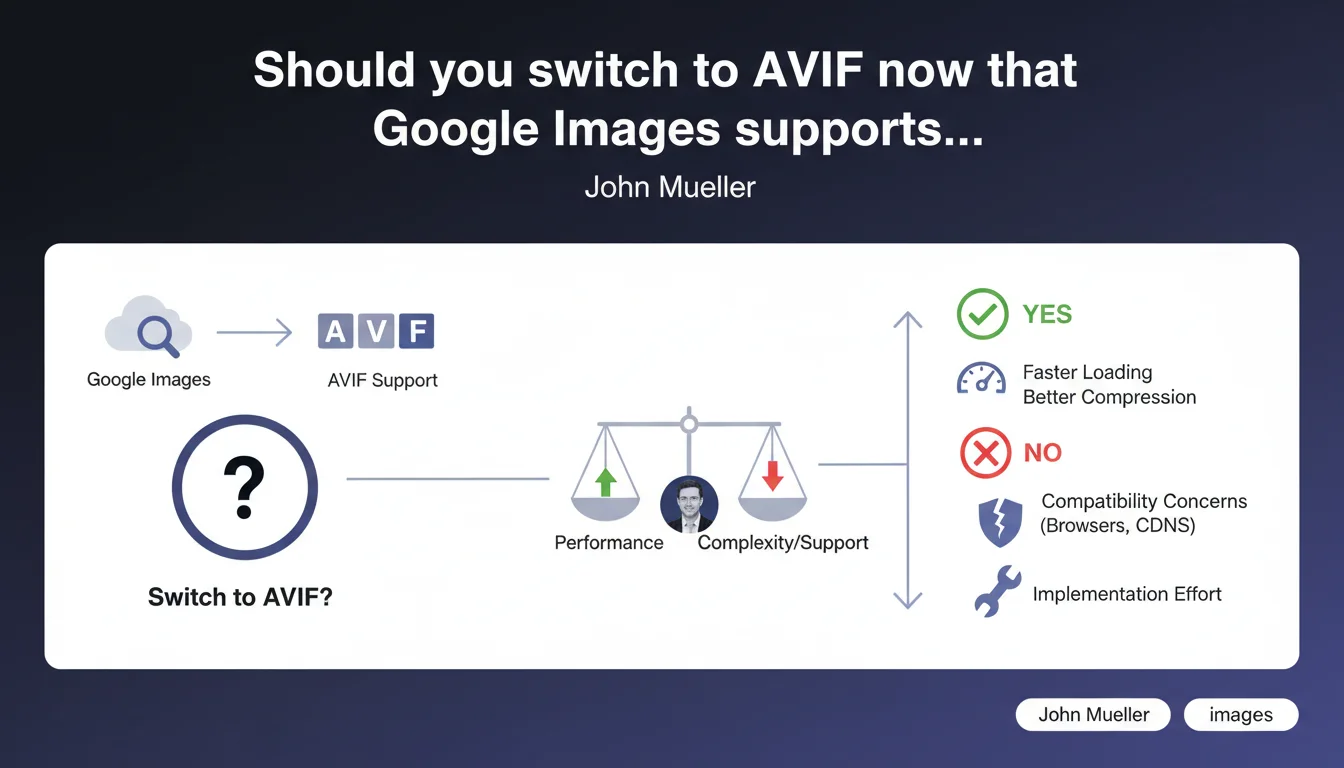
Google Images now supports the AVIF image format. This modern codec offers superior compression compared to WebP and JPEG, but its adoption requires a cost-benefit analysis based on your technical context and audience.
What you need to understand
What is the AVIF format and why is Google integrating it now?
AVIF (AV1 Image File Format) is a modern image format based on the AV1 video codec. It promises much more aggressive compression than WebP — sometimes up to 50% file size reduction at equivalent visual quality.
Google is integrating it into Google Images because the format has reached sufficient technical maturity and major browsers (Chrome, Firefox, Safari since iOS 16) now support it. It's the logical follow-up to WebP, but with even stronger theoretical compression gains.
What does this support concretely change for image SEO?
Google can now crawl, index, and display your AVIF images in image search results. Before this announcement, uploading AVIF files would have been counterproductive — Google didn't handle them correctly.
The reduced file weight of AVIF images directly impacts your Core Web Vitals, particularly LCP (Largest Contentful Paint). A hero image in AVIF loads faster than JPEG or WebP, which improves user experience and potentially your ranking.
What are the technical prerequisites for using AVIF?
First, you need to verify that your technical stack supports AVIF encoding: image server, CDN, CMS. Not all environments natively compile this format.
Next, implement a fallback strategy using the <picture> tag: offer AVIF as priority, then WebP, then JPEG/PNG for older browsers. Without a fallback, you'll block a portion of your users.
- Browser support: Chrome 85+, Firefox 93+, Safari 16+ (iOS 16+, macOS Ventura+)
- Compression: up to 50% reduction compared to JPEG, 20-30% vs WebP depending on cases
- Encoding time: AVIF is slower to encode than WebP — watch out for on-the-fly image processing pipelines
- Mandatory fallback: approximately 10-15% of visitors still use AVIF-incompatible browsers
- SEO: Google now indexes AVIF the same way as JPEG, PNG, WebP, and GIF
SEO Expert opinion
Does this announcement really change the game for image SEO?
Let's be honest: no, not radically. Google has supported WebP for years, and few sites have massively adopted it. AVIF is objectively superior, but the incremental gain from WebP → AVIF is less dramatic than JPEG → WebP.
The real benefit lies in cases where every kilobyte counts: e-commerce sites with hundreds of product images, media outlets with heavy photo galleries, creative portfolios. For a corporate blog with 3 images per article, the impact will be marginal.
Do the performance gains observed in the field justify the switch?
Tests show that AVIF can indeed reduce file size by 30 to 50% compared to WebP on complex images (realistic photos, gradients). But on simple visuals (vector illustrations, UI screenshots), the gain is less obvious — sometimes WebP remains more efficient. [To verify] depending on your visual content type.
And that's where it gets tricky: AVIF encoding is CPU-intensive. If you generate thumbnails on the fly, processing time can triple compared to WebP. Some CDNs charge for this CPU time, which wipes out the bandwidth savings.
Should you migrate your entire image library right now?
No. A massive migration is rarely justified. Start by identifying the 20% of images that generate 80% of traffic: homepage, top product pages, viral articles. Test AVIF on these critical assets and measure the real impact on your Core Web Vitals.
Another point: Google doesn't say whether AVIF provides a ranking advantage in Google Images. Technical support doesn't mean an SEO bonus. Until proven otherwise, it's a web performance lever, not a direct ranking signal.
Practical impact and recommendations
What should you concretely do if you want to adopt AVIF?
Start with a compatibility audit: web server (Apache/Nginx must serve the correct image/avif MIME type), CDN (Cloudflare, Fastly support AVIF but certain settings are required), CMS or static site generator.
Next, implement the <picture> structure with multiple sources. Minimal example:
<picture>
  <source srcset="image.avif" type="image/avif">
  <source srcset="image.webp" type="image/webp">
  <img src="image.jpg" alt="Description">
</picture>
The browser automatically chooses the first format it supports. The final <img> serves as universal fallback.
What metrics should you monitor to measure impact?
Track your Core Web Vitals before/after via Google Search Console, PageSpeed Insights, or a RUM (Real User Monitoring) tool. Focus on LCP — that's where AVIF delivers the most.
Also monitor the crawl rate of Googlebot Image in your server logs. If your AVIF files are being properly indexed, you should see requests with the Googlebot-Image User-Agent targeting these files. No requests = configuration issue.
What errors should you avoid during rollout?
Classic mistake: forgetting the fallback. Result: broken images on Safari 15, pre-Android 12, older Edge. Test on BrowserStack or equivalent.
Another trap: encoding AVIF with overly aggressive quality settings. AVIF can produce visual artifacts at very low quality. Don't go below a quality factor of 60-65 (0-100 scale), except for A/B tests validating acceptability.
- Verify that your server/CDN correctly serves the
image/avifMIME type - Implement a WebP + JPEG/PNG fallback using
<picture> - Test rendering on Safari iOS 15, Android 11, pre-Chromium Edge
- Measure CPU impact of AVIF encoding if generating on the fly
- Compare AVIF file weight vs WebP on your actual images (not generic benchmarks)
- Monitor LCP before/after in Google Search Console (Core Web Vitals tab)
- Verify in logs that Googlebot-Image crawls your .avif files correctly
- Update image sitemaps if you use them
❓ Frequently Asked Questions
Est-ce que Google privilégie les images AVIF dans le classement de Google Images ?
Faut-il remplacer toutes mes images WebP par de l'AVIF ?
Mon CMS WordPress supporte-t-il AVIF nativement ?
Quel est le taux de compatibilité navigateur pour AVIF actuellement ?
L'encodage AVIF est-il vraiment plus lent que WebP ?
🎥 From the same video 9
Other SEO insights extracted from this same Google Search Central video · published on 13/11/2024
🎥 Watch the full video on YouTube →
💬 Comments (0)
Be the first to comment.