
Official statement
Other statements from this video 8 ▾
- □ Has mobile-first indexing really been a game-changer for SEO since 2016?
- □ Is the meta keywords tag still worth anything for SEO in 2025?
- □ Does using Google Analytics or Chrome really boost your SEO rankings?
- □ Why does Google normalize your HTML even when it's broken?
- □ Does CSS really influence the SEO weight of your H1-H6 tags?
- □ How does Caffeine actually ingest Googlebot data into Google's search index?
- □ Should you really de-optimize certain pages to boost your SEO performance?
- □ Why does Google document only one single meta tag in its official SEO guide?
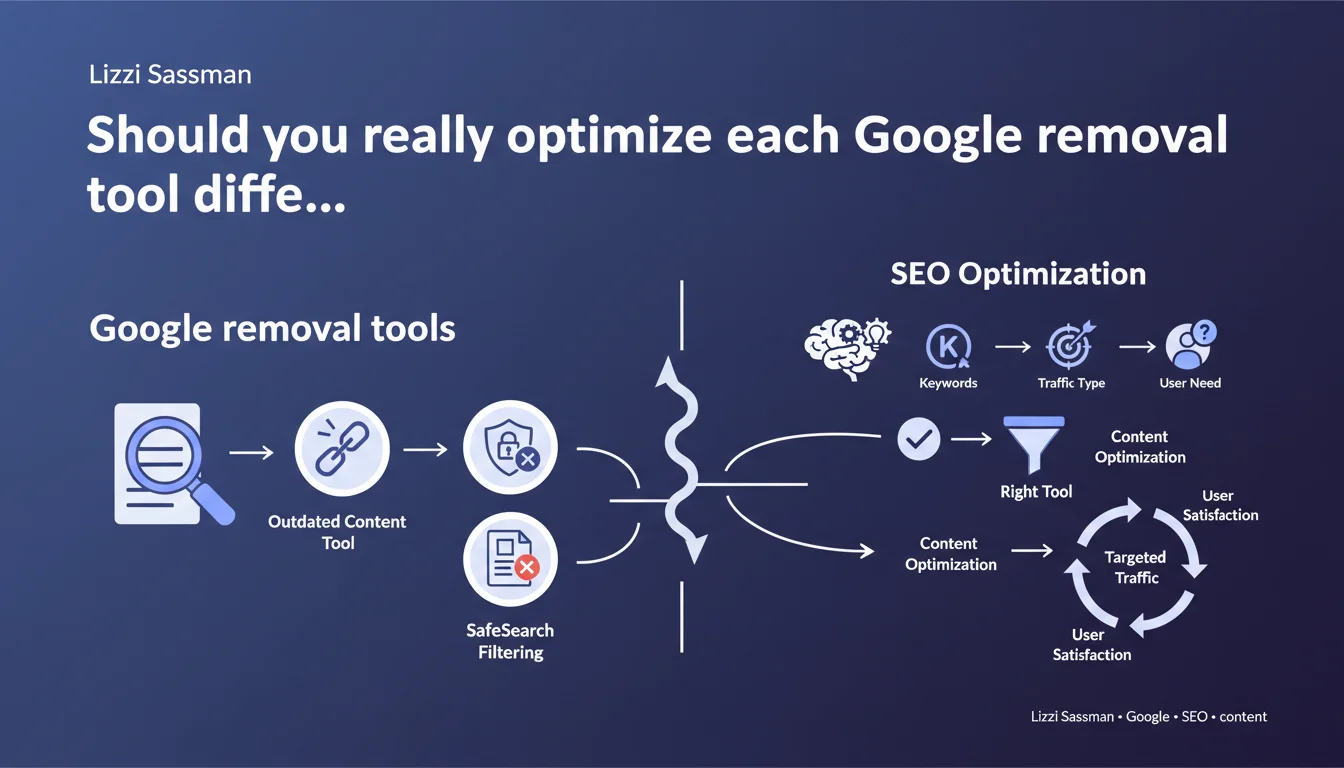
Google recommends optimizing the documentation of its various removal tools for specific keywords in order to guide users to the right tool. In practical terms, this means that each help page should target distinct queries based on the actual need (emergency removal, deindexing, GDPR takedown, etc.). The implication for SEOs: even for technical documentation, search intent takes priority.
What you need to understand
Why is Google talking about SEO optimization for its own tools?
The statement may seem trivial, but it reveals a reality: even Google struggles to correctly direct its own traffic. Their removal tools are numerous (Search Console, legal removal request form, SafeSearch, emergency removal tool) and users often end up on the wrong form.
The idea is straightforward: each tool must rank on different queries that match actual intent. For example, someone searching "remove page from Google urgently" should not land on the standard GDPR process that takes weeks. And vice versa.
What does this teach us about Google's SEO approach?
Google applies to its own documentation the principles it has preached for years: target intent, not just generic keywords. Each page must answer a specific need with specific vocabulary.
It's also an implicit admission that keyword targeting remains relevant — even in 2025, even for Google. Otherwise why bother optimizing each tool differently? The algorithm should theoretically understand it on its own, right? Except it doesn't. The reality on the ground is that you still need to guide the machine.
What are the essential takeaways for an SEO practitioner?
- Search intent takes priority: two similar pages should target different queries if they answer distinct needs
- Semantic context matters: use the exact vocabulary that users employ in their context (urgency, legal, technical, etc.)
- Even giants need to optimize: if Google has to do it for its own documentation, so do you
- One page = one specific job: don't try to cover everything on a single "remove content" URL
- Cannibalization can come from vague vocabulary: two pages with generic terms will compete with each other
SEO Expert opinion
Is this approach really new or just repackaged common sense?
Let's be honest: it's basic SEO common sense. Targeting different keywords for different pages has been standard practice since 2010. What's interesting is that Google feels the need to publicly say it for its own tools.
It confirms two things. One: their algorithm doesn't perform miracles on its own, even on their own properties. Two: on-page optimization remains a powerful lever if it's well thought out. No need to over-interpret — just apply the fundamentals correctly.
What nuances should we apply to this statement?
The risk is falling into keyword stuffing 2.0: creating 15 ultra-targeted pages that all look the same. Google is talking here about tools that are truly different with distinct processes. This isn't permission to duplicate content by simply swapping out 3 keywords.
The critical nuance — and this is where things get tricky for many sites — is that each page must have genuine unique value. If your two pages on "urgent removal" and "immediate takedown" say exactly the same thing with just a different title, you're missing the point. The intent must be different, so the content must be too.
In what cases can this strategy backfire?
If your site lacks sufficient authority or crawl budget, multiplying targeted pages can become counterproductive. You're fragmenting your signals instead of concentrating them. For a small site, sometimes a solid pillar page is better than a complex architecture of micro-pages.
Another edge case: sectors where users don't make a clear distinction in their searches. If 90% of your users type "remove content from Google" without specifying context, creating 5 ultra-targeted pages serves no purpose — you first need to rank on this generic query with a hub page, then segment.
Practical impact and recommendations
What should you concretely do to apply this logic?
First step: map your pages by actual intent, not by administrative category. List your similar content and ask yourself: does the user searching for A really have the same need as the one searching for B? If yes, merge them. If no, differentiate clearly.
Second step: analyze SERPs for each targeted query. Look at what's currently ranking. If Google shows very different pages for "remove page from Google" vs "temporarily deindex URL," it's because it detects distinct intents. Align your content accordingly.
Third step: adjust vocabulary and on-page signals. Title, H1, introduction, semantic field — everything must reflect the specific intent. Don't try to cast a wide net on a narrow page; it doesn't work anymore.
What mistakes should you avoid with this approach?
Classic mistake: creating near-identical pages with just swapped keywords. Google isn't fooled. If the content brings nothing different, you're creating cannibalization and soft duplicate content.
Another trap: neglecting internal architecture. Having 10 well-targeted pages is good. But if they link poorly to each other or if the linking structure creates confusion, you lose the effect. Think hub-and-spoke: one pillar page + clearly differentiated satellite pages.
How can you verify that your targeting strategy is coherent?
- Run a cannibalization audit with Search Console: identify pages ranking on the same queries
- Verify that each page targets a distinct keyword cluster, not ultra-similar variations
- Analyze bounce rate and user behavior: if visitors leave quickly, the page isn't answering their intent
- Test your titles and meta descriptions: do they clearly reflect the difference between your pages?
- Check your internal linking: does it logically guide the user to the right page based on their need?
- Measure conversions or actions by page: a well-targeted page should have a specific engagement rate
🎥 From the same video 8
Other SEO insights extracted from this same Google Search Central video · published on 03/11/2025
🎥 Watch the full video on YouTube →
💬 Comments (0)
Be the first to comment.