
Official statement
Other statements from this video 8 ▾
- □ Le mobile-first indexing a-t-il vraiment changé la donne en SEO depuis 2016 ?
- □ Utiliser Google Analytics ou Chrome améliore-t-il vraiment votre référencement ?
- □ Pourquoi Google normalise-t-il votre HTML même quand il est cassé ?
- □ Le CSS influence-t-il réellement le poids SEO de vos balises H1-H6 ?
- □ Comment Caffeine ingère-t-il vraiment les données de Googlebot dans l'index ?
- □ Faut-il vraiment dé-optimiser certaines pages pour améliorer ses performances SEO ?
- □ Faut-il vraiment optimiser différemment chaque outil de suppression Google ?
- □ Pourquoi Google ne documente-t-il qu'une seule balise meta dans son guide SEO officiel ?
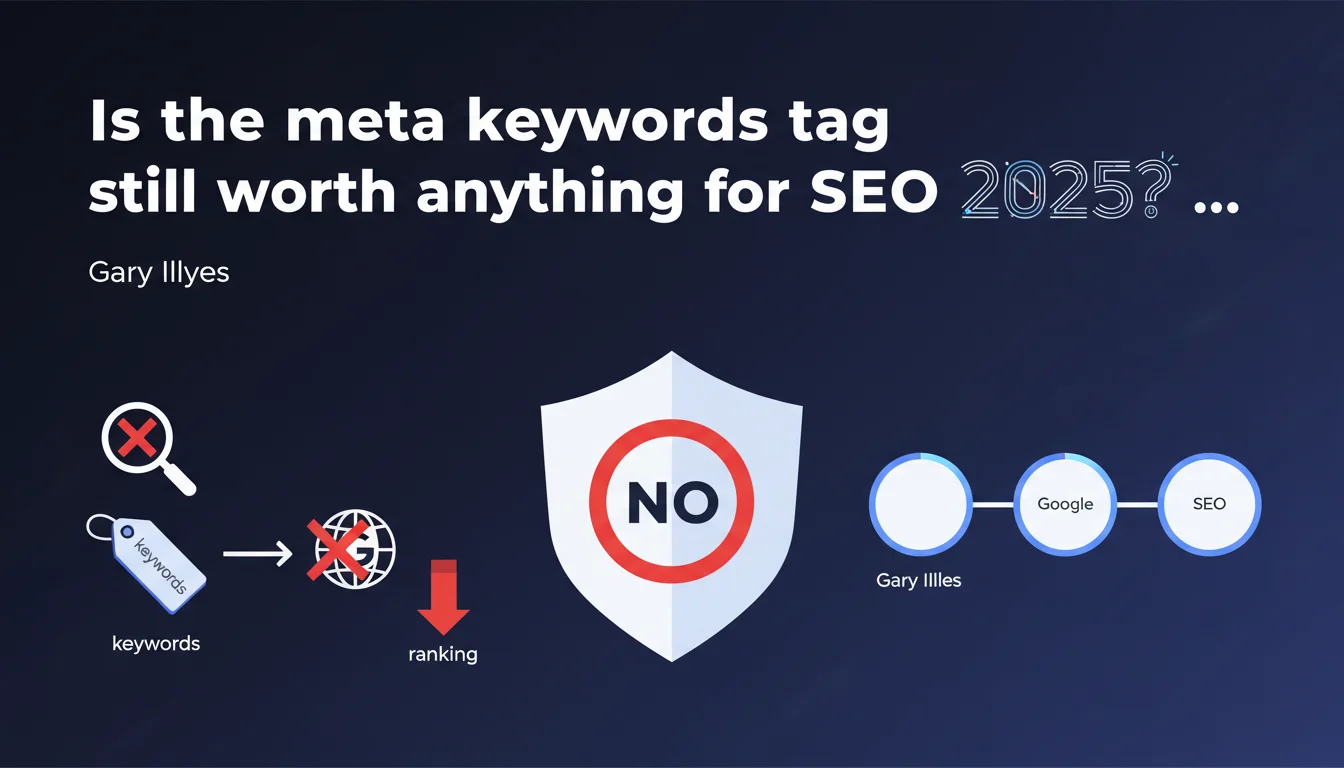
Google does not and has never used the meta keywords tag for ranking. This tag is completely ignored by Google's algorithm and always has been. In short, it's dead code on your pages.
What you need to understand
Why has Google ignored this tag from the very beginning?
The meta keywords tag was created in the 1990s, when search engines primarily relied on metadata provided by webmasters. The problem? It was massively abused.
Unscrupulous webmasters would stuff it with dozens of unrelated keywords just to manipulate search results. Google decided from its inception to never include it in its ranking algorithm.
Does this statement apply only to Google?
Yes, and that's an important distinction. Other search engines historically used this tag — notably Bing and Yahoo in their early days. But today, Bing has also confirmed that it no longer uses this tag for ranking.
Yandex in Russia might still leverage it to some extent, but for the vast majority of global organic traffic, this tag is dead and buried.
How does it differ from meta description and meta robots?
This is crucial not to confuse. The meta description tag doesn't directly impact ranking either, but it influences click-through rate from the SERPs — which has a measurable indirect effect.
Tags like meta robots (noindex, nofollow, etc.) have a direct technical impact on indexation and crawling. The meta keywords tag, on the other hand, is strictly useless for Google.
- Meta keywords: no impact on Google ranking, never used
- Meta description: no direct ranking signal, but influences CTR
- Meta robots: technical control of indexation and crawling
- Removing the meta keywords tag will never penalize your site
- Keeping it will never help you either — it's just useless code
SEO Expert opinion
Does this statement change anything about our SEO practices?
No, and that's precisely the point. Gary Illyes is simply reaffirming a position that Google has held for over 20 years. This isn't news, it's a reminder.
Why this reminder now? Because we still see — and it's astonishing — CMSs, SEO plugins, and "best practices" recommending you fill in this tag in 2025. A complete waste of time.
Are there any cases where this tag could be useful?
Let's be honest: technically, it can serve internal site search engines. Some proprietary search systems still exploit it to categorize content.
But for public SEO, on Google and similar engines? Zero utility. If your agency or service provider is still spending time on this, you should question their actual expertise.
Is there any risk in keeping it on your site?
No direct penalty, no. Google ignores it, period. But there is an indirect risk: revealing your keyword strategy to competitors who inspect your source code.
Some competitive intelligence tools still crawl these tags to identify your target topics. Why make their job easier — and besides, it lightens your HTML.
Practical impact and recommendations
Should we remove this tag from all our pages?
The short answer: yes, if you have the time and resources. The nuanced answer: it's not a critical priority if your technical backlog is already overflowing.
Removing the meta keywords tag slightly lightens your HTML, eliminates a potential vector for competitive information leakage, and cleans up your code. But it won't earn you any ranking positions.
If your CMS generates it automatically, simply disable the option. If it's hard-coded in your templates, take advantage of your next technical overhaul to remove it.
How do I check if my site still uses this tag?
Two simple approaches. First option: inspect the source code of a handful of strategic pages (homepage, main categories, top content). Look for <meta name="keywords"> in the <head>.
Second approach, more systematic: use Screaming Frog or a similar crawler to extract all meta tags from your site. Export the data and filter on "keywords". You'll immediately see the scope of the cleanup needed.
What other tags really deserve our attention?
Focus your energy on what truly matters. The title tag remains the most powerful on-page ranking signal — it must be unique, precise, and contain your primary keyword.
The meta description, while not impacting ranking, directly influences your CTR in the SERPs. A well-written description can increase your traffic by 20-30% at equal positions.
The meta robots tags (with their canonical and hreflang variants) control the technical architecture of your indexation. A mistake here can cost you dearly in visibility.
- Check for the presence of meta keywords on your main pages via manual inspection or crawling
- Disable automatic generation of this tag in your CMS or SEO plugin
- Remove hard-coded tags from your templates if manually coded
- Audit your title tags and meta descriptions — these are what really matter
- Verify proper configuration of your meta robots and canonical tags
- Train your editorial teams to stop wasting time on meta keywords
- Document this rule in your internal SEO guidelines to prevent any backtracking
🎥 From the same video 8
Other SEO insights extracted from this same Google Search Central video · published on 03/11/2025
🎥 Watch the full video on YouTube →
💬 Comments (0)
Be the first to comment.