
Official statement
Other statements from this video 8 ▾
- □ Le mobile-first indexing a-t-il vraiment changé la donne en SEO depuis 2016 ?
- □ La balise meta keywords sert-elle encore à quelque chose en SEO ?
- □ Utiliser Google Analytics ou Chrome améliore-t-il vraiment votre référencement ?
- □ Pourquoi Google normalise-t-il votre HTML même quand il est cassé ?
- □ Le CSS influence-t-il réellement le poids SEO de vos balises H1-H6 ?
- □ Comment Caffeine ingère-t-il vraiment les données de Googlebot dans l'index ?
- □ Faut-il vraiment dé-optimiser certaines pages pour améliorer ses performances SEO ?
- □ Faut-il vraiment optimiser différemment chaque outil de suppression Google ?
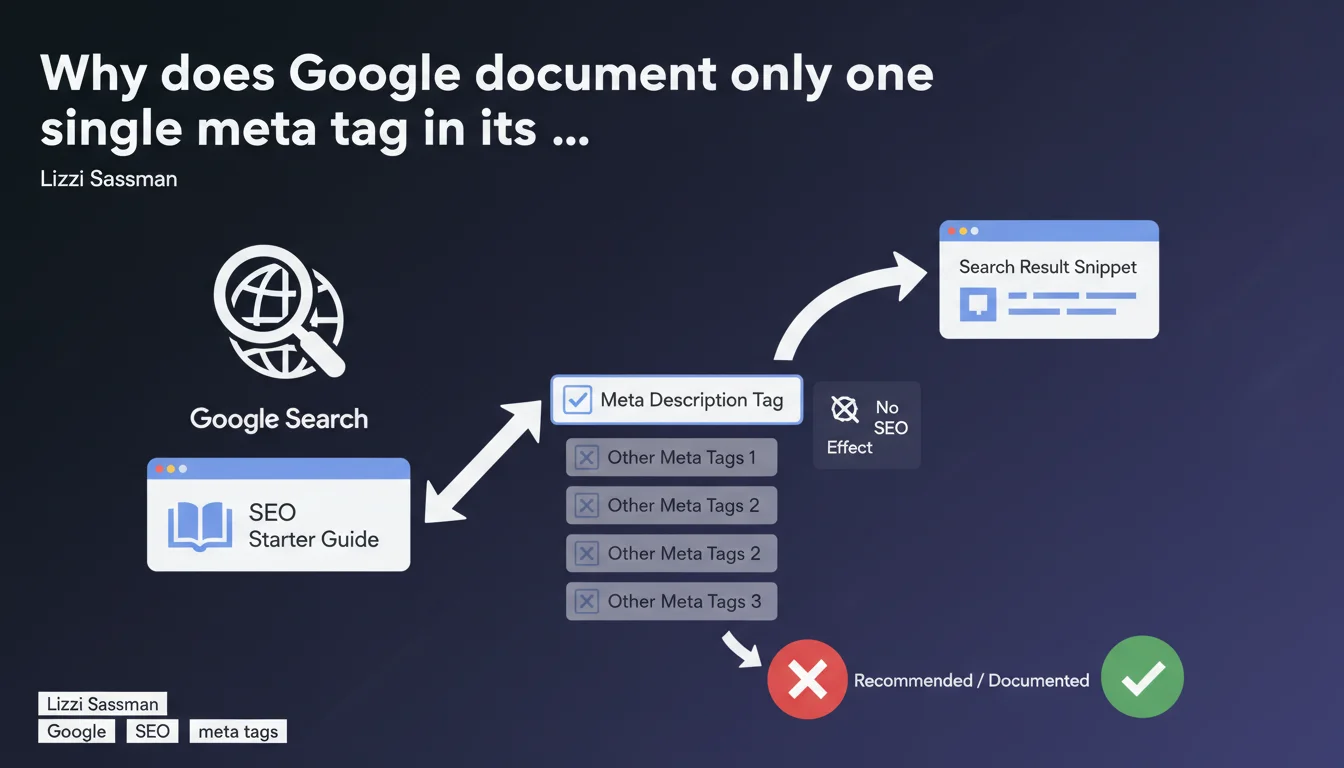
In its SEO Starter Guide, Google explicitly recommends only one meta tag: the meta description. Other meta tags are deliberately ignored because they generally have no impact on search rankings. This simplification choice reveals a lot about what Google truly considers a priority.
What you need to understand
What does this exclusivity granted to the meta description really mean?
Google makes a radical cut in its official guide. Among all existing meta tags — keywords, robots, author, and others — only the meta description earns its place. This is not an oversight, it's a message.
The SEO Starter Guide is aimed at beginners, true, but this drastic selection reveals what Google judges as truly worth mastering. If a tag doesn't appear in this reference document, it's because it doesn't deserve your attention according to Mountain View.
Does the meta description really have an impact on rankings?
Let's be clear: the meta description is NOT a ranking factor. Google has repeated this dozens of times. So why document it if it doesn't influence rankings?
Because it impacts your click-through rate (CTR) in search results. A good meta description improves the attractiveness of your snippet, which can indirectly influence traffic — and potentially the behavioral signals that Google observes.
Why are other meta tags being sidelined?
The meta keywords tag has been dead since 2009. The robots tag can be useful in specific cases, but it falls under advanced technical management, not basic SEO.
Google intentionally simplifies the message to prevent beginners from wasting time on optimizations with no value. It's also a way to combat persistent SEO myths that encourage stuffing sites with useless tags.
- Only the meta description appears in Google's official guide
- This choice reflects what Google considers priority and useful
- The meta description does not influence rankings but improves CTR
- Other meta tags are ignored because they have no measurable SEO effect
- This simplification aims to eliminate obsolete practices
SEO Expert opinion
Is this position consistent with what we observe in the field?
Absolutely. In 15 years of practice, I've seen countless over-optimized sites with useless meta tags. Not a single one ever progressed because of them.
On the other hand, a well-crafted meta description? That can boost your CTR by 20-30% on certain competitive queries. And when your competitor displays a generic snippet against your persuasive meta description, you win clicks — even if you're in position 3 and they're in position 2.
What nuances need to be added to this statement?
Google doesn't document certain tags that remain technically important: robots, canonical, hreflang. Why? Because the Starter Guide targets fundamentals, not advanced technique.
These tags are not useless — they're just absent from Google's simplified discourse. Don't neglect them if you manage a multilingual site, an e-commerce site with product variants, or a complex architecture.
Is Google underestimating the importance of the meta description?
Paradoxically, yes. By documenting it only for its cosmetic role (improving the snippet), Google obscures its indirect impact on engagement.
A better CTR can send positive signals to Google: users prefer your result. Over time, this can influence your ranking — not directly, but via user behavior. Google will never say this explicitly, but field data shows it.
Practical impact and recommendations
What should you concretely do with this information?
Stop wasting time on meta tags with no value. No meta keywords, no fanciful meta author tags, no tags invented by a WordPress plugin.
Focus your efforts on writing unique meta descriptions for your strategic pages. Target 150-160 characters, include your value proposition, and think UX before SEO.
How do you verify that your meta descriptions are optimal?
Audit your pages with high traffic potential. Identify those with CTR below average in Google Search Console (Performance > Pages).
Test different formulations: direct questions, numerical benefits, calls to action. Measure the impact on CTR after 2-3 weeks. Iteration is key.
What mistakes must you absolutely avoid?
Never duplicate your meta descriptions. Google ignores them and generates its own extracts — you lose control of the snippet.
Don't overload with keywords. Your meta description addresses humans who will click, not an algorithm that ignores it for rankings.
- Remove all unnecessary meta tags (keywords, non-standard author)
- Write unique meta descriptions for strategic pages
- Limit to 150-160 characters to avoid truncation
- Analyze CTR in Search Console to identify pages to optimize
- Test different formulations and measure impact over 2-3 weeks
- Never duplicate meta descriptions between pages
- Prioritize persuasion and clarity over keyword stuffing
🎥 From the same video 8
Other SEO insights extracted from this same Google Search Central video · published on 03/11/2025
🎥 Watch the full video on YouTube →
💬 Comments (0)
Be the first to comment.