
Official statement
Other statements from this video 8 ▾
- □ Le mobile-first indexing a-t-il vraiment changé la donne en SEO depuis 2016 ?
- □ La balise meta keywords sert-elle encore à quelque chose en SEO ?
- □ Pourquoi Google normalise-t-il votre HTML même quand il est cassé ?
- □ Le CSS influence-t-il réellement le poids SEO de vos balises H1-H6 ?
- □ Comment Caffeine ingère-t-il vraiment les données de Googlebot dans l'index ?
- □ Faut-il vraiment dé-optimiser certaines pages pour améliorer ses performances SEO ?
- □ Faut-il vraiment optimiser différemment chaque outil de suppression Google ?
- □ Pourquoi Google ne documente-t-il qu'une seule balise meta dans son guide SEO officiel ?
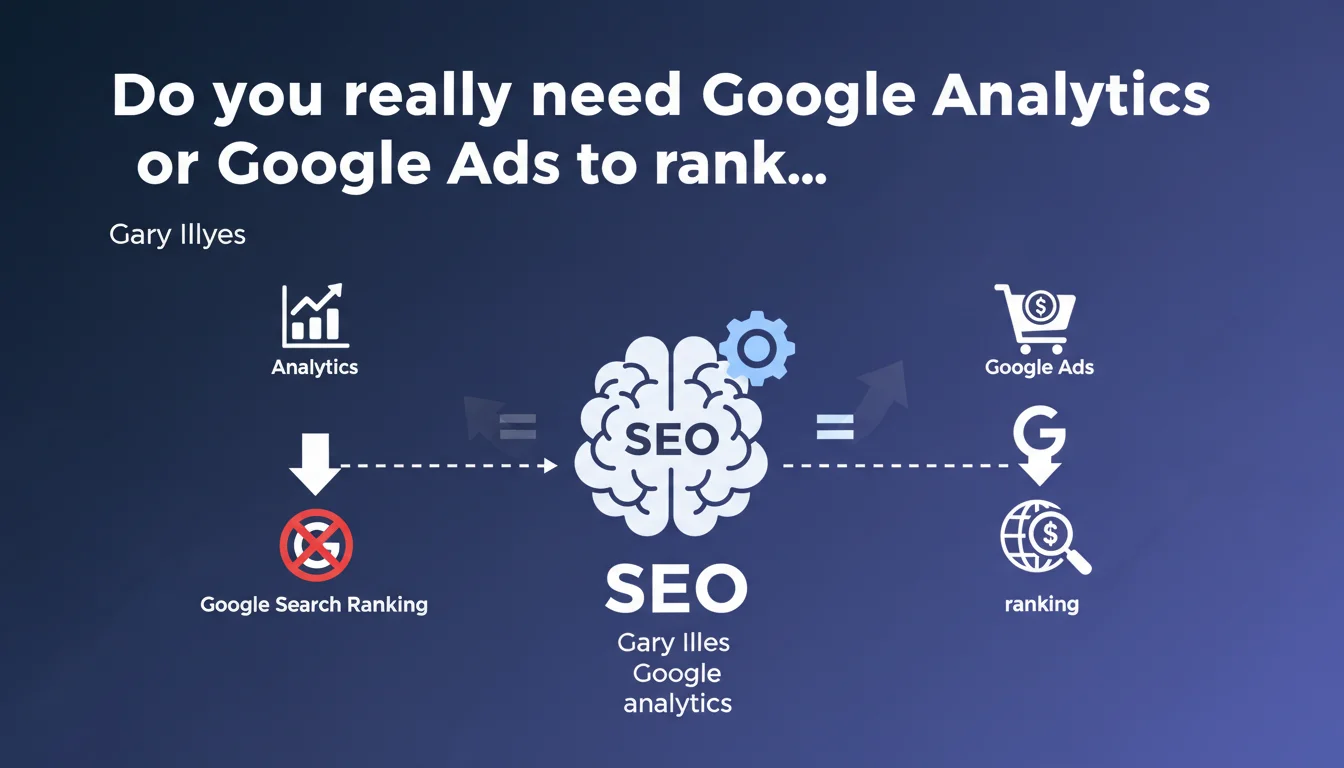
Google claims that none of its products (Analytics, Chrome, Ads, etc.) provides direct SEO advantages. Using Gmail, Google Workspace, or other Google services does not influence your positions in search results. This statement aims to debunk persistent myths about the so-called "bonuses" of the Google ecosystem.
What you need to understand
Why does Google feel the need to clarify this point?
Because the myth of internal advantage has persisted for years in the SEO community. How many times have you heard that using Google Analytics or hosting your emails with Google conferred a mysterious little boost?
This belief relies on seemingly sound logic — Google would have access to more data about sites using its services, so it could favor them. Except Lizzi Sassman sets the record straight: no Google product generates SEO advantage.
What exactly is covered by this statement?
We're talking about the entire Google ecosystem: Analytics, Tag Manager, Google Ads, Chrome, Gmail, Workspace, Fonts, Maps, reCAPTCHA... the list is long. None of these services has a direct impact on your organic rankings.
The underlying idea? Google compartmentalizes its systems. The Search team doesn't dip into Analytics data to decide who deserves the top position. At least, that's the official version — and it has the merit of being consistent with previous statements.
Does this neutrality really apply to all scenarios?
The statement is clear, but the devil is in the details. There are indirect effects that Google doesn't explicitly mention here.
For example, using Google Fonts via its CDN can improve loading speed thanks to caching — and speed impacts SEO. Similarly, a fast and well-hosted site (even on Google Cloud) performs better than a slow site, but it's not the fact of using Google Cloud that boosts the ranking.
- No direct bonus linked to using Google products (Analytics, Ads, Chrome, etc.)
- Google claims to compartmentalize its data — Search doesn't consult Analytics for ranking
- Indirect effects exist (technical performance, UX) but don't constitute a deliberate competitive advantage
- This clarification aims to debunk persistent myths in the SEO community
SEO Expert opinion
Is this statement really consistent with what we observe in the field?
Let's be honest — yes and no. On one hand, nothing in empirical data proves that using Analytics gives a boost. Sites without any Google products rank very well, while others with the entire Google ecosystem struggle to take off.
On the other hand, there's a nuance that Google glosses over a bit too quickly: behavioral data. Chrome collects usage signals (time on page, bounce rate, etc.) that can indirectly influence the algorithm through user experience metrics. Google says this isn't an "advantage" linked to the product itself, but rather a measure of the site's actual quality. Technically correct, but the boundary is thin.
Why does this confusion persist then?
Because correlation is not causation, and many well-ranked sites use the Google ecosystem. But it's often because these sites are managed by competent teams that use the best tools — not because Google favors them.
The other factor? Confirmation bias. Someone migrates to Google Analytics, sees their positions climb two weeks later, and concludes it's related. When it was probably due to technical optimizations made at the same time.
Should we really take this statement at face value?
Yes, overall. Google has no strategic interest in lying about this point — it would create a catastrophic antitrust precedent. Favoring its own products in Search would be a gift to regulators, and Google knows it.
That said, let's keep a critical eye. Official statements reflect stated policy, not necessarily all algorithmic subtleties. And that's where it gets tricky — between what Google says and what the algorithm actually does, there's sometimes a gap that even internal engineers struggle to explain.
Practical impact and recommendations
Should we abandon Google products to diversify our data sources?
No. That would be a disproportionate reaction. Google Analytics 4, Search Console, and Tag Manager remain reference tools for monitoring and analyzing SEO performance.
The real lesson here is not to choose a tool solely for a hypothetical SEO advantage. Use Analytics because it's performant, not because you think Google will reward you. If Matomo or Plausible better meets your needs (GDPR, data ownership), go ahead without concern.
What concrete mistakes should we avoid after this clarification?
First mistake: thinking that installing Analytics will "flag" your site to Google and accelerate indexing. False. It's Search Console that does that, through sitemaps and the URL inspection tool.
Second mistake: paying Google Ads thinking it boosts your SEO. The two systems are completely separated. You can spend €50,000 a month on Ads, it won't change your organic ranking. And that's for the best — otherwise, it would be pure pay-to-win.
How to optimize your strategy in light of this clarification?
Focus on what actually impacts SEO: quality content, user experience, technical performance, thematic authority. The tools you use to measure these dimensions have no bearing on your positions.
If you use Google Fonts, make sure it's optimized for performance (self-hosting or preconnect). If you're on Google Cloud, verify that your server response time is excellent. The tool matters little — the final result is what counts.
- Choose your analytics tools based on your business needs, not an SEO fantasy
- Never pay for Google Ads hoping to improve your organic search ranking
- Continue using Search Console — it's the only Google tool that impacts SEO indirectly by facilitating indexing
- Optimize technical performance regardless of the hosting provider or CDN used
- Measure the real impact of your optimizations with reliable tools, Google or otherwise
🎥 From the same video 8
Other SEO insights extracted from this same Google Search Central video · published on 03/11/2025
🎥 Watch the full video on YouTube →
💬 Comments (0)
Be the first to comment.