
Official statement
Other statements from this video 12 ▾
- □ Is mobile really driving more than half of all Google search traffic to websites?
- □ Is Google really crawling your entire site exclusively with a mobile user agent?
- □ Can Google Search Console really diagnose your mobile indexing problems?
- □ Is it really necessary to use a sitemap and Google Merchant Center to get properly indexed by Google?
- □ Is mobile speed really the bottleneck that's killing your search rankings?
- □ Is Google Search Console's mobile usability report really enough to fully optimize your site?
- □ Does the Mobile Friendly Test really catch the mobile SEO problems that matter for your rankings?
- □ Does a simplified mobile design really work just as well on larger screens?
- □ Are mobile and desktop content gaps killing your e-commerce SEO performance?
- □ Is responsive web design really still the best strategy for cross-device SEO?
- □ Is hiding critical content on mobile really worth the ranking penalty you'll pay?
- □ Is infinite scrolling really killing the crawlability of your product pages?
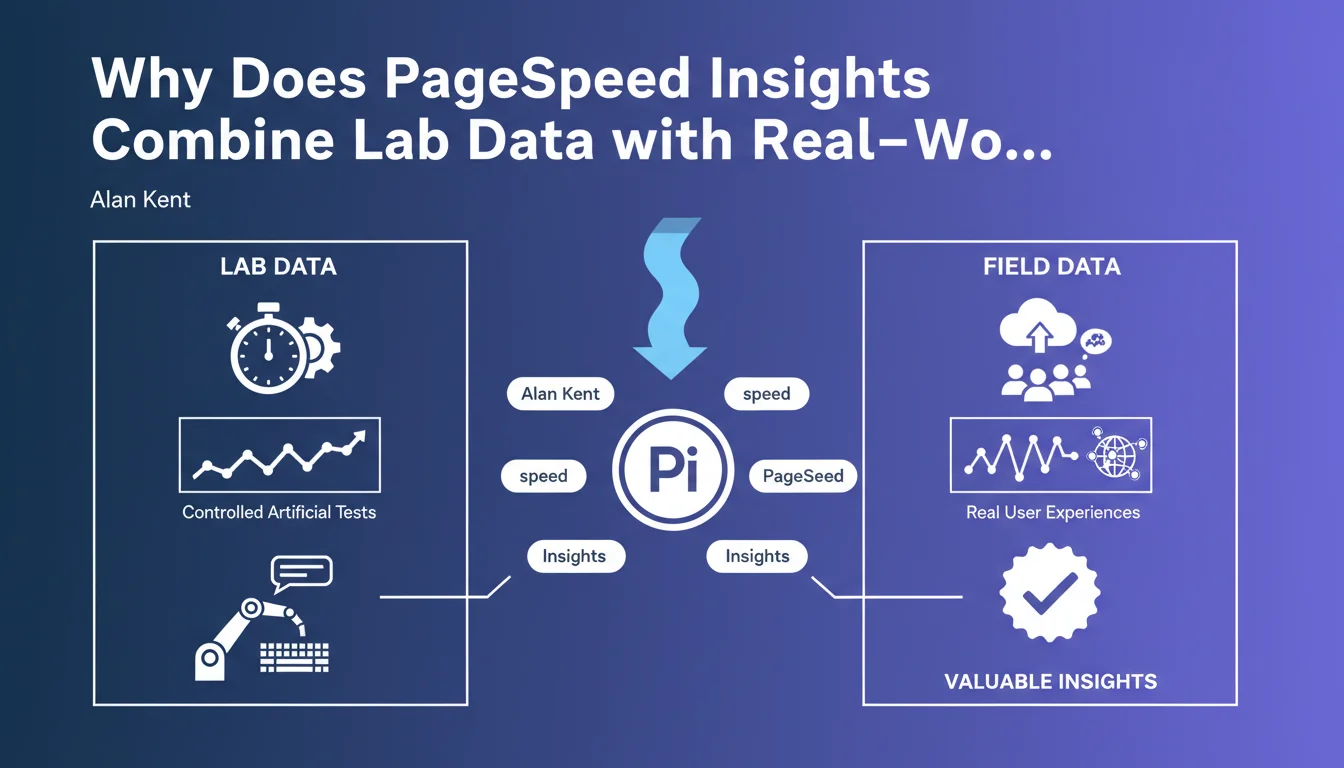
PageSpeed Insights blends artificial test results (lab data) with metrics from real users (field data). This dual approach lets you diagnose technical issues AND measure actual impact on user experience. A site can ace the lab but disappoint real users—or vice versa.
What you need to understand
What's the Difference Between Lab Data and Field Data?
Lab data comes from controlled tests run by Lighthouse in a standardized environment. Fixed connection, standard device, defined setup—it's reproducible, but artificial.
Field data (or CrUX) captures what your visitors actually experience: their unstable 4G, their older smartphone, their browsing from a moving train. It's real, in all its variability.
Why Does Google Push This Two-Pronged Approach?
Because a 95 Lighthouse score means nothing if your real users hit 4-second LCP times. The lab catches technical errors—the field measures business impact.
Conversely, poor field data can reveal a structural issue (slow server, blocking resources) that the lab will confirm and help you diagnose.
How Does PageSpeed Insights Pull These Two Sources Together?
The tool displays field Core Web Vitals first if your site has enough traffic. Below that, it offers a detailed Lighthouse audit with technical recommendations.
This layout forces you to look at both angles: what the engine sees (lab) and what users experience (field). Ignore one, and you're flying half-blind.
- Field data = real user experience (CrUX), priority for ranking
- Lab data = technical diagnosis, reproducible, useful for root cause identification
- The two complement each other: field identifies the problem, lab prescribes the fix
- Sites without CrUX data (insufficient traffic) show only lab metrics
- Google recommends optimizing for both, but prioritizes field data for rankings
SEO Expert opinion
Does This Duality Confuse Practitioners?
Let's be honest: yes. Many clients panic when their Lighthouse score is green but field data is red. Or the reverse.
The problem is Google doesn't explicitly weight the relative importance. We know field Core Web Vitals impact rankings, but how much gap does it tolerate between field and lab? [Needs verification]—no public data on that.
Is Field Data Always Reliable?
No. A low-traffic site won't have CrUX data—or the data will be too volatile to act on. In that case, does Google fall back to lab? Mystery.
Another issue: CrUX data aggregates over a 28-day rolling window. Deploy a fix today, and you'll wait weeks to see the field impact. Meanwhile, you're flying blind.
Should You Treat Both Data Types with Equal Priority?
No. If you must choose, prioritize field data—that's what Google uses for rankings. But the lab stays essential for diagnosing and iterating fast without waiting for CrUX validation.
In practice? Fix lab alerts, validate field impact. In that order.
Practical impact and recommendations
How Do You Interpret Gaps Between Lab and Field?
First step: compare both sources in PageSpeed Insights. If lab is solid but field is poor, look to your real audience—older devices, degraded connections, distant geographies.
If lab is weak but field is strong, you might have a Lighthouse configuration issue (throttling doesn't match reality) or your audience benefits from effective caching/CDN.
What Concrete Actions Should You Take to Align Both?
Start by segmenting your CrUX data by device (mobile vs desktop) and country. A terrible LCP might stem from 10% of your traffic in one region—no need to rebuild everything.
Next, test in the lab with realistic profiles: slow 3G, 4x CPU throttling, mid-range mobile device. Lighthouse defaults to a Moto G4—if your audience uses iPhone 15, that's not representative.
- Check both tabs in PageSpeed Insights regularly (field + lab)
- Prioritize optimizations that improve field Core Web Vitals
- Use the lab to quickly test fixes before deploying
- Segment CrUX data by device and region to spot problem pockets
- Track field metric trends over 28 days after each change
- Never settle for a perfect Lighthouse score—always validate with real data
Should You Invest in Third-Party Tools to Go Deeper?
PageSpeed Insights is a starting point, but it lacks granularity for thorough audits. Tools like WebPageTest (for advanced lab work) or CrUX Dashboard (to analyze field history) provide insights PSI doesn't.
If your field data plateaus despite lab optimizations, it may pay to cross-check multiple tools—and especially to set up RUM (Real User Monitoring) to capture your own metrics, independent of CrUX.
❓ Frequently Asked Questions
Les données terrain ont-elles plus de poids que les données labo pour le ranking ?
Que faire si mon site n'a pas de données CrUX ?
Combien de temps faut-il pour voir l'impact d'une optimisation dans les données terrain ?
Un bon score Lighthouse garantit-il de bonnes données terrain ?
Faut-il surveiller PageSpeed Insights tous les jours ?
🎥 From the same video 12
Other SEO insights extracted from this same Google Search Central video · published on 02/06/2022
🎥 Watch the full video on YouTube →
💬 Comments (0)
Be the first to comment.