
Official statement
Other statements from this video 12 ▾
- □ Should you trust PageSpeed Insights or Search Console to measure your site's speed?
- □ Does Google really index all of your website's content?
- □ Is Googlebot Really Ignoring Your JavaScript Links If You're Not Using <a> Tags?
- □ Can you safely link to HTTP websites without hurting your SEO rankings?
- □ Does Google really expect you to write 'naturally' to rank well?
- □ Should you really delete your disavow file?
- □ Is implementing Schema markup through Google Tag Manager really holding back your SEO performance?
- □ Does blocking crawl with robots.txt actually prevent deindexation?
- □ Can you safely list the same URL in multiple sitemap files without harming your SEO?
- □ How can you index embedded iframe content without indexing the source page separately?
- □ Is the HSTS preload list really a game-changer for your SEO rankings?
- □ Does a descriptive domain name really guarantee your ranking for that search query?
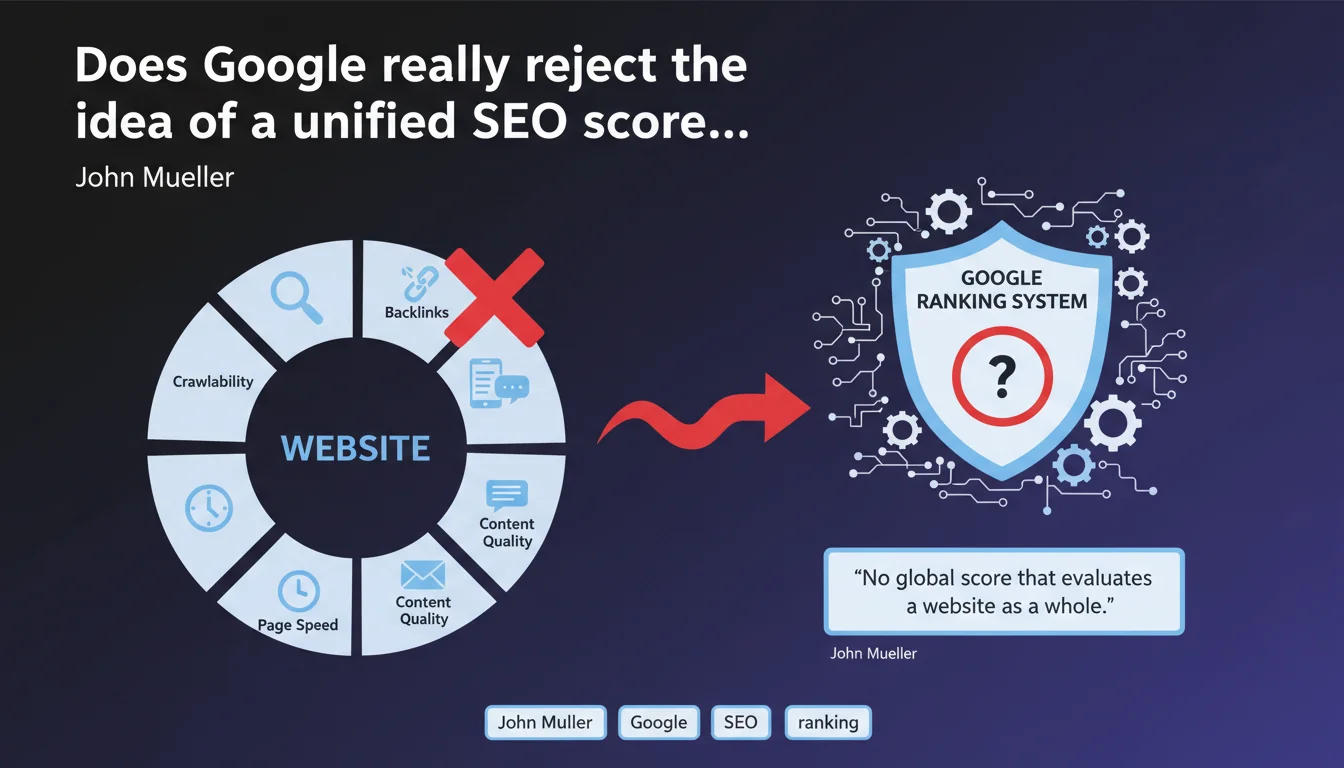
Google claims it does not use a global SEO score to evaluate websites. Unlike third-party tools that offer synthetic ratings, Google's algorithm analyzes hundreds of independent signals without merging them into a single metric. This statement challenges the relevance of audits based on a unique 'health score.'
What you need to understand
Why does Google reject the idea of a unified SEO score?
Google's position is clear: no global score summarizes the SEO quality of a site in their system. This statement directly contradicts the logic of third-party SEO tools (SEMrush, Ahrefs, Screaming Frog) that all propose a 'health score' or 'site score' ranging from 0 to 100.
Google's algorithm works differently. It evaluates hundreds of distinct signals — page load speed, content relevance, backlink authority, user experience, information freshness. These signals are not aggregated into a final score. They are weighted contextually depending on the query, search intent, and industry sector.
Does this approach change how we work?
In practice, this means a site can excel on some criteria and be mediocre on others — without preventing it from ranking on specific queries. A blog with catastrophic page speed but ultra-targeted expert content can outperform a technically perfect but hollow site.
This reality contradicts the 'checklist' approach where one tries to achieve 100/100 everywhere. Google favors targeted optimization based on business objectives, not universal technical perfection.
- No single metric: Google does not aggregate its signals into a global score
- Contextual weighting: each query activates different signals with varying weights
- Selective excellence: no need to aim for 100/100 on all criteria — focus on those impacting your target queries
- Third-party tools limited: SEO platform scores are approximations, not reflections of Google's algorithm
SEO Expert opinion
Is this statement consistent with real-world observations?
Yes and no. In principle, the absence of a single score does align with what we observe: sites with opposite technical profiles can coexist on page one. A poorly optimized WordPress site can beat an ultra-fast Next.js site if its content better answers the search intent.
But — and here's where it gets tricky — this statement says nothing about minimum thresholds. Google may not have a global score, but it clearly has eligibility criteria. A site with a 15-second load time will never rank, regardless of content quality. [To verify]: Google does not specify where these thresholds sit or how they evolve by sector.
Have third-party tools become useless with this revelation?
Absolutely not. Platform scores like Ahrefs or SEMrush remain useful as relative health indicators. They help quickly detect critical issues (orphaned pages, cannibalization, massive 404 errors) and track evolution over time.
The trap is treating them as objectives in themselves. Moving from 78/100 to 92/100 on a tool guarantees no progress in Google if the improved criteria have no impact on your strategic queries. Use these scores as diagnostic tools, not as success KPIs.
What are the practical limitations of this statement?
Mueller provides no insight into the hierarchy of signals. Not all criteria carry equal weight — we know that. But which ones to prioritize when resources are limited? This statement doesn't help deciding between overhauling site architecture or rewriting 200 pages of content.
Practical impact and recommendations
Should we stop tracking SEO tool scores?
No. Continue monitoring them, but change your interpretation. A global score of 85/100 means nothing if your strategic pages have critical issues. Decouple the global score from detailed diagnostics.
Focus on subcategories that directly impact your objectives: if targeting informational queries, prioritize content depth and semantic structure. For e-commerce, bet on speed, structured data, and mobile UX.
How do you prioritize optimizations without a reference score?
Adopt a query-centered approach rather than site-centered. For each strategic keyword group, identify the 3-4 signals that make the difference in your niche. Analyze competitors ranking: which criteria do they share?
Test and measure. Improve one criterion at a time on a sample of pages, then track impact on positions and organic traffic. This empirical method compensates for the lack of official guidance on signal weighting.
What changes should you make to client reporting?
Ban dashboards centered on a single SEO score. Replace them with segmented dashboards: technical performance (Core Web Vitals, crawlability), content quality (depth, semantic relevance), authority (link profile), user experience (engagement, bounce rate).
Contextualize each metric against business objectives. An e-commerce client doesn't care about 98/100 accessibility if conversion rate stagnates. Link each optimization to measurable impact on revenue or conversions.
- Stop aiming for 100/100 on global audits — focus on criteria strategic for your target queries
- Segment your reporting by signal type (technical, content, authority, UX) rather than presenting a single score
- Analyze ranking competitors to identify determining signals in your sector
- Test optimizations on page samples before deploying them at scale
- Link each SEO metric to a business KPI (qualified traffic, conversions, organic revenue)
- Use third-party tool scores as alerts for critical issues, not as final objectives
❓ Frequently Asked Questions
Les outils comme Ahrefs ou SEMrush mentent-ils avec leur score SEO ?
Si Google n'a pas de score global, comment compare-t-il deux pages concurrentes ?
Dois-je arrêter de corriger les erreurs détectées par Google Search Console ?
Comment savoir quels signaux prioriser pour mon site ?
Un site peut-il ranker avec un mauvais score PageSpeed Insights ?
🎥 From the same video 12
Other SEO insights extracted from this same Google Search Central video · published on 04/07/2022
🎥 Watch the full video on YouTube →
💬 Comments (0)
Be the first to comment.