
Official statement
Other statements from this video 12 ▾
- □ Faut-il se fier à PageSpeed Insights ou à la Search Console pour mesurer la vitesse de son site ?
- □ Google indexe-t-il vraiment tout le contenu de votre site ?
- □ Pourquoi Googlebot ignore-t-il vos liens JavaScript si vous n'utilisez pas de balises <a> ?
- □ Google a-t-il vraiment abandonné l'idée d'un score SEO global ?
- □ Peut-on créer des liens vers des sites HTTP sans risque SEO ?
- □ Faut-il vraiment supprimer son fichier de désaveu de liens ?
- □ Faut-il vraiment éviter d'implémenter le Schema markup via Google Tag Manager ?
- □ Robots.txt vs meta robots : pourquoi bloquer le crawl peut-il nuire à la désindexation ?
- □ Peut-on dupliquer la même URL dans plusieurs fichiers sitemap sans risque SEO ?
- □ Comment indexer le contenu d'une iframe sans indexer la page source ?
- □ HSTS et preload list : une fausse piste pour le référencement ?
- □ Pourquoi un nom de domaine descriptif ne garantit-il pas votre classement sur sa requête ?
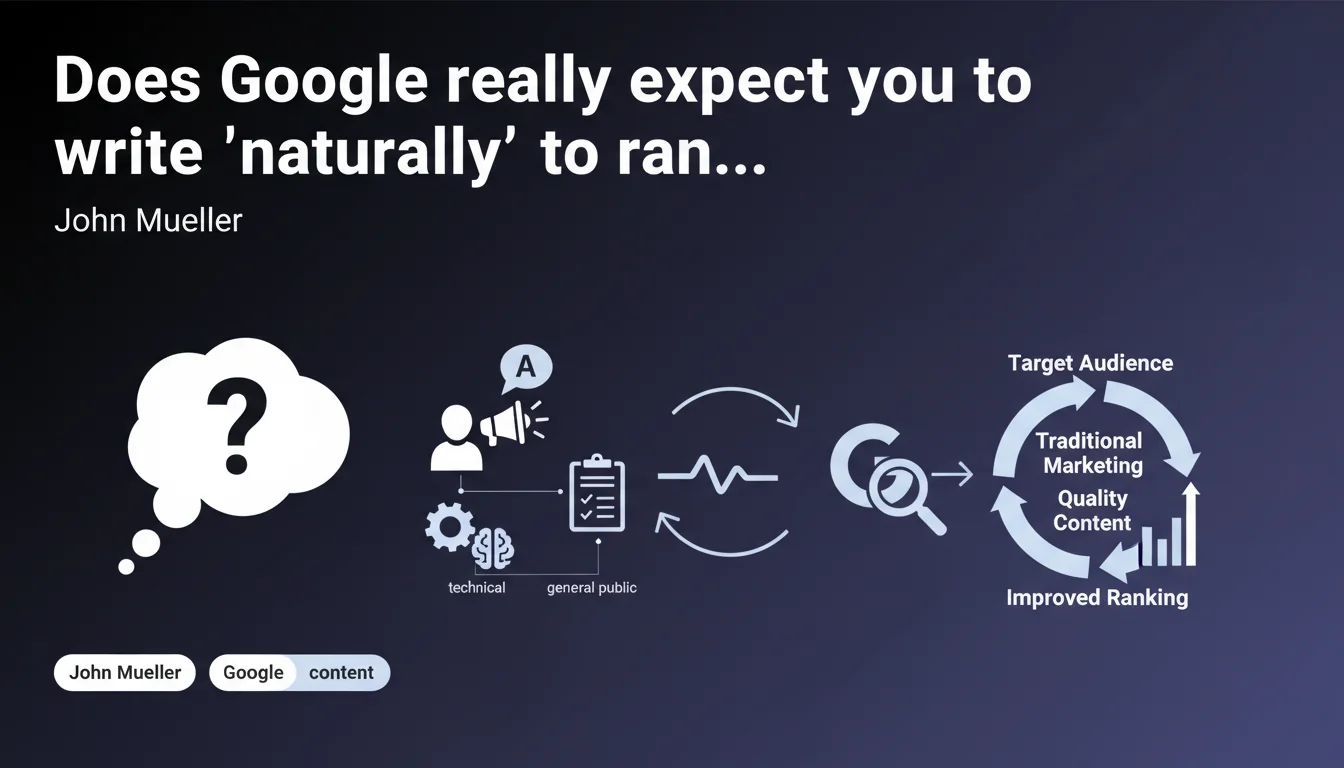
Google claims its systems are designed to process natural content and that you can write however you wish, as long as you target your audience. The key lies in adapting your tone and style (technical vs. general public) according to traditional marketing principles, not artificial optimization for crawlers.
What you need to understand
What does "writing naturally" actually mean according to Google?
Google claims that its algorithmic systems are trained to understand naturally written content, meaning without tricks specifically designed for robots. The underlying idea: stop asking yourself if a particular phrasing will "please the algorithm."
This statement continues Google's messaging against keyword stuffing and excessive optimization practices. Yet it remains deliberately vague about what exactly constitutes "natural content" in the eyes of AI.
Why does Google insist on adapting to the audience?
The mention of target audience (technical vs. general public) is not insignificant. Google implicitly acknowledges that quality content varies by context: a scientific article filled with jargon can be perfectly "natural" for researchers, but incomprehensible to the general public.
The traditional marketing approach mentioned refers to personas and segmentation. You must write for humans with specific needs, not for a generic algorithm.
What signals does Google use to evaluate this natural quality?
Google remains evasive about precise technical mechanisms. We know that language models (BERT, MUM, etc.) analyze semantics, syntactic coherence, and lexical diversity. But no public metric allows you to objectively measure whether your text is "natural enough."
What is certain: content generated en masse by AI or stuffed with redundant keywords triggers negative signals. [To verify]: the exact thresholds where Google shifts from "natural" to "over-optimized" remain opaque.
- Natural content = written for humans, not for crawlers
- Adapting to audience register (technical/general public) is explicitly validated
- Google provides no objective metric to measure "naturalness"
- The boundary between legitimate optimization and over-optimization remains unclear
SEO Expert opinion
Is this statement consistent with real-world observations?
Let's be honest: in practice, we see that some "natural" content by human standards ranks poorly, while ultra-optimized pages (impeccable HTML structures, calculated keyword density) dominate the SERPs. The contradiction is only apparent.
The "naturalness" Google talks about doesn't exclude structure, coherent heading tags, internal linking. It refers more to the absence of crude text manipulation. An article that is well-structured and optimized can be perfectly natural if every sentence adds value.
What nuances should we add to this message?
Mueller's message is generic — and that's where it gets tricky. "Writing naturally" isn't enough if you ignore search intent, the structure users expect, or the competition for your target query.
A concrete example: you can write fluent, natural text about "car insurance" without ever answering the questions users are asking (comparison tools, coverage types, pricing). Result: natural content, but useless for ranking.
Google says "write for your audience" but forgets to mention: you still need to understand your audience through data (Search Console, analytics, keyword research). Without that, you're writing into a void.
In what cases does this rule not apply?
For transactional content or e-commerce product pages, the notion of "natural" quickly hits its limits. You must structure information (technical specs, pricing, CTAs) in a standardized way to be competitive.
Same for featured snippets: achieving position zero often requires formatting your answer very artificially (numbered lists, HTML tables), which contradicts the idea of completely natural writing.
Practical impact and recommendations
What should you concretely do to stay "natural" without harming SEO?
First step: identify your target persona and expertise level. Technical content for developers can (and should) use specialized vocabulary. A general-audience article requires simplified explanations. Google values this consistency.
Next, analyze search intent via the current SERP. If the top 3 results all use an FAQ structure, that's what your audience expects. Stay natural in tone, but adapt your structure.
Avoid classic pitfalls: mechanical keyword repetition, convoluted sentences to fit keyword variations, mass AI-generated content without human review. These signals betray artificiality.
What mistakes should you avoid to not slip into over-optimization?
Ban keyword stuffing (density > 3-4% on your main keyword). Vary your vocabulary: use synonyms, co-occurrences, related semantic fields. Google now understands concepts, not just exact terms.
Be wary of tools that automatically generate paragraphs around keywords. They often produce redundant text with no added value. If you wouldn't read your own content in full, there's a problem.
Don't sacrifice readability for SEO. Overly long sentences, unnecessary jargon, confusing structure: all indirect signals (bounce rate, weak time on page) that penalize ranking.
How can you verify that your approach is balanced?
Have your content reviewed by someone representing your target audience. If they find the text flows well, is informative, and has no awkward repetitions, you're on the right track.
Monitor your engagement metrics (time on page, scroll depth, bounce rate). Natural, relevant content retains visitors. Weak engagement signals indicate a mismatch between your writing and expectations.
Use AI content detection tools if you partially automate production. A high score signals generic text that Google might devalue over time.
- Precisely define your persona and expertise level
- Analyze search intent and expected formats via the SERP
- Vary vocabulary: synonyms, co-occurrences, semantic fields
- Avoid any mechanical keyword repetition (density < 3%)
- Prioritize readability: short sentences, airy structure, clear headings
- Measure engagement (time on page, scroll depth, bounce)
- Have content reviewed by an audience representative
- If using AI, systematically review and humanize
❓ Frequently Asked Questions
Écrire naturellement signifie-t-il abandonner toute optimisation SEO ?
Peut-on utiliser du contenu généré par IA tout en restant « naturel » ?
Quelle densité de mots-clés est considérée comme naturelle ?
Google pénalise-t-il vraiment les contenus sur-optimisés ?
Comment adapter le registre technique sans perdre en SEO ?
🎥 From the same video 12
Other SEO insights extracted from this same Google Search Central video · published on 04/07/2022
🎥 Watch the full video on YouTube →
💬 Comments (0)
Be the first to comment.