
Official statement
Other statements from this video 12 ▾
- □ Faut-il se fier à PageSpeed Insights ou à la Search Console pour mesurer la vitesse de son site ?
- □ Google indexe-t-il vraiment tout le contenu de votre site ?
- □ Pourquoi Googlebot ignore-t-il vos liens JavaScript si vous n'utilisez pas de balises <a> ?
- □ Google a-t-il vraiment abandonné l'idée d'un score SEO global ?
- □ Peut-on créer des liens vers des sites HTTP sans risque SEO ?
- □ Faut-il vraiment écrire « naturellement » pour ranker sur Google ?
- □ Faut-il vraiment éviter d'implémenter le Schema markup via Google Tag Manager ?
- □ Robots.txt vs meta robots : pourquoi bloquer le crawl peut-il nuire à la désindexation ?
- □ Peut-on dupliquer la même URL dans plusieurs fichiers sitemap sans risque SEO ?
- □ Comment indexer le contenu d'une iframe sans indexer la page source ?
- □ HSTS et preload list : une fausse piste pour le référencement ?
- □ Pourquoi un nom de domaine descriptif ne garantit-il pas votre classement sur sa requête ?
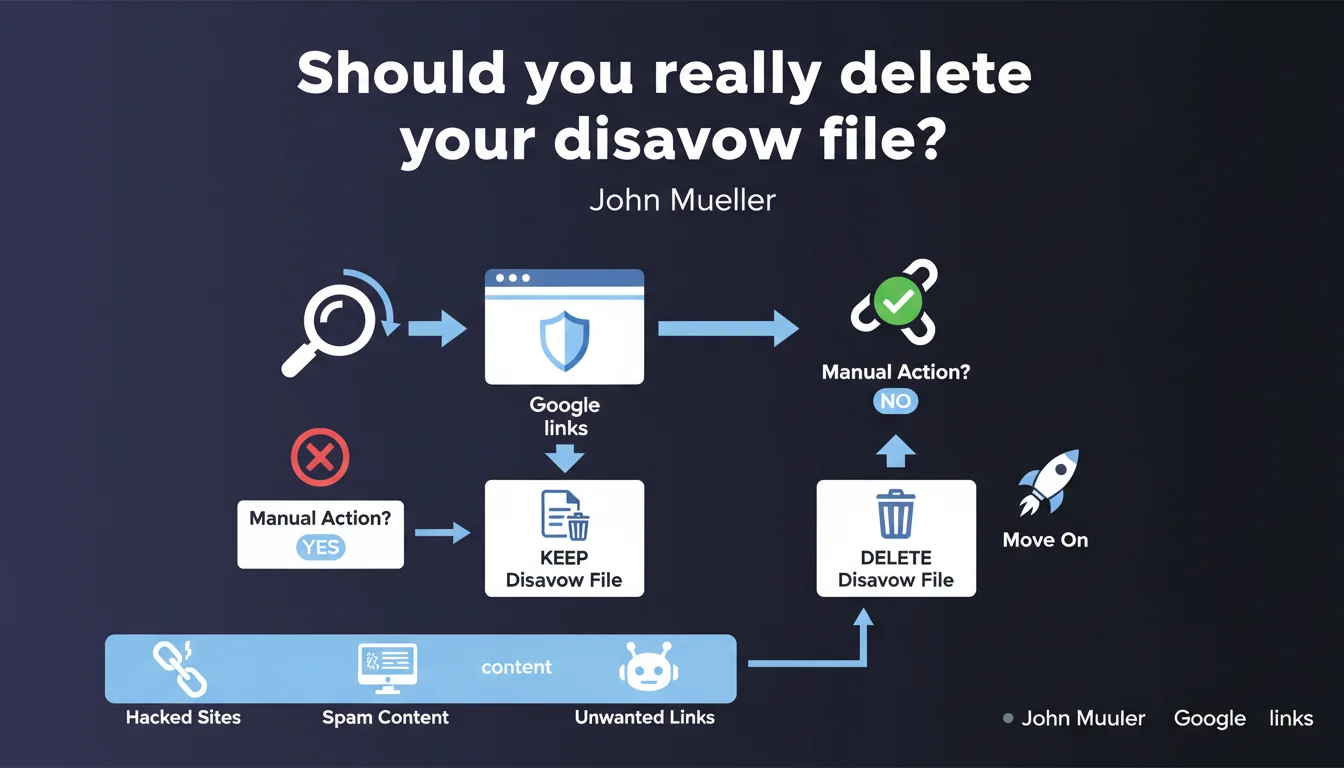
Google claims its algorithm now automatically ignores spam links and backlinks from hacked sites. If you've never received a manual action, you can safely remove your disavow file — these toxic links no longer impact your rankings.
What you need to understand
Why is Google changing its position on link disavowal?
For years, the disavow file was presented as an essential defensive tool against negative SEO attacks and accumulated toxic links. Google now acknowledges that its algorithm has evolved enough to automatically filter out most of these parasitic signals.
This statement marks a turning point in backlink management. The algorithm now distinguishes natural links from spam patterns without manual intervention from the webmaster. Hacked sites injecting thousands of links, auto-generated content farms, poorly constructed PBN networks — all of this would be neutralized upfront.
What does it concretely mean "if you haven't received a manual action"?
This is the crucial point. A manual action appears in Search Console when a Google human reviewer detects a deliberate violation of guidelines. If your profile displays no penalty of this type, it means Google considers your link profile acceptable.
Spam links pointing to your site without your consent do not trigger a manual action. They are simply ignored by the algorithm. The disavow then serves no purpose — and can even harm if you accidentally disavow legitimate links.
What is the difference between ignoring a link and penalizing it?
Ignoring means the link is neither positive nor negative in the PageRank calculation. It is neutralized, as if it didn't exist. Penalizing involves active punishment that degrades the target site's ranking.
Google has claimed for years that spam links don't penalize — they're just without effect. This statement confirms that the engine has refined its ability to distinguish signal from noise, making the disavow largely obsolete for most websites.
- The algorithm automatically filters out spam links and hacked sites
- The disavow file is only useful if you have an active manual action
- Toxic links naturally occur — this is no longer an issue in itself
- Removing the disavow file poses no risk if no manual penalty exists
- Google recommends moving on rather than obsessively auditing every backlink
SEO Expert opinion
Is this statement consistent with field observations?
Yes and no. On clean sites with natural link profiles, we indeed observe that spam link spikes no longer impact rankings the way they did 5-7 years ago. Basic negative SEO attacks (spam comments, trash PBNs) appear to have lost their destructive effect.
However — and this is where it gets tricky — some edge cases still show suspicious fluctuations after a massive influx of low-quality links. [To be verified] whether these fluctuations are truly causal or just correlative with other factors (core updates, content changes, etc.).
In which cases is disavow still relevant?
If you have a manual action for artificial links, the disavow is mandatory for penalty removal. This is the only scenario where Google explicitly requires you to clean up your profile and document your efforts through this file.
Another case: sites that engaged in aggressive link building in the past (bulk buying, triangular exchanges, PBNs) and want to clean up their profile before a manual review hits. Here, the disavow is preventive insurance, even if Google says it's no longer necessary.
Should you blindly trust this recommendation?
Google has an interest in reducing the volume of disavow files to lighten its computational load and limit human errors (webmasters disavowing good links out of paranoia). This recommendation also serves to simplify public discourse: less panic about negative SEO, fewer support tickets.
Let's be honest: if you've never engaged in manipulative link building and your Search Console is free of penalties, removing the disavow is probably safe. But if you have a murky history or questionable backlinks from past campaigns, keep a copy of the file before deleting it — and monitor your positions for 4-6 weeks.
Practical impact and recommendations
What should you concretely do with your disavow file?
First step: check in Search Console whether you have an active manual action ("Manual actions" section). If no alert appears, you're probably eligible for file removal.
Next, quickly audit your link profile via Ahrefs, Majestic, or SEMrush. Look at the ratio of toxic links / clean links. If 95% of your profile is natural with a few scattered spams, the disavow serves no purpose. If you have hundreds of domains disavowed following past link building campaigns, think twice.
What mistakes should you avoid when removing the file?
Don't remove the disavow if you have an active manual action — this is the only absolute rule. Google will ask you to prove your cleanup efforts, and the disavow file is part of that documentation.
Another trap: removing the file then panicking at the first traffic fluctuation. Rankings move constantly for a thousand reasons. Give the engine 4 to 6 weeks to recrawl your backlinks and adjust the calculation. If a sudden and persistent drop appears, you can always re-upload the file.
How should you monitor impact after removal?
Note your positions on your top 20 strategic keywords before removal. Use Rank Tracker, SEMrush Position Tracking, or even a simple Google Sheets spreadsheet with Search Console API.
Also monitor your overall organic traffic in Analytics and impressions in Search Console. If nothing moves significantly in 6 weeks, it means Google is applying what it says: your spam links were already being ignored.
- Verify the absence of manual action in Search Console
- Download a copy of your current disavow file (security backup)
- Audit your link profile to identify disavowed domains and their reason
- Note your current positions on 15-20 priority keywords
- Remove the disavow file via Search Console (Links > Disavow links section)
- Wait 4 to 6 weeks and compare positions / organic traffic
- If significant drop, reactivate the disavow file and analyze suspicious domains
❓ Frequently Asked Questions
Puis-je supprimer mon fichier disavow si j'ai déjà eu une action manuelle dans le passé, mais qu'elle est résolue ?
Est-ce que supprimer le disavow peut améliorer mes positions si j'avais désavoué de bons liens par erreur ?
Combien de temps faut-il à Google pour recalculer mon profil de liens après suppression du disavow ?
Le negative SEO existe-t-il encore si Google ignore automatiquement les liens spam ?
Dois-je continuer à auditer mes backlinks régulièrement même sans fichier disavow ?
🎥 From the same video 12
Other SEO insights extracted from this same Google Search Central video · published on 04/07/2022
🎥 Watch the full video on YouTube →
💬 Comments (0)
Be the first to comment.