
Official statement
What you need to understand
The link disavow file (disavow file) is a tool provided by Google through Search Console. It allows webmasters to indicate to the search engine which backlinks they want ignored in their site's evaluation.
According to the latest official statements, Google is now capable of automatically ignoring the vast majority of spam or low-quality links. The search engine has considerably improved its algorithms for detecting and neutralizing artificial links.
This technical evolution means that manual disavowal is no longer necessary in most common situations. Google does the filtering work automatically, without any intervention on your part.
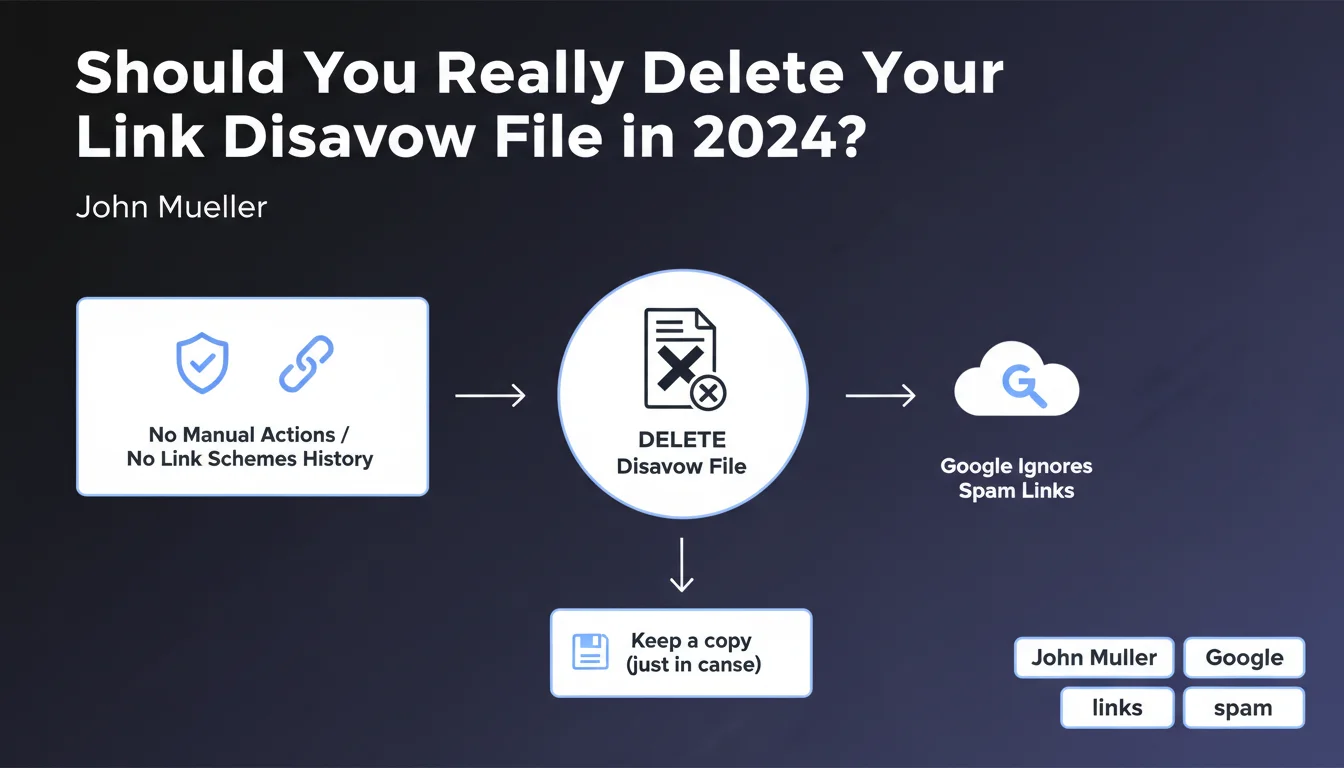
- The disavow file remains relevant only in case of manual action received from Google
- It can be useful if you have a proven history of prohibited SEO practices (massive link buying, link networks, etc.)
- For natural spam links that any website receives, no action is necessary
- Automatic tools estimating link "toxicity" are unreliable and misleading
- Possibly keep a copy of your file as a precaution, but its deletion carries no risk
SEO Expert opinion
This official position confirms what SEO experts have been observing for several years in the field. Sites that have deleted their disavow file have generally seen no negative impact on their organic performance.
However, an important nuance must be made according to your history. If your site has been subject to aggressive link building campaigns before 2015-2016 (massive link buying, comment spam, PBN networks), some caution is still advisable. In these specific cases, a manual backlink audit may reveal problematic patterns that are better kept in the disavow.
The recommended approach is clear: focus your time and energy on creating quality content and obtaining natural links rather than on the defensive management of a disavow file that, in 95% of cases, brings no added value.
Practical impact and recommendations
- Check your Search Console first: If you've never received a manual action concerning artificial links, you can safely delete your disavow file
- Keep a local copy: As a precaution, download and archive your current file before deleting it from Search Console
- Audit your SEO history: If your site has been subject to aggressive link building practices before 2016, first conduct a thorough manual audit
- Ignore automatic alerts: Don't panic at notifications from third-party tools reporting "toxic" links - Google already handles them automatically
- Stop obsessive monitoring: Stop wasting time analyzing every new backlink to assess whether it should be disavowed
- Reallocate your resources: Invest the time saved in actions with real impact: content creation, technical optimization, user experience improvement
- Document your decision: If you manage client sites, clearly explain this evolution of practices recommended by Google
In summary: Link disavow has become an obsolete tool for the vast majority of websites. Free yourself from this time-consuming task and focus on what genuinely generates SEO value.
Strategic management of your link profile and overall optimization of your organic presence remain complex exercises requiring expertise and experience. For sites with high business stakes or having a complex SEO history, support from a specialized SEO agency can prove judicious for making the right strategic decisions and avoiding costly mistakes during the transition to these new practices.
💬 Comments (0)
Be the first to comment.